
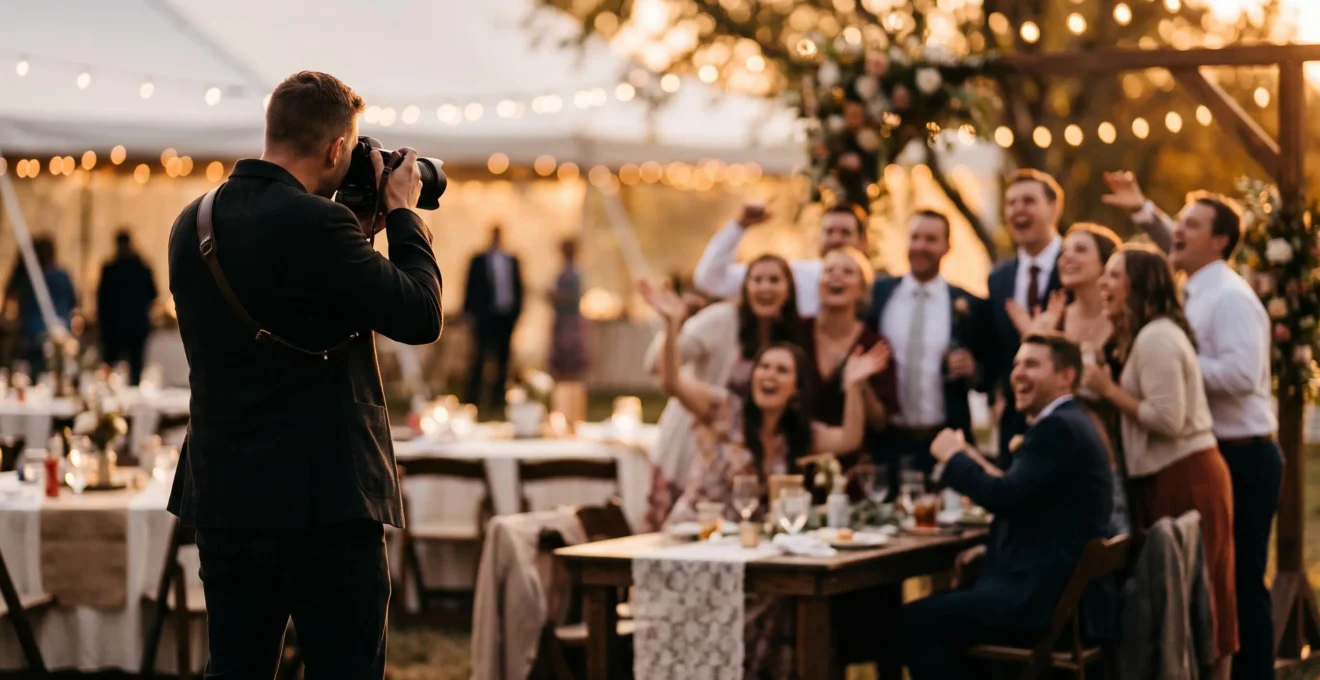
The key to powerful candid wedding photography isn’t being a ‘fly on the wall’; it’s learning to predict the emotional future of a scene.
- Genuine moments follow predictable patterns, from the rhythm of laughter during speeches to the quiet interactions in transitional spaces.
- The most common mistake is passive waiting. True reportage requires active, predictive observation to identify the narrative weight of a moment *before* it peaks.
Recommendation: At your next event, stop hunting for reactions. Instead, focus on a single group, identify the emotional catalyst—the storyteller or the most expressive listener—and anticipate the emotional arc of their interaction.
You’re there, camera ready, settings dialed in. You see the bride’s father turn to her, a flicker of an expression on his face, and by the time you lift the camera, it’s gone. A ghost of a moment. Every wedding photographer knows this frustration. You are physically present, but you’re a fraction of a second too late, perpetually capturing the aftermath of emotion rather than its peak. The market is clear: authentic, unposed photography is what couples crave. In fact, a 2026 industry survey of over 11,500 couples found that 67% prefer natural, documentary-style images. Yet, most advice remains superficial: “use a long lens,” “be a fly on the wall.”
This advice encourages passivity. It treats candid moments as random, unpredictable events that you can only hope to catch by chance. But what if they aren’t random at all? What if genuine interactions, from uproarious laughter to subtle, tearful glances, follow observable patterns? The true skill of reportage photography isn’t about being invisible; it’s about developing an acute sense of anticipation. It’s the art of seeing the emotional trajectory of a moment and positioning yourself for the destination before it arrives.
This guide moves beyond the basics of candid capture. We won’t just tell you to be a quiet observer; we’ll teach you what to observe. We will deconstruct the anatomy of a wedding day, exploring the predictable rhythms of human emotion, the strategic art of positioning, and the mental discipline required to stop reacting and start predicting. You will learn to see the story before it unfolds, ensuring those powerful, fleeting moments end up in your camera, not just in your memory.
This article breaks down the essential strategies for mastering predictive observation in wedding photography. Explore the structure below to navigate through the core concepts that will transform your approach from passive waiting to active storytelling.
Summary: A Practical Guide to Anticipating Unposed Wedding Photography Moments
- Why Authentic Laughter Erupts in Predictable Patterns During Wedding Speeches and Toasts
- How to Position Yourself for Candid Moments Without Making Guests Self-Conscious or Aware
- Prime Lenses for Intimacy or Zooms for Flexibility: Which Captures Better Candid Moments at Weddings
- The Passive Mistake That Makes Candid Photographers Miss 70% of Genuine Emotional Moments
- When Candid Moments Peak During the Wedding Day: The 4 Critical Windows to Prioritise
- Which Wedding Moments Generate the Most Powerful Micro-Expressions Worth Intensive Focus
- How to Develop the Observational Discipline Required for Pure Reportage Wedding Coverage
- How to Master Reportage Wedding Photography Without Any Posed Intervention
Why Authentic Laughter Erupts in Predictable Patterns During Wedding Speeches and Toasts
Wedding speeches are a goldmine for candid photographers, but not because they are random explosions of emotion. They are, in fact, highly structured social performances with a predictable emotional rhythm. The mistake many photographers make is simply pointing the camera at the speaker or the couple and waiting. The master observer understands the call-and-response pattern inherent in any good toast. A speaker builds a narrative, drops a punchline or a heartfelt memory, and then pauses, creating a vacuum that the audience fills with laughter, tears, or applause. Your job is to anticipate that vacuum.
Instead of focusing only on the couple, scan the room during the setup of a story. Identify the key players: the parents, the siblings, the childhood friend mentioned by name. The speaker will often make eye contact with them just before delivering a key line. This glance is your pre-moment cue. As the punchline lands, your lens should already be on the bride’s sister who was just referenced, ready to capture her reaction. You’re not just shooting what’s happening; you’re shooting the echo of what was just said.
This predictive model applies to more than just jokes. Heartfelt moments follow the same cadence. A speaker’s voice cracks, they take a deep breath—these are signals. Your focus should immediately shift to the parents or the partner, because their emotional response is the other half of that moment. You are capturing a dialogue, and the most powerful images often lie in the reaction, not the statement itself. The goal is to capture those peak moments, like when the “bride is completely doubled over in laughter,” by understanding the conversational turn-taking that produces them.
By treating speeches not as monologues but as dialogues between the speaker and the room, you transform your role from a passive documentarian to a predictive storyteller.
How to Position Yourself for Candid Moments Without Making Guests Self-Conscious or Aware
The concept of being a “fly on the wall” is misleading. You are a person with a camera, and guests will notice you. The key is not to achieve true invisibility, but to become a non-disruptive, accepted part of the environment. As one professional guide notes, you should expect guests to notice you at first, but trust that they will quickly accept your presence and return to acting naturally. This process is accelerated by your own demeanor. Move slowly, deliberately, and with purpose. Avoid sudden movements. Your body language should communicate “I belong here and am not a threat to your natural behavior.” The goal is to be seen but not *felt*.
Your positioning is your primary tool. Instead of standing in the center of a room, use the architecture. Doorways, archways, and large pillars are your allies. They break your silhouette and allow you to observe without being the center of attention. Adopt the “broken triangle” formation: position yourself at an offset angle to the two people you’re observing, forming the third point of a triangle. This is less confrontational than a head-on position and allows you to capture profiles and interactions more naturally. It’s a fundamental technique used by photojournalists to work unnoticed in the background.
As the image demonstrates, using the environment for cover doesn’t mean hiding. It means framing your perspective in a way that is unobtrusive. You are not spying; you are composing from a distance, waiting for the narrative to unfold. This patient presence is what allows you to capture unforced and unscripted moments. Eventually, guests become so accustomed to your quiet, constant presence that they forget you’re documenting them, allowing their genuine selves to emerge. This is the art of becoming part of the background scenery.
Ultimately, your confidence and comfort are contagious. If you are at ease navigating the space, the guests will be at ease in your presence.
Prime Lenses for Intimacy or Zooms for Flexibility: Which Captures Better Candid Moments at Weddings
The debate between prime and zoom lenses for wedding photography often boils down to a false dichotomy. The common wisdom suggests primes are for portraits and zooms are for action, but for the candid photographer, the choice is more nuanced. It’s not about which lens is “better,” but about how each lens choice dictates your physical strategy and observational style. A zoom lens allows you to reframe a scene instantly from a fixed position, making it an excellent tool for reacting quickly in unpredictable environments. You can go from a wide establishing shot to a tight emotional detail without taking a single step.
However, this very flexibility can become a crutch, encouraging a passive, stationary shooting style. A prime lens, by contrast, forces you to “zoom with your feet.” To change your composition, you must move. This mandatory movement can be a powerful catalyst for observation. As you physically navigate a space to find the right framing, you are forced to see new angles, notice different interactions, and become more deeply integrated into the flow of the event. A prime lens demands a more intimate, participatory approach to photography.
The technical differences further inform the strategic choice, as seen in the comparison below. Primes often offer wider maximum apertures, which is not just about low light performance but about creating significant subject separation and beautiful bokeh, isolating a candid moment from a busy background. They are also typically lighter and less conspicuous. As a practical comparison of lens types shows, the differences in weight and optics are substantial.
| Criterion | Prime Lens (e.g., 50mm f/1.8) | Zoom Lens (e.g., 24-70mm f/2.8) |
|---|---|---|
| Typical Weight | ~150 grams | ~800 grams or more |
| Maximum Aperture | Often f/1.2–f/1.8 | Typically f/2.8–f/4 |
| Background Blur (Bokeh) | Stronger subject isolation at wide apertures | Less separation due to smaller max aperture |
| Optical Path | Fewer glass elements, often punchier contrast | More complex path; high-end models close the gap |
| Shooting Style | Forces the photographer to move to reframe | Allows instant reframing from a fixed position |
Ultimately, many of the best reportage photographers carry both. They use the zoom for unpredictable, fast-moving parts of the day like the ceremony exit, and switch to a small prime for the cocktail hour to encourage a quieter, more observant, and intimate approach.
The Passive Mistake That Makes Candid Photographers Miss 70% of Genuine Emotional Moments
The single greatest mistake a candid photographer can make is equating “candid” with “passive.” It’s the belief that your job is to simply wait, unseen, for something interesting to happen. This reactive mindset is why so many photographers are perpetually a half-second too late. They see the laugh, then they raise the camera. True reportage is an active, not a passive, discipline. It’s about storytelling. As one professional puts it, candid photography “isn’t just taking photographs of people when they aren’t looking — it’s the art of telling the story of who, what, when, why, or where.” A storyteller doesn’t just record dialogue; they anticipate the plot twists.
Consider a reception with 150 guests. During the toasts, an emotional story is told. The passive photographer focuses on the couple, capturing their reaction. They get a good shot. But they miss the bride’s grandmother at a corner table, quietly weeping. They miss the groom’s college roommates erupting in silent, knowing laughter. As coverage data on wedding photography shows, a single photographer simply cannot capture every reaction at every table simultaneously. Therefore, you must make a strategic choice. This choice is based on narrative weight. Which reaction tells the *most* important part of the story in this exact moment?
The active photographer has already been “reading the room.” They’ve observed the bonds between people all day. They know the grandmother is the family’s emotional center. Before the toast even begins, they have formulated a hypothesis: “If a touching story is told, the grandmother’s reaction will be the most poignant.” They position themselves to have a clear line of sight to both the couple and the grandmother. They are not passively waiting for a moment; they are actively testing a narrative hypothesis. This is the fundamental shift: from being a moment-catcher to a story-hunter.
Stop thinking of yourself as a photographer waiting for a picture. Start thinking of yourself as a journalist looking for the heart of the story. The pictures will follow.
When Candid Moments Peak During the Wedding Day: The 4 Critical Windows to Prioritise
A wedding day is not a constant stream of high emotion; it’s a series of peaks and valleys. The predictive photographer knows where to invest their energy by focusing on the “transitional moments”—the seams in the formal schedule where people let their guard down. While everyone else is resetting, you should be at your most alert. There are four critical windows where genuine, unscripted moments are most likely to surface, and they are increasingly what clients want documented, as recent industry data on 2026 wedding timelines indicates that couples are prioritizing candid reception coverage over long lists of formal portraits.
The first window is the Getting Ready “Lull.” This isn’t the period of hair and makeup, but the quiet 20-30 minutes *after* everyone is dressed but *before* they have to leave. The nervous energy is palpable. People are sitting around, ties are being adjusted one last time, and quiet, reflective conversations happen. This is a time of pure anticipation, and the expressions are unguarded and real.
The second window is the Post-Ceremony Recessional. The formal part is over. The couple has just walked back down the aisle, and they are often immediately funneled into a private space or a receiving line. That short walk from the altar to the cocktail hour is an explosion of relief, joy, and congratulatory hugs. The formal “photo face” drops, and pure emotion takes over. Stay close to the couple and their immediate family during this short, chaotic, and beautiful stretch.
The third window is the Couple’s First Solitude. Many modern couples now schedule a brief, 10-minute period alone immediately after the ceremony, before rejoining their guests. This is an absolute goldmine. As one expert notes, this leads to “super romantic, sweet photos as a couple celebrates being married just the two of them.” Stand back with a long lens and simply document their quiet, private celebration. The fourth and final window is the Late-Night Dance Floor. After the formal dances are over and the open bar has been active for a while, the dynamic shifts. High heels come off, ties are loosened, and the dancing becomes less performative and more cathartic. This is where you get the uninhibited joy and hilarious moments that truly capture the spirit of the party.
By identifying these predictable peaks in the day’s emotional landscape, you can conserve your own energy and focus your observational powers where they will yield the most powerful results.
Which Wedding Moments Generate the Most Powerful Micro-Expressions Worth Intensive Focus
While big, obvious emotions like laughter and tears are the bread and butter of wedding photography, the most profound and telling moments are often the most fleeting. These are micro-expressions—the involuntary, split-second flashes of emotion that betray a person’s true feelings. As the pioneering psychologist Dr. Paul Ekman discovered, “When someone tries to conceal his or her emotions, leakage of that emotion will often be evident in that person’s face.” For a photographer dedicated to capturing authentic stories, learning to spot this “leakage” is an advanced skill.
These expressions are incredibly brief. In fact, research on facial emotion detection shows that true micro-expressions can flash across a face in as little as 1/25th of a second. This makes them nearly impossible to capture reactively. You cannot see a micro-expression and then decide to take a picture. You must anticipate the situations that are most likely to produce them and be shooting *through* the moment with the hope of capturing it. It requires intense focus and a deep understanding of emotional triggers.
Certain wedding moments are high-stakes interactions ripe for producing these expressions. The most fertile ground includes:
- The Father’s “Hand-Off”: As a father gives his daughter away, there is often a complex mix of pride, joy, and a subtle sense of loss. His public face may be smiling, but for a fraction of a second, his true, mixed emotions will show.
- The “First Look”: The moment one partner sees the other for the first time. Beneath the overt joy, you might find a micro-expression of awe, relief, or even shock.
- Reactions to the Vows: Listen for a particularly personal or surprising line in the vows. The partner’s reaction may be a quick, involuntary flash of surprise or deep recognition before their more composed “photo face” returns.
Capturing these moments requires you to be zoomed in, focused on the face, and often shooting in short bursts to increase your chances of catching the split-second emotional truth.
It is the pinnacle of predictive photography—capturing an emotion that is almost invisible to the naked eye, but which tells the deepest story of all.
How to Develop the Observational Discipline Required for Pure Reportage Wedding Coverage
Mastering reportage photography is less about learning a new technique and more about unlearning a habit: the habit of intervention. Many photographers feel a constant urge to direct, to pose, to “fix” a scene. The purist reportage mindset, however, requires a radical commitment to non-intervention. As one photographer puts it, “I prefer to work candidly for the entire day at my weddings; I don’t manipulate anything and want the wedding to happen like I wasn’t there.” This requires developing a new kind of discipline—not the discipline of technical perfection, but of patient, relentless observation.
This discipline is a muscle, and it’s built through practice, both on and off the job. Start by taking your camera to public places—a park, a café, a busy street corner. Give yourself an assignment: to tell the story of one person or group for 15 minutes without them noticing you and without taking a single posed shot. This exercise forces you to practice positioning, to anticipate movement, and to find narrative in the mundane. It pushes you past the initial hesitation and discomfort of photographing strangers, which is essential for working confidently at a wedding.
Case Study: Split-second Lens Decisions During a Live Wedding Reveal
The discipline of observation is also about being prepared to adapt instantly. In one documented instance, a wedding photographer walking with a couple spotted a large, unexpected floral installation on the ceiling. With the transport schedule ticking, there was no time to “set up a shot.” The photographer, who was using a zoom lens, was able to instantly capture a wide establishing shot of the couple under the installation and then immediately zoom in for a tighter detail of the florals, all within a matter of seconds. This ability to see, interpret, and execute a multi-shot sequence on the fly, without interrupting the flow of the day, is a direct result of practiced observational discipline. It marries environmental awareness with technical readiness.
Developing this discipline also means learning to trust the unfolding reality. You must have faith that authentic, beautiful moments will happen without your orchestration. Your job is not to create these moments, but to be ready when they appear. This requires a profound mental shift from being a director to being a witness.
Your Action Plan: An Audit for Predictive Observation
- Review Your ‘Misses’: Go through a recent gallery. Identify the moments you almost captured. What was the pre-moment cue you missed? Was it a glance, a deep breath, or a shift in posture? List them.
- Map the Emotional Arc: For your best candid shot, try to reconstruct the minute leading up to it. Who was the catalyst? What was the build-up? Draw the “emotional arc” of the interaction.
- Analyze Your Positioning: Look at your wide shots. Were you in the center of the room (passive) or using architecture and angles (active)? Score your positioning strategy for each key event on a scale of 1-5.
- Conduct a ‘No-Intervention’ Drill: At your next shoot, pick one 30-minute window (e.g., cocktail hour) and make a rule: you are not allowed to speak to a guest or direct a photo. You can only observe and shoot.
- Identify Narrative Threads: Before the next wedding, look at the couple’s story. Who are the key relationships? Formulate two “narrative hypotheses” (e.g., “The bond between the bride and her grandmother will be a key emotional story”). Then, actively hunt for moments that prove or disprove them.
Over time, you’ll find that your camera is in your hand and pointed at the right person, not because you reacted fast, but because you knew, ten seconds earlier, that they were the story.
Key Takeaways
- The foundation of great candid photography is not invisibility, but prediction. Shift your mindset from passively waiting to actively anticipating emotional arcs.
- Your choice of lens (prime vs. zoom) is a strategic decision that dictates your movement and observational style, not just your image quality.
- Focus your energy on “transitional moments” and high-stakes interactions, like the father’s hand-off or post-ceremony solitude, which are fertile ground for genuine micro-expressions.
How to Master Reportage Wedding Photography Without Any Posed Intervention
Mastering pure reportage is the culmination of all these skills. It is the seamless integration of predictive observation, strategic positioning, technical readiness, and a deep, empathetic understanding of human interaction. The master reportage photographer is constantly “reading the room.” As photographer Nicole Kilday explains, it’s about sensing “the weight of a moment, the quality of the light, the energy in the space” and knowing instinctively which approach a scene requires. It’s a fluid dance between proximity and distance, intimacy and discretion.
This mastery manifests as a quiet, confident presence that guests barely register. The ultimate compliment for a reportage photographer is not “you took great photos,” but “we barely knew you were there.” This is the kind of feedback that signals true success in the craft.
Dave produced a wealth of gorgeous, classic images whilst barely being noticeable throughout the entire event, and my wife and I continue to be astonished by the results.
– Client testimonial on an invisible documentary photographer, David B Photography
Achieving this level of mastery is not about following a rigid set of rules, but about cultivating a state of heightened awareness. It’s about trusting your intuition, which is sharpened over years of practice. You begin to see the invisible threads connecting people in a room. You feel the shift in energy as a quiet moment is about to become a loud one. You see the light changing and know where the most beautiful portrait will happen in five minutes, so you start drifting in that direction now. You are no longer just a photographer; you are a conductor of attention, and your instrument is your camera.
The journey to mastering reportage is a commitment to seeing the world not as a series of potential pictures, but as a continuous flow of stories. Your challenge, and your ultimate reward, is to learn how to read that flow and capture its most meaningful currents.