
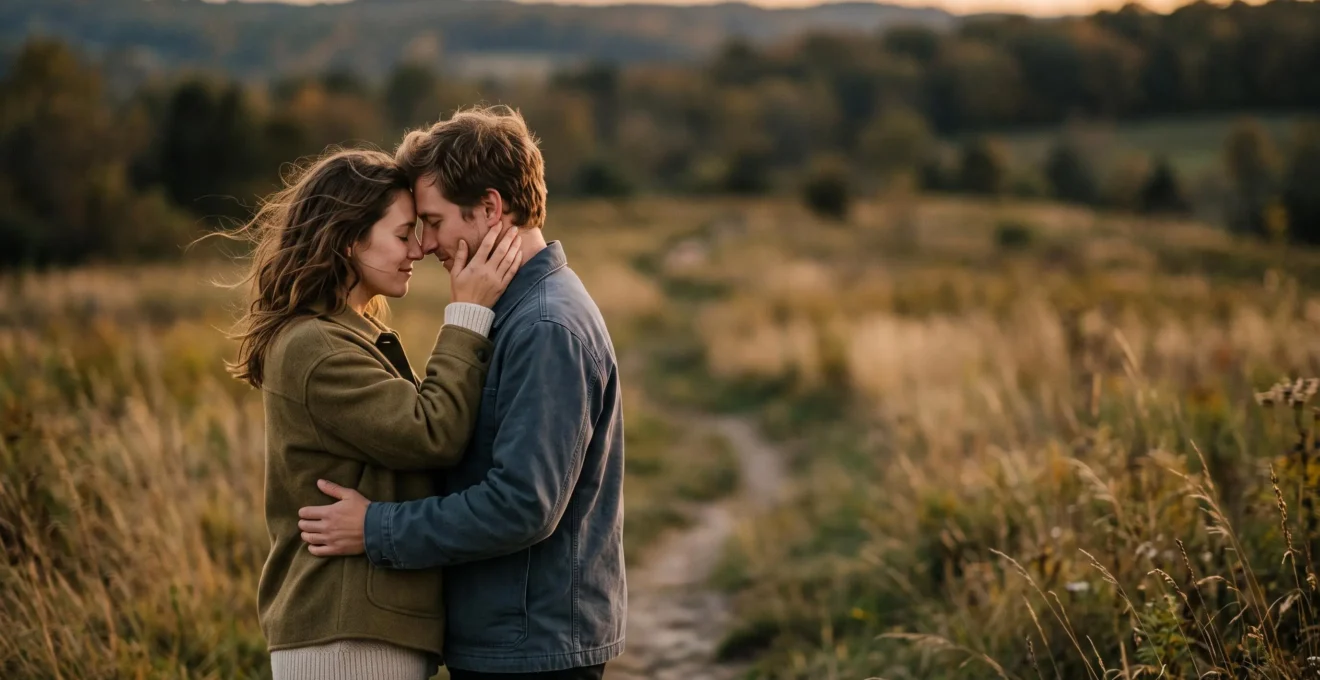
Authentic couple photos don’t come from better poses; they emerge when the photographer shifts from a director to an emotional safety facilitator.
- Genuine intimacy on camera is a byproduct of psychological comfort, not a list of prompts.
- Using movement-based direction and reading subtle body language cues are more effective than static posing.
Recommendation: Reframe your role. Instead of trying to ‘create’ moments, focus on building a safe space where the couple’s natural connection can unfold on its own.
You’ve done everything right. You scouted the perfect golden-hour location, prepped your couple with a style guide, and came armed with a Pinterest board full of romantic prompts. Yet, as you look through the back of your camera, the images feel… stiff. The smiles look forced, the embraces are hesitant, and a subtle awkwardness permeates every frame. It’s a common frustration for wedding photographers who strive for that elusive, genuine connection but find their sessions fall flat despite their best efforts.
The conventional wisdom tells us to “make them laugh” or “have them whisper secrets,” treating the session like a checklist of interactions. But this approach often misses the fundamental reason couples freeze up: a lack of emotional safety. They feel like they are performing for a stranger, and their bodies instinctively reflect that discomfort. The result is a gallery of pretty pictures that lack the soulful intimacy you and your clients crave.
But what if the key wasn’t in adding more direction, but in fundamentally changing your role? What if, instead of being a director of poses, you became a gentle facilitator of connection? This guide is built on that premise. We will move beyond superficial prompts to explore the psychological underpinnings of on-camera comfort. We’ll deconstruct why some couples are naturally affectionate while others are inhibited, and how you can use specific techniques to build trust and create an environment where authentic moments aren’t just possible—they are inevitable.
This article will provide a clear roadmap, breaking down the theory and practice of facilitating genuine intimacy. From understanding session timing to reading pre-emotional cues, you’ll gain the tools to transform your couple sessions from awkward photo shoots into meaningful, shared experiences.
Summary: A Guide to Directing Authentic and Intimate Couple Portraits
- Why Some Couples Naturally Express Affection on Camera While Others Feel Inhibited
- How to Use Movement Prompts That Generate Authentic Intimacy Instead of Static Pose Instructions
- 15-Minute Quick Session or 60-Minute Deep Intimacy: Which Duration Suits Different Couple Types
- The Over-Direction Mistake That Prevents Authentic Moments During Couple Portrait Sessions
- When to End Couple Portrait Sessions Early Despite Scheduled Time Remaining
- How to Read Body Language Cues That Signal Emotional Moments 10 Seconds Before They Peak
- How to Direct Couples Into Flattering Poses When They Feel Awkward and Camera-Shy
- How to Master Efficient Wedding Portraiture That Delivers Artistic Results in Under 20 Minutes
Why Some Couples Naturally Express Affection on Camera While Others Feel Inhibited
The first step in facilitating connection is understanding its source. When a couple steps in front of your lens, they bring their entire relational history with them, including their ingrained patterns of expressing affection. A couple’s comfort with public displays of affection (PDA) is not random; it’s often deeply rooted in their individual attachment styles, developed since childhood. As one editorial team explains, “individuals with a secure attachment style tend to be comfortable with intimacy” and are more likely to be openly affectionate, while those with avoidant styles may feel genuine discomfort with closeness in a public or semi-public setting like a photo shoot.
Your role is not to judge or force this, but to recognize it. A camera-shy couple isn’t necessarily a “less in love” couple; they may simply have a different relational blueprint. Pushing an avoidant-leaning person into overt displays of passion is a recipe for awkwardness because it violates their innate sense of emotional safety. Instead of seeing this as a barrier, view it as a crucial piece of information. Your job is to meet them where they are, creating a space so secure that their unique, perhaps more subtle, form of connection can emerge.
This dynamic isn’t just psychological theory; it has observable cross-cultural relevance. While affection is a universal language, its expression varies. For instance, a 2025 cross-cultural study published in PLOS ONE across three countries highlighted how cultural norms influence displays of affection and their link to relationship satisfaction. This reminds us that a couple’s background and culture add another layer to how they will interact. By understanding these deep-seated influences, you can shift from feeling frustrated by their inhibition to feeling empowered to create the right conditions for their specific brand of authenticity to shine.
How to Use Movement Prompts That Generate Authentic Intimacy Instead of Static Pose Instructions
Once you understand the ‘why’ behind a couple’s potential hesitation, you can shift your technique from static to dynamic. The biggest mistake photographers make is giving instructions that lead to a stationary pose, like “put your foreheads together.” This freezes the couple in a moment of self-awareness, making them think about *how they look* rather than *how they feel*. The antidote is to use movement-based prompts that require interaction and focus on an action, not a result.
Instead of “look at each other,” try “start a few feet apart, and on the count of three, walk toward each other and embrace as if you haven’t seen one another in a month.” Instead of “nuzzle into his neck,” try “trace the line of her jaw with your nose, from her ear to her chin.” These prompts give the couple a task to perform together. Their minds become occupied with the movement, allowing their natural, un-self-conscious reactions to surface. The resulting moments—a soft laugh, a gentle touch, an unscripted glance—are the building blocks of authentic intimacy.
This process is grounded in neuroscience. When you ask a couple to focus on each other’s movements and expressions, you are activating their mirror neurons. As cited research on relationship neuroscience explains, “mindful observation — deliberately focusing on another person’s facial expressions, body language, and vocal tone — strengthens these neural pathways.” You are essentially guiding them into a state of heightened connection, and your camera is there to document the fallout. You become a connection facilitator, with the movement prompt being your primary tool.
15-Minute Quick Session or 60-Minute Deep Intimacy: Which Duration Suits Different Couple Types
The tools for facilitating connection are only as good as the container you create for them. A critical, often overlooked, element of this container is time. Not all couples need the same amount of time to reach a state of emotional safety. Attempting to rush a hesitant couple into deep intimacy in a 15-minute mini-session is like trying to have a profound conversation in a crowded, noisy room—it’s simply not the right environment.
As a facilitator, you must learn to diagnose your couple’s needs and match them to the appropriate session length. High-energy, spontaneous couples who are already comfortable with PDA might thrive in a quick, dynamic 20-minute shoot. For most, however, true comfort is a process. It’s widely noted in the industry that it often takes couples 15-20 minutes just to settle their nerves and move past the initial feeling of being “on display.” Genuine connection often doesn’t start to consistently appear until the 30-minute mark and beyond.
This is where offering different session lengths becomes a strategic tool. A longer, 60-to-90-minute session isn’t about getting more photos; it’s about buying the time needed to build trust, allow for warm-ups, and let the initial performance anxiety fade away naturally. A structured comparison can help clients understand this value.
| Session Type | Typical Duration | Best Suited For |
|---|---|---|
| Mini Session | 15-30 minutes | High-energy, spontaneous couples wanting a quick, single-location snapshot |
| Standard Session | 45-90 minutes | Couples wanting variety across one or two locations with room to warm up |
| Extended / Date-Night Style Session | Up to 3 hours | Couples wanting a full narrative arc and multiple outfits/locations |
By asking diagnostic questions before booking—”Do you envision a quick snapshot of your love, or a deeper storytelling experience?” or “How comfortable are you typically with being the center of attention?”—you can guide them to the right choice. This positions you as an expert who understands the nuances of human connection, not just a photographer selling blocks of time. This insight is reinforced by expert advice on choosing an engagement session length, which emphasizes matching the session duration to the couple’s desired experience and personality.
The Over-Direction Mistake That Prevents Authentic Moments During Couple Portrait Sessions
Even with the right intentions, many photographers sabotage authentic moments through over-direction. This happens when your guidance becomes a constant stream of micro-managing instructions: “Tilt your head a little more,” “Move your hand here,” “Now smile bigger.” While born from a desire for a ‘perfect’ shot, this behavior has the opposite effect. It pulls the couple out of their shared experience and forces them back into their heads, making them hyper-aware of your presence and their own perceived flaws. It shatters the very emotional safety you’ve worked to build.
The goal is to provide a framework, not a straitjacket. You give a movement-based prompt and then you do the most important thing: you step back and observe. You allow for the “in-between” moments—the quiet glance after a laugh, the way he brushes hair from her face without being told. These are the moments that hold the most authentic emotion, and they can only happen in the space you create by *not* directing.
Avoiding over-direction requires trust—in your couple and in your own ability to capture what unfolds. It means being comfortable with a little silence and imperfection. You are guiding them to an emotional starting point and then allowing them to finish the journey on their own. The following checklist can serve as a practical guide to keep your direction minimal and your facilitation maximal.
Action Plan: Avoiding the Over-Direction Trap
- Simplify Communication: Give one simple, clear instruction at a time. Instead of a long list of adjustments, focus on a single action-oriented prompt and see what happens.
- Lighten the Atmosphere: Use a relaxed tone and humor. Treat the session like a casual hangout you happen to be photographing, not a formal, high-stakes production.
- Prioritize Key Shots: Have a mental list of a few essential, meaningful shots. Get those first, then allow for creative variations to emerge naturally, reducing the pressure to “get it right” on every take.
- Let Comfort Build: Don’t force a perfect pose on the first try. Let the couple’s comfort and confidence build through repetition and practice, refining their interaction organically rather than through verbal commands.
When to End Couple Portrait Sessions Early Despite Scheduled Time Remaining
As a connection facilitator, your most important metric is the couple’s emotional and physical well-being. A scheduled 60-minute session is a guideline, not a contract that must be fulfilled at all costs. Learning to recognize the signs of fatigue is an advanced skill that separates a good photographer from a great one. Pushing a couple past their point of exhaustion is the fastest way to destroy emotional safety and produce strained, lifeless photos.
The signs are often subtle at first. The genuine Duchenne smiles (which we’ll cover next) become harder to come by. Their movements become slower, their responses to your prompts less enthusiastic. One partner might start shifting their weight, or you might hear a quiet sigh. These are cues that their energy tank is running low. Continuing to direct them is not only unproductive but can also leave them with a negative memory of the experience. As one bride shared after a long shoot, “Ours was 2 hours. It was exhausting! My back started to hurt from all the posing.” This kind of feedback highlights how physical discomfort directly impacts the session’s success.
Ours was 2 hours. It was exhausting! My back started to hurt from all the posing.
– WeddingWire Forum Contributor
Ending a session 15 minutes early when you feel you’ve “got the shot” and the couple’s energy is waning is a powerful statement. It tells them, “I value your well-being more than my schedule.” This act of empathy builds immense trust and ensures they leave feeling positive and cared for. It is far better to have 45 minutes of incredible, connected images than 60 minutes that end with forced smiles and exhaustion. Knowing when to stop is just as important as knowing how to start.
How to Read Body Language Cues That Signal Emotional Moments 10 Seconds Before They Peak
The most powerful portraits capture an emotion at its peak. But these peaks are fleeting. As a facilitator, your job is to become an expert observer, learning to recognize the subtle signals that appear seconds *before* a genuine emotion fully surfaces. This anticipatory skill allows you to have your camera ready, not to react to a moment that has already passed, but to capture it as it unfolds.
The most well-known of these cues is the Duchenne smile. Unlike a polite “social” smile that only uses the mouth, a genuine Duchenne smile involves the involuntary contraction of the orbicularis oculi muscles around the eyes, creating “crow’s feet.” It’s the physical manifestation of true joy. As researchers from iMotions note, “a Duchenne Smile radiates authentic joy.” While it’s the gold standard, don’t be fooled into thinking it can’t be imitated; research from the British Psychological Society found that 71% of people can consciously fake one. This is why you must look for a constellation of cues, not just one.
Unlike polite or “Pan-Am” smiles that engage only the mouth, a Duchenne Smile radiates authentic joy.
– iMotions Research Team
Look for the “pre-moment” signals. Before a big laugh, you might see a slight intake of breath and the head tilting back. Before a tender, intimate glance, you might see a softening of the jaw and a slight parting of the lips. When one partner tells a story, watch the other partner’s face—their subtle nod, the way their eyes light up in recognition. These are the micro-expressions that precede the main event. By training your eye to catch these almost imperceptible shifts in body language, you are no longer just a photographer; you are reading the emotional energy of the room and anticipating where the story is going next.
How to Direct Couples Into Flattering Poses When They Feel Awkward and Camera-Shy
Even with a focus on facilitation and movement, there are times when you need to provide more direct guidance to ensure flattering results, especially with camera-shy couples. The key is to direct in a way that minimizes cognitive load and self-consciousness. One of the most effective and gentle techniques is physical mirroring. Instead of using abstract verbal commands like “turn your body 45 degrees toward me,” which can be confusing, you demonstrate the pose yourself.
Stand in front of the couple and physically model the body position you’re looking for. Then, simply ask them to “mirror me.” This approach is intuitive and removes the anxiety of interpretation. They are simply copying a shape, which is a much lower-pressure task than trying to construct a pose from a series of verbal instructions. You can guide one partner into a base pose by mirroring them, and then ask the other partner to interact with them naturally. This creates a solid, flattering foundation from which authentic interactions can then bloom.
This method is part of a larger philosophy of creating structured, yet flexible, posing systems that prioritize client comfort. It’s about having a plan that doesn’t feel rigid.
Case Study: The ‘Posing for Purpose’ Method
Photographers like Cameron & Tia have developed a system called ‘Posing for Purpose.’ This structured approach guides couples through a sequence of foundational poses, variations, and verbal prompts. The system is designed specifically to lead nervous couples through a session in a way that builds comfort and predictability, delivering both a positive client experience and emotionally resonant images that are also technically flattering. This demonstrates that structure and authenticity are not mutually exclusive when the system is built around the couple’s comfort.
By combining gentle mirroring techniques with a reliable posing foundation, you can guide even the most awkward couples into positions that feel good and look great. This builds their confidence early in the session, making them more receptive to the more intimate, movement-based prompts to come. You are providing a secure starting point, a ‘home base’ pose they can return to, which reinforces their sense of safety.
Key Takeaways
- Shift your role from a director of poses to a facilitator of emotional safety.
- Use movement-based prompts to generate natural interactions instead of static, awkward poses.
- Read the couple’s energy and comfort levels, and be willing to adjust session length or end early to preserve trust.
- Become an expert observer of micro-expressions to anticipate emotional peaks before they happen.
How to Master Efficient Wedding Portraiture That Delivers Artistic Results in Under 20 Minutes
All these principles of facilitation, movement, and observation culminate in the ultimate test for a wedding photographer: creating beautiful, connected portraits on a wedding day, often in less than 20 minutes. This high-pressure environment seems at odds with the patient, trust-building process we’ve discussed, but it’s not. Efficiency on a wedding day is a direct result of the preparation and trust you’ve built beforehand, especially during an engagement session.
The engagement session is your rehearsal. It’s where you teach your couple your language of direction, discover their natural chemistry, and identify the prompts that resonate most with them. By the time the wedding day arrives, you are not working with strangers. You have a shared history and a foundation of trust. You can use a verbal shortcut—”Remember that walking prompt we did by the lake?”—and they will instantly know what to do, allowing you to get to the heart of the moment quickly.
This efficiency can be structured into your offerings, providing value for different client needs while still delivering quality.
Case Study: A Two-Tier System for Efficiency
A Chicago-based engagement photographer demonstrates this by offering a structured ‘Mini Session’ of 20-30 minutes alongside a longer ‘Full Session.’ The mini-session, held at a single pre-scouted location, is designed for couples wanting a handful of polished images quickly. This shows how a pre-planned, efficient system—built on reliable prompts and locations—can deliver quality results in a short timeframe, a skill directly transferable to a compressed wedding day timeline.
Mastering the 20-minute wedding portrait session is the synthesis of all these skills. It requires you to have scouted your location in advance, to have a mental shortlist of reliable prompts, and to have established such a strong rapport with your couple that they can drop into a state of connection almost instantly. It’s not about rushing; it’s about leveraging a pre-existing foundation of emotional safety to create authentic intimacy on a deadline.
By shifting your perspective from director to facilitator, you unlock a more profound and authentic way of capturing love. Begin today to integrate these principles into your workflow and watch as your couple sessions transform from awkward obligations into celebrated moments of genuine connection.