
Efficient wedding portraiture isn’t about rushing a checklist; it’s a system of high-impact direction that creates authentic emotional variety in minimal time.
- Use short, action-based prompts (e.g., “Whisper your favourite dessert”) instead of static pose commands to elicit genuine reactions.
- Systematically manage group photos with a pre-defined list and a designated family “wrangler” to gather people efficiently.
Recommendation: Shift your focus from “time saved” to the emotional value and variety you can create per minute. This is the key to delivering a gallery that feels both expansive and authentic, even within tight constraints.
You’re a wedding photographer, and you know the feeling. The timeline is tight, the reception is starting, and you’re caught between a couple wanting a magazine-worthy portrait gallery and a wedding planner tapping their watch. The conventional wisdom is to create exhaustive shot lists, scout locations for hours, or rely on a “first look” to buy more time. While helpful, these logistical fixes don’t address the core challenge: how to direct human beings to produce authentic, varied, and artistic portraits when the pressure is on and the clock is ticking.
Many photographers spend 90 minutes on couple portraits, exhausting their subjects and missing crucial reception coverage. Others rush through a handful of stiff, awkward poses, delivering a gallery that feels thin and repetitive. The real problem isn’t the lack of time; it’s the lack of a system for maximising the value of that time. What if the secret wasn’t about finding more minutes, but about making every minute more productive and emotionally resonant? What if you could generate 25+ distinct portrait variations in under 20 minutes, not by rushing, but by being smarter with your direction?
This article moves beyond basic timeline management. We will deconstruct a directive system built for efficiency without sacrificing quality. We’ll explore how to use five-word instructions to get natural reactions, how to manage the beautiful chaos of family photos, and how to avoid the trap of repetitive expressions. This is a framework for transforming your limited portrait time from a source of stress into your most focused, creative, and productive part of the wedding day.
This guide breaks down the essential strategies for mastering time-crunched wedding portraiture. Below, you will find a structured approach to transforming your workflow, from managing client expectations to directing with precision and confidence.
Summary: Mastering the 20-Minute Wedding Portrait
- Why Couples Expect 25+ Portrait Variations When You Only Have 15 Minutes of Their Attention
- How to Direct Wedding Couples Into Natural Poses Using 5-Word Instructions Instead of Lengthy Explanations
- Family Group Portraits: Systematic Organisation Methods or Flexible Chaos Management at British Weddings
- The Repetitive Expression Mistake That Makes 30 Wedding Portraits Look Nearly Identical
- When to Extend Couple Portrait Time Beyond the Scheduled 15 Minutes and When to Cut Short
- Why Successful Hybrid Coverage Requires 30% More Contracted Time Than Pure Reportage or Traditional Approaches
- 15-Minute Quick Session or 60-Minute Deep Intimacy: Which Duration Suits Different Couple Types
- How to Direct Romantic Couple Sessions That Feel Authentic Instead of Awkward
–
–
–
–
–
Why Couples Expect 25+ Portrait Variations When You Only Have 15 Minutes of Their Attention
The fundamental conflict in wedding portraiture stems from a gap between perception and reality. Couples spend months, even years, curating Pinterest boards filled with dozens of epic, romantic, and perfectly lit portraits. They see a final gallery, not the process. This creates an implicit expectation for variety and quantity. Yet, on the day itself, they are also the hosts of a major event, eager to join their guests for cocktails and celebration. The desire for a vast gallery clashes directly with their limited attention span and the day’s relentless schedule.
Industry standards often fuel these expectations. For instance, many professional resources suggest that most photographers recommend around 45 minutes for couple portraits alone. When a couple hears this, they anchor their expectations to a lengthy, dedicated session. Your 15-minute slot, squeezed between the ceremony and reception, seems insufficient by comparison. They don’t understand that a skilled photographer with a system can produce more variety in 20 minutes than an unprepared one can in an hour.
The key is to manage these expectations upfront while having a workflow that delivers. As wedding photographer Jaimie Nicole Krause notes, the session can be defined by its purpose, not just its length. This reframes the conversation from a lack of time to a strategic choice.
Couple portraits? Typically 15–20 minutes. Long enough to slow down, reconnect, and take it in—or short enough to get you to cocktail hour fast. Your call.
– Jaimie Nicole Krause, Wedding Day Timeline Planning: How Long Everything Actually Takes
Your job is not to fight for more time, but to build a directive system so efficient that it produces a gallery that feels expansive and complete, regardless of the minutes on the clock. It’s about proving that the quality and variety of the final images are a result of skill and process, not just brute-force time allocation.
How to Direct Wedding Couples Into Natural Poses Using 5-Word Instructions Instead of Lengthy Explanations
The biggest time-waster during a portrait session isn’t moving between locations; it’s overcoming stiffness and awkwardness. Lengthy explanations like “Now, I want you to stand here, put your arm around her, look into her eyes, and feel the love” are confusing and often result in forced, unnatural expressions. The solution is a system of frictionless direction built on short, action-based prompts. These prompts give the couple something to *do* rather than a static pose to *hold*, generating genuine reactions that become the photograph.
This approach bypasses the brain’s tendency to overthink and allows for authentic emotion to surface. Instead of “Smile for the camera,” try “Whisper what you’re having for dinner tomorrow.” Instead of “Look romantic,” try “Nose to nose, now breathe each other in.” These five-word commands are easy to process and trigger natural micro-movements, laughter, and intimacy. This philosophy is simple: action beats static posing every time.
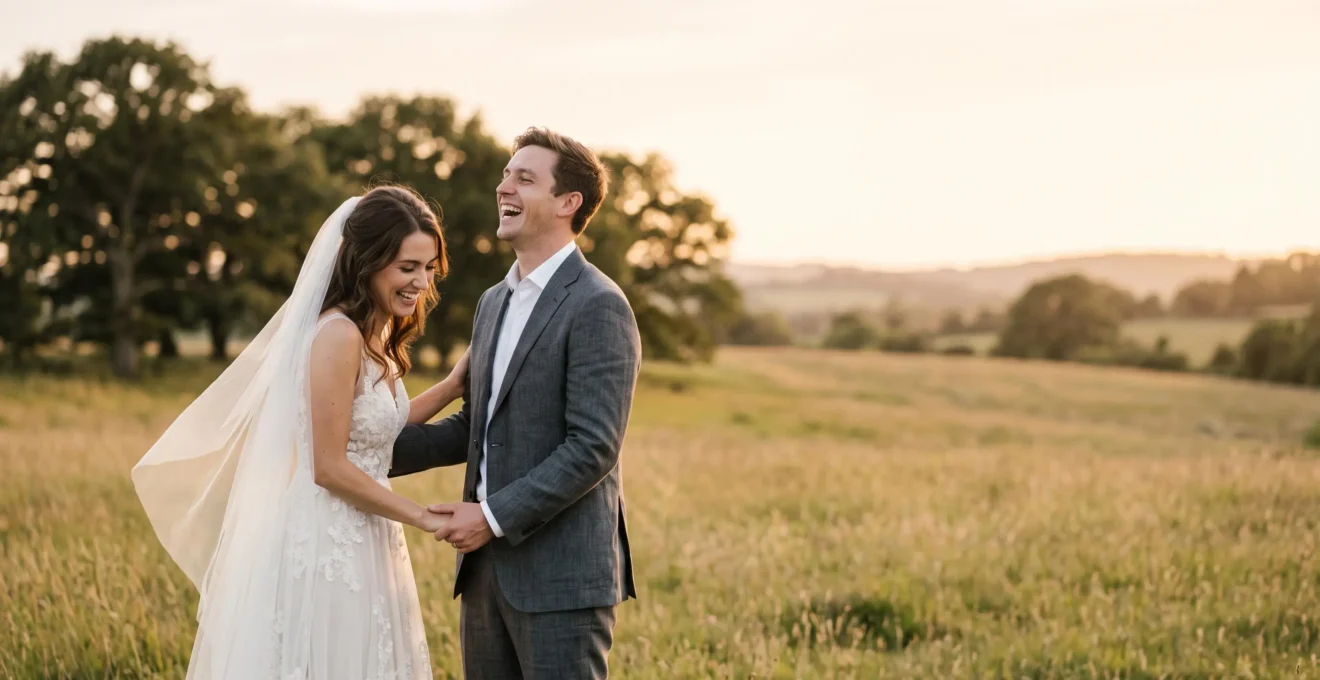
As this image demonstrates, the goal is the unguarded moment that follows the prompt. Your job is to create the catalyst and be ready to capture the result. An effective directive system relies on a handful of these action-oriented prompts:
- Walking and Interacting: “Walk towards me, holding hands, bumping hips.”
- Playful Prompts: “Try to make her laugh using only three words.”
- Sensory Cues: “Close your eyes and remember the smell of her perfume on your first date.”
- Micro-Movements: “Gently brush the hair from his face.”
By giving your subjects a simple task, you free them from the pressure of “posing.” Their genuine reaction—be it laughter, surprise, or quiet intimacy—becomes the beautiful, authentic portrait you were aiming for, all achieved in a fraction of the time.
Family Group Portraits: Systematic Organisation Methods or Flexible Chaos Management at British Weddings
Family formals are the ultimate test of a wedding photographer’s efficiency. This part of the day has the most moving parts, the most personalities, and the highest potential for descending into time-consuming chaos. While a degree of flexibility is essential, success hinges on a systematic approach that begins long before the wedding day. Without a plan, this segment can easily derail the entire timeline, as for most weddings, formal family photos take between 20 and 30 minutes—time you often don’t have.
The core of an efficient system is eliminating confusion and decision-making on the day. Your primary tool is a pre-agreed, hyper-detailed shot list. This isn’t just “Bride’s Family”; it’s a specific, named list of every single combination the couple wants. The second key is communication. Everyone on that list must be told the exact time and location for photos *before* the wedding day. This prevents the classic “Where’s Uncle Bob?” scenario that can waste 10 precious minutes.
On the day, your system needs a “wrangler.” This isn’t you. Assign a loud, trusted, and well-liked family member or friend from each side to be your point person. Hand them the list. While you are shooting one group, they are responsible for gathering the people for the next shot. This creates a seamless production line. Your job is to arrange and shoot, not to hunt for guests. The essential pillars of this system are:
- A Named Shot List: Finalised with the couple at least two weeks prior. No additions on the day.
- Advance Notification: A specific time and location communicated to all required family members.
- The Designated Wrangler: A non-photographer responsible for gathering the groups.
This organisational framework provides the structure. It allows you to move through the combinations quickly and confidently, transforming potential chaos into a controlled, efficient, and even enjoyable part of the day.
The Repetitive Expression Mistake That Makes 30 Wedding Portraits Look Nearly Identical
You’ve nailed a beautiful pose. The light is perfect, the composition is strong. You take the shot. Then you take a slightly wider version. Then a vertical. You end up with five images that are technically different but emotionally identical. This is the repetitive expression trap, and it’s the fastest way to make a gallery feel thin despite having many photos. Achieving true emotional variety doesn’t always require a new pose; it requires a new moment.
A powerful, and often overlooked, technique is for the photographer to move, not the couple. As photographer Joy Michelle points out, once a couple is in a comfortable base pose, you can create immense variety by changing your own angle and perspective. This is far more efficient than re-posing the couple every 30 seconds. Shoot through foliage, get low, shoot from above, or move to the side to capture different profiles. This creates new compositions and backgrounds while the couple remains connected in their moment.
What can really help to freshen your work can be you moving instead of the couple moving… you can get a tremendous amount of variety without them changing their pose.
– Joy Michelle, Tips for GREAT Wedding Photography Poses
To vary the *expression*, you need a system for resetting the couple’s emotional state. This is where the “prompt ladder” comes in. It’s a method of escalating prompts from low-pressure to high-intimacy, ensuring the couple feels comfortable at every stage and giving you a range of moods to capture, from playful and laughing to soft and romantic.
Action Plan: The Prompt Ladder for Emotional Variety
- Establish a Base Pose: Start with a simple, comfortable physical position (e.g., side-by-side, one arm around the other) before giving any verbal prompts.
- Introduce Low-Pressure Prompts: Use easy, playful actions first to break the ice and elicit natural smiles (e.g., “Walk towards me like you’re a little bit drunk”).
- Move to Soft Romantic Prompts: Once they look physically relaxed, introduce gentle, connecting prompts (e.g., “Gently rest your foreheads together and breathe”).
- Gauge Comfort for Intimacy: Only use higher-intimacy prompts (e.g., “Whisper the moment you knew they were the one”) if the couple is visibly comfortable and connected.
- Reset and Repeat: After a sequence, have them shake it out, then start a new base pose and climb the ladder again with different prompts to create a new set of expressions.
By combining photographer movement with a structured prompt ladder, you can generate a dozen unique looks from a single base pose, ensuring your gallery is rich with both compositional and emotional variety.
When to Extend Couple Portrait Time Beyond the Scheduled 15 Minutes and When to Cut Short
Even the most perfectly planned timeline must be flexible. While your goal is to work efficiently within a 15-20 minute window, a great photographer knows when to stick to the schedule and when to adapt. The decision to extend or cut short a portrait session isn’t random; it’s a strategic choice based on a few key factors: the couple’s energy, the environmental conditions, and the “magic” happening in the moment. The industry standard might be that photographers agree that couple portraits take between 45 minutes to an hour, but your reality is what’s happening on the ground.
Extend the session when:
- The couple is genuinely enjoying it. If they are relaxed, laughing, and clearly treasuring this quiet time together, don’t be the one to break the spell. These are the moments that yield the most authentic and emotional images. A few extra minutes here are worth more than 30 minutes with a stiff, uncomfortable couple.
- The light is extraordinary. If that perfect golden hour light finally breaks through the clouds, you seize it. A wedding timeline is a guide, not a prison. Communicating with the coordinator (“I need five more minutes for this light!”) is key.
- You haven’t “got the shot” yet. If you feel the results so far are safe but uninspired, and you know a different spot or prompt could unlock something special, it’s worth asking for a little more time.
Cut the session short when:
- The couple is visibly stressed or exhausted. Forcing a tired or anxious couple to continue posing will only result in strained, unhappy photos. It’s better to have 10 minutes of great images than 30 minutes of mediocre ones. Send them back to their party to recharge.
- The weather turns against you. If it starts raining heavily or becomes unbearably hot, protecting your clients’ comfort (and your gear) is the priority. You can always try to grab another 10-minute session later in the evening.
- You’ve already captured incredible variety. If your system is working and you’ve already banked a fantastic range of shots—wide, tight, laughing, romantic—in 15 minutes, don’t drag it out just to fill time. End on a high note and give them the gift of more time at their reception.
Expert advice often suggests building in flexibility from the start. As one expert recommends in The Knot, you can allocate at least 30 minutes for portraits but break it into two 20-minute chunks. This is a brilliant strategy, allowing for a session before the ceremony and another brief one at sunset, mitigating risk and doubling your chances for great light.
Why Successful Hybrid Coverage Requires 30% More Contracted Time Than Pure Reportage or Traditional Approaches
The rise of hybrid coverage—where one photographer is responsible for delivering both professional photos and video clips—is a game-changer for wedding timelines. It’s a compelling service to offer, but it fundamentally alters the time-value equation. The critical mistake is assuming you can simply “grab a few video clips” during the photo session. In reality, effective hybrid coverage requires a different mindset, different lighting considerations, and, most importantly, significantly more time. Attempting to do both within a standard photography timeline will lead to compromised results in both mediums.
The core issue is that photo and video have conflicting needs. A great photo can be captured in 1/250th of a second. A great video clip needs 5-10 seconds of sustained, stable action. Posing for a photo is static; acting for a video requires movement. Switching between these two modes isn’t just a button press; it’s a mental and logistical reset. This context-switching takes time. When you add a separate videographer into the mix, the time needed for directed shots expands even more. A common rule of thumb is that if you hire separate photo and video teams you need to double the time for formal photos and video formals.
Even as a solo hybrid shooter, the time stacks up. You need to direct an action, shoot it for video, then refine the peak of that action into a still pose and shoot it for photo. Each “shot” effectively has to be done twice, in different ways. This compounding effect is why successful hybrid coverage demands more contracted time than a single-medium approach.
Case Study: Time Breakdown for Hybrid Coverage
An analysis of wedding videography coverage illustrates how dual-mode shooting compounds the time required. The study found that capturing bride and groom preparations alone often requires about two hours to cover both photo and video moments adequately. Later in the day, combined portrait sessions for both photography and videography frequently take another two hours. This demonstrates that simply adding video to a photography workflow doesn’t just add a few minutes; it can double the time needed for key directed parts of the day, proving that hybrid work must be planned and timed as a distinct, more intensive service.
Therefore, when contracting for hybrid work, you must educate your client that they are not just “adding video.” They are choosing a more complex, time-intensive style of coverage that requires a 30-50% buffer in the timeline for any directed sessions (portraits, family formals) compared to a photo-only contract.
15-Minute Quick Session or 60-Minute Deep Intimacy: Which Duration Suits Different Couple Types
The ideal duration for a couple’s portrait session is not one-size-fits-all. While your system should allow you to work efficiently in 20 minutes, tailoring the session length to the couple’s personality is the hallmark of a client-focused professional. The goal is to place them in a scenario where they will be most comfortable and, therefore, most authentic. For this reason, many photographers find that bride and groom portraits are typically given 45 minutes so the couple doesn’t feel rushed, creating a buffer that can be adapted. The key is to diagnose the couple’s “type” during your initial consultations.
Are they “Performers” who love being the center of attention and have a huge guest list they’re dying to get back to? Or are they a “Camera-Shy” pair who need time to warm up and connect away from the crowd? Matching the session duration to their temperament is crucial for success. A long, intimate session will feel like a chore to an extroverted couple, while a quick, high-energy session will only heighten the anxiety of an introverted one.
The following table, based on recommendations from Lin & Jirsa Photography, provides a framework for discussing and scheduling the right type of session for your clients. It transforms the timeline discussion from a logistical negotiation into a collaborative plan to get the best possible photos for *them*.
| Session Type | Recommended Duration | Best Suited For |
|---|---|---|
| Quick Sprint Session | 15–20 minutes | Performers, large guest-focused weddings, couples wanting more mingling time |
| Standard Couple Portraits | 30–45 minutes | Balanced couples wanting variety without a long shoot |
| First Look + Portraits Combined | 45–60 minutes | Couples wanting a private emotional moment plus portraits |
| Deep Intimacy / Legacy Session | 60 minutes | Camera-shy couples, intimate elopements, connection-focused sessions |
By presenting these options, you empower the couple to choose what fits their vision for the day. This proactive approach ensures they feel heard and allows you to plan your technical and creative strategy accordingly, guaranteeing a session that is not only efficient but also perfectly suited to their personalities.
Key Takeaways
- Effective portrait direction relies on short, action-based prompts over static posing to elicit genuine emotion quickly.
- Create variety not by constantly re-posing the couple, but by moving yourself and using a “prompt ladder” to shift the emotional tone.
- Systematise family photos with a detailed, pre-agreed list and a designated non-photographer “wrangler” to maximise efficiency.
How to Direct Romantic Couple Sessions That Feel Authentic Instead of Awkward
The ultimate goal of any couple session is to capture romance that feels real. The line between authentic intimacy and cringeworthy awkwardness is incredibly fine, and it’s your direction that makes all the difference. The secret is to create an environment of comfort and trust, using prompts that invite connection rather than demand performance. It starts by abandoning vague commands like “look in love” and adopting a more specific, sensory-based directive system.
A solid foundation is the side-by-side stance. It’s incredibly versatile, working for both tight, intimate portraits and wider environmental shots. From this simple base, you can layer on a series of small, connecting actions. The “whispering prompt” is one of the most effective tools in this system. Asking one partner to whisper something to the other—be it “what you love most about them” or “the stupidest thing they did last week”—almost guarantees a genuine reaction, whether it’s a tender smile or a burst of laughter. It’s a manufactured moment that produces a real one.
The most powerful prompts are often the quietest. They draw the couple inward, making them forget about the camera. These are not about big actions, but about small, shared sensory experiences.
Whisper small prompts like “Breathe in and close your eyes” to help them sink deeper into the moment.
– The Honcho Editorial Team, How to Pose Wedding Couples: 30+ Poses to Inspire You
This approach focuses on creating a safe space for the couple to simply be with each other. A successful workflow for authentic romance involves these steps:
- Set the physical base first. Get them into a comfortable position (e.g., side-by-side, holding hands) before you start talking.
- Use a calm, quiet tone of voice. Your energy sets the mood for the entire session.
- Give a full, specific prompt. Instead of “get close,” try “stand facing each other, hold both hands, and slowly lean in until your foreheads touch.”
- Focus on breathing and senses. Prompts like “close your eyes and feel the sun on your skin” or “breathe in the smell of his cologne” are grounding and help them connect to the present moment, together.
By guiding them through a series of gentle, connecting actions, you are no longer posing them. You are simply facilitating moments of genuine connection and capturing them as they unfold.
By implementing this directive system, you transform from a photographer just taking pictures into a director crafting moments. You can now confidently manage client expectations, navigate tight timelines, and deliver a gallery rich with the authentic, artistic, and varied portraits your clients dream of, all while giving them back the most valuable thing on their wedding day: time.