
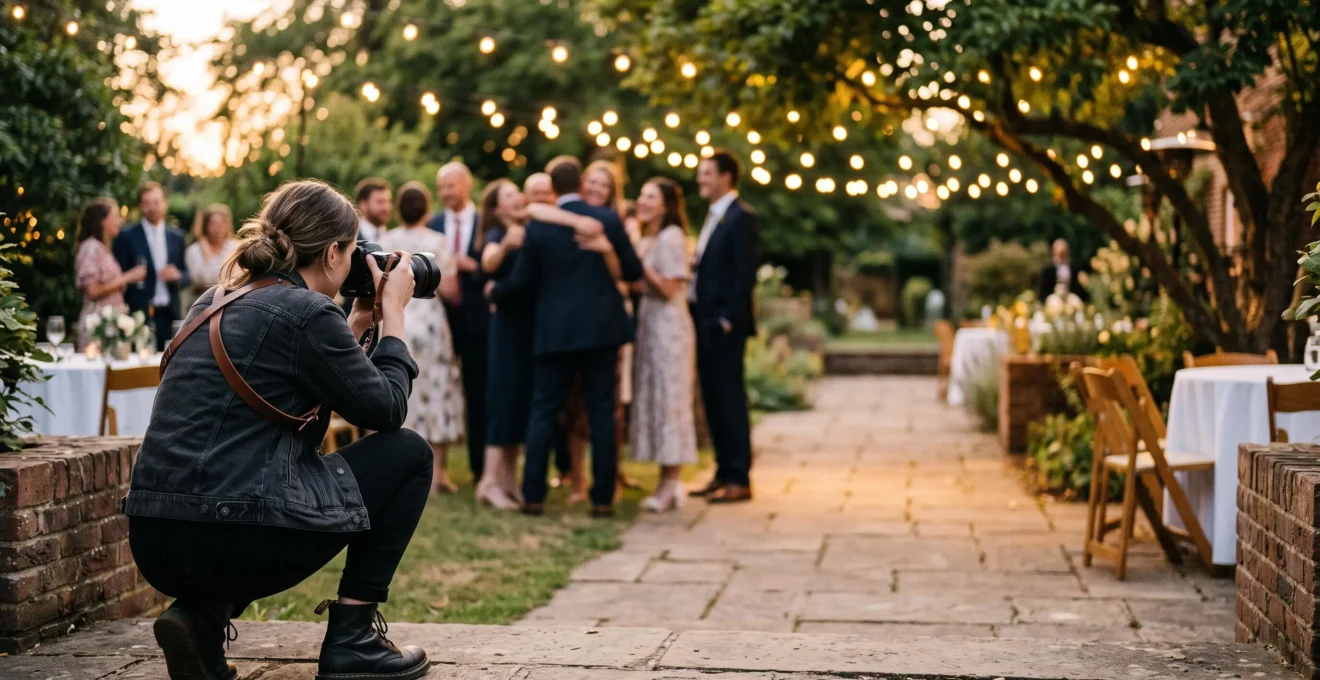
True reportage wedding photography isn’t passive observation; it is an active journalistic discipline requiring you to anticipate the story, not just react to it.
- Success depends on shifting from a “photographer” mindset to that of an “active witness,” focusing on narrative integrity over manufactured moments.
- This approach rejects the “fly on the wall” myth, demanding instead proactive positioning and deep situational awareness to capture authentic emotion.
Recommendation: Abandon the director’s chair. Train your eye to see the moments *before* they happen by studying human interaction, not posing guides.
You’ve been there. The forced smiles, the awkward hand placements, the endless group shots where the life drains from everyone’s eyes. As a photographer trained in the art of the perfect portrait, you know how to command a scene. But a growing number of clients, particularly savvy urban couples, are asking for something different. They want truth, not performance. They want the story of their day, not a gallery of staged tableaus. This shift creates a fundamental conflict for the traditionalist: how do you deliver a complete, compelling narrative when you are forbidden from directing it?
The common advice is to “be a fly on the wall” or “just capture candid moments.” These are platitudes, not strategies. They lead to portfolios filled with random, disconnected snapshots—people laughing at jokes you didn’t hear, crying for reasons you didn’t see. This passive approach is a dereliction of duty. The real mission of a reportage photographer is not simply to be invisible; it is to be a deeply observant, predictive, and active witness. It’s a discipline forged not in studios, but in the field, where understanding the story is the only thing that matters.
But what if the key wasn’t in the lens you use, but in the mindset you adopt? What if the skills of a conflict photojournalist—anticipation, ethical non-intervention, and a relentless focus on narrative integrity—were the true requirements for mastering this craft? This guide is not about taking better candid photos. It is a methodology for transitioning from a director of portraits to a journalist of authentic human connection. We will deconstruct the discipline, from client education and observational training to the gear that enables silence and the mindset that turns waiting into watching. You will learn to see the story unfold, one genuine moment at a time.
This article provides a complete framework for adopting a pure reportage methodology. Explore the principles and practical steps to transform your approach to wedding photography.
Summary: Mastering Reportage Wedding Photography: The Art of Zero Posed Intervention
- Why Educated Urban Couples Increasingly Request Pure Reportage Over Posed Wedding Photography
- How to Develop the Observational Discipline Required for Pure Reportage Wedding Coverage
- Silent Mirrorless or Robust DSLR: Which System Enables Better Reportage Wedding Photography
- The Passive Reportage Mistake That Leaves You With 4 Hours of Empty Waiting Instead of Story
- Which Wedding Styles Allow Pure Reportage Coverage Without Disappointing Couples With Sparse Formal Portraits
- The Passive Mistake That Makes Candid Photographers Miss 70% of Genuine Emotional Moments
- How to Train Your Eye to Detect Subtle Facial Micro-Expressions 1 Second Before They Appear
- How to Anticipate and Capture Candid Wedding Moments Before They Vanish Forever
Why Educated Urban Couples Increasingly Request Pure Reportage Over Posed Wedding Photography
The demand for unposed, authentic wedding photography is not a fleeting trend; it is a fundamental market shift driven by a desire for realism over fantasy. Educated, media-savvy couples are tired of the polished, homogenous look of traditional wedding albums. They don’t want to remember a day spent performing for a camera; they want to see the real, unscripted story of their commitment. This is reflected in hard data; recent market research shows that candid photography now holds over 40.3% of the wedding photography market, making it the largest single segment. This statistic isn’t just about a style preference; it’s about a philosophical shift in what a wedding photograph is for.
These clients are often consumers of high-quality documentary films and photojournalism. They understand the power of a genuine moment and are repulsed by artifice. When they say “no posed photos,” they are making an ethical request: “Do not manipulate our memories.” For the photographer trained in portraiture, this is a challenge to your core function. You are no longer a director creating beauty, but a journalist tasked with finding it. Your value is no longer in your ability to pose a couple, but in your ability to become so attuned to the environment that you can capture their story without leaving a trace.
Understanding this client is the first step. They are not asking for less work; they are asking for a different, more difficult kind of work. They value subtlety over spectacle and emotion over perfection. They will judge your work not by the flawlessness of the poses, but by the authenticity of the feelings you captured. This requires a profound re-evaluation of your role and a commitment to a new set of skills centered on observation, anticipation, and discretion.
How to Develop the Observational Discipline Required for Pure Reportage Wedding Coverage
Observational discipline is not a passive state; it is an active, mentally strenuous practice. It is the core skill that separates the journalist from the person with a camera. Henri Cartier-Bresson, a master of this craft, noted that “the subject must be approached tiptoeing.” This is not just about physical quietness; it is about a quietness of intent. You are there to witness, not to impose. This requires rewiring your photographer’s brain, which is trained to look for compositions and then direct subjects into them. Instead, you must learn to see the world in unfolding narratives and position yourself for the climax.
This discipline begins with preparation. It means knowing the key players, understanding the family dynamics, and being aware of the day’s emotional beats before you even arrive. Who is the emotional grandmother? Where are the old friends who are likely to share a tearful hug? These are not just details; they are signposts for future moments. During the event, your primary tool is listening. The sound of a rising laugh in a group of guests is a direct indicator of an impending photograph. By moving closer to conversations, you are not being intrusive; you are gathering intelligence to predict the emotional arc of the scene.
This is a hunter’s game, and patience is your ally. You must learn to differentiate between empty waiting and active watching. Active watching involves constantly scanning, anticipating lines of sight, and pre-composing frames around areas where action is likely to occur. It is a constant, exhausting process of hypothesis and observation. As Cartier-Bresson’s philosophy suggests, you are waiting for the “decisive moment” where the geometry of the scene and the peak of the emotion align. This moment is not a matter of luck; it is the inevitable result of disciplined anticipation.
Your Action Plan: Applying Photojournalism Principles
- Gear Ready: Pre-set your camera for the environment. A missed moment because you were changing a setting is a failure of preparation.
- Find a Foreground: Actively compose with layers. Shoot through doorways, foliage, or over shoulders to add depth and a sense of place to your images.
- Listen & Anticipate: Stand near, not far from, guest groups. The content of a conversation is the best predictor of a future emotional reaction.
- Find Your Position: Don’t stay static. Move around a scene, even climbing on a chair if necessary, to find the angle that best tells the story.
- Master Your Lenses: Choose the right lens for the moment’s needs—a wide lens for context, a longer lens for compression and discretion, but never as a tool to stay disengaged.
Silent Mirrorless or Robust DSLR: Which System Enables Better Reportage Wedding Photography
In photojournalism, the best camera is the one that doesn’t announce its own presence. For the reportage wedding photographer, this principle is paramount. The debate between mirrorless and DSLR systems is not merely about image quality but about the ethics of non-intervention. Your gear can either be a tool for silent observation or a barrier that constantly reminds subjects they are being photographed. As specialist Markus Morawetz advises, the goal is to be “as stealthy as a ninja.” The click of a DSLR’s mirror slap during a silent vow exchange is a catastrophic failure of that mission. It is an intervention.
This paragraph introduces the technical differences. The illustration below highlights the compact and unobtrusive nature of a modern mirrorless camera, a key asset for a reportage photographer.
As the close-up shows, the design philosophy of mirrorless systems often prioritizes smaller, lighter bodies. This isn’t just about comfort over a 12-hour day; it’s about psychological impact. A smaller camera is less intimidating to subjects, allowing them to forget you are there and behave naturally. The most significant advantage, however, is the fully silent electronic shutter. The ability to capture high-resolution images with zero sound is not a luxury; it is a fundamental requirement for working in the quiet, emotionally charged spaces of a wedding.
While modern DSLRs are robust, their core technology is inherently mechanical and audible. The advanced eye-tracking and face-detection autofocus in today’s mirrorless cameras also provide a critical edge, allowing you to trust the technology to nail focus while you concentrate 100% on composition and anticipating the moment. The choice is clear: for pure reportage, the technological advantages of mirrorless systems directly serve the ethical and practical needs of the craft.
The following table, based on extensive field reports on mirrorless adoption, breaks down the critical differences for a wedding documentarian.
| Criteria | Mirrorless | DSLR |
|---|---|---|
| Shutter Sound | Fully silent electronic shutter available, ideal for ceremonies | Mechanical mirror slap, audible even in quiet moments |
| Weight & Portability | Kits typically 30-40% lighter, easier to carry for 10+ hours | Heavier body and lens combinations |
| Autofocus | Advanced eye/face tracking, highly customizable | Reliable but generally less adaptive tracking |
| Discretion / Guest Perception | Smaller, less intimidating profile helps subjects forget the camera | Larger, more visually imposing presence |
The Passive Reportage Mistake That Leaves You With 4 Hours of Empty Waiting Instead of Story
There is a dangerous myth in “candid” photography: the idea that if you just stand back and wait, moments will magically present themselves. This is the path to a four-hour cocktail “hour” yielding nothing but flat, disconnected images of people holding drinks. This is not reportage; this is surveillance. The passive photographer becomes a victim of the day’s lulls, producing a gallery that reflects their own boredom rather than the wedding’s narrative. As the editors at SLR Lounge bluntly state, “Every laugh we hear is a missed opportunity for a nice candid image.” If you can hear it but not see it, you were in the wrong place.
The solution is to abandon the static mindset. A wedding is a fluid, multi-threaded event. While the main “action” may be paused, dozens of sub-narratives are constantly playing out. The active witness is always moving, scanning, and repositioning. Instead of planting yourself in one “safe” spot, you should be a ghost drifting through the space, treating downtime as prime time for capturing the quieter, often more powerful, emotional threads. It’s in these moments that a father-in-law might offer a quiet word of advice, or two old friends reconnect with a meaningful glance. These are the textures of the story.
This image of abandoned chairs symbolizes the emptiness of passive waiting. It is the scene a reactive photographer finds *after* the story has already happened and moved on.
To avoid capturing only the aftermath, you must stay “on” and keep hustling for the shot. Active reportage means you are constantly working. During lulls, your mission shifts from capturing peak action to documenting the connective tissue of the day. This involves:
- Moving through the space instead of standing still. Proximity creates opportunity.
- Watching guest reactions, which are often more compelling than the event they are watching.
- Photographing small gestures—the adjustment of a cufflink, a hand on a shoulder, a shared smile. These are the building blocks of intimacy.
- Treating quiet moments as a chance to capture the reaction shots that give context to the main events.
Which Wedding Styles Allow Pure Reportage Coverage Without Disappointing Couples With Sparse Formal Portraits
The commitment to pure reportage must begin with client education. Not every couple that says they want “candid photos” understands the full implications of a zero-intervention approach. Specifically, they may not realize this means no traditional, posed family formals. A photographer who accepts a “pure reportage” brief for a highly traditional wedding is setting themselves up for conflict and a disappointed client. The key is to match the approach to the event’s structure and the couple’s genuine expectations.
Weddings that are inherently fluid and less structured are the ideal canvas for this style. Think of a backyard wedding, a relaxed cocktail-style reception, or an elopement where the focus is entirely on the couple’s interaction. In these settings, the story flows naturally, and the lack of structured events is part of the narrative itself. The photographer’s job is to document the organic flow of the day. Conversely, a large, traditional wedding with a long list of expected group photos is a poor fit. Attempting a pure reportage approach here will inevitably lead to missing shots that the family, if not the couple, deems essential.
However, there is a middle ground. For couples who value authenticity but still feel pressure to have some portraits, the “prompt-based session” is an invaluable tool. This technique maintains documentary integrity by replacing static posing with action-oriented prompts. As a documentary studio’s workflow demonstrates, instead of saying “Stand here and smile,” the photographer gives a prompt like, “Walk towards me and tell each other the most ridiculous thing that happened this week.” The photographer then steps back and documents the genuine laughter, gestures, and interaction that result. The images feel alive and authentic because the emotion is real, even if the situation was initiated. This is a crucial technique for bridging the gap between client expectations and documentary principles, often best practiced first during what expert Clane Gessel calls the “best dress rehearsal,” the engagement shoot.
The Passive Mistake That Makes Candid Photographers Miss 70% of Genuine Emotional Moments
The single greatest error a transitioning photographer makes is focusing on the wrong subject. During key moments like speeches, the first dance, or the cake cutting, the amateur points their camera at the person performing the action. The professional points it at the people reacting to the action. An image of a best man giving a speech is a simple record. An image of the bride’s father wiping away a tear while listening to that speech is a story. The emotion is rarely in the event itself, but in the response to it.
As photographer Zoe Larkin notes, “Speech reaction photos are one of my favorite parts of the wedding day – people are truly focused on the speaker and forget about the photographer.” This is a critical insight. When guests are engaged in an event, their emotional guards are down. They are not conscious of the camera, making their reactions pure and unscripted. This is the goldmine for a reportage photographer. Missing these moments is a failure of awareness. It is a passive mistake born from following the obvious action instead of searching for the deeper narrative.
To correct this, you must train yourself to think in pairs of action and reaction. When the first dance begins, your job is not just to photograph the couple. Your job is to capture the couple, then immediately pan to the parents watching them, then to the grandparents, then to the bridal party. You must become a master of the “reaction shot.” This requires constant movement and a wide awareness of the entire room, not just the designated center of attention. You are not documenting a series of isolated events; you are documenting a web of interconnected relationships and emotions. The real story is found in the connections between the threads, not in a single thread itself.
How to Train Your Eye to Detect Subtle Facial Micro-Expressions 1 Second Before They Appear
The truly great moments in reportage are gone in an instant. As Henri Cartier-Bresson famously warned, “Once you miss it, it is gone forever.” The ability to capture peak emotion is not about fast reflexes; it’s about seeing the future. Emotions do not appear spontaneously; they are preceded by a cascade of subtle, involuntary facial movements known as micro-expressions. Training your eye to detect these precursors is the closest you can come to predicting the future. It is the difference between capturing a full laugh and capturing the moment just after the laugh has died.
This process is about learning emotional kinesics. A slight furrowing of the brow and tightening of the lips often precedes tears. A crinkling at the corners of the eyes happens a fraction of a second before a genuine smile (a Duchenne smile) fully forms. A quick intake of breath or a glance towards a loved one can signal an impending emotional outburst. Your mission is to learn this silent language. Watch people. Study films with the sound off. Pay attention to the faces in conversations around you. You are building a mental library of emotional tells.
This close-up of a guest’s face captures that precise, fleeting moment—the glistening of the eye, the tension in the mouth—that occurs just before the emotional dam breaks. This is the moment you are hunting.
In practice, this means when you identify a subject in an emotionally charged situation—like a mother watching her son get married—you don’t wait for the tear to fall. You watch her eyes, her mouth, her hands. When you see the tell, the subtle shift in muscle tension, you raise the camera and frame the shot. You are firing the shutter not at what is happening, but at what you know is about to happen. This is the pinnacle of anticipatory observation. It is a skill that takes years of dedicated practice to hone, but it is what elevates reportage from simple documentation to a profound form of witnessing.
Key Takeaways
- Abandon Passivity: True reportage is an active hunt for story, not passive waiting. Constantly move, listen, and anticipate.
- Focus on Reaction: The most powerful emotions are often found not in the person performing an action, but in the faces of those watching it.
- Master Non-Intervention: Your greatest tool is silence—in your gear and your presence. The goal is to document the story, not become part of it.
How to Anticipate and Capture Candid Wedding Moments Before They Vanish Forever
Anticipation is the synthesis of all the skills we have discussed. It is where observational discipline, technical readiness, and an understanding of human emotion converge. It is what Henri Cartier-Bresson described as “the simultaneous recognition, in a fraction of a second, of the significance of an event.” This is not a mystical talent but a practical methodology. It involves a constant process of identifying an unfolding event, scanning for both primary and secondary subjects, positioning for the optimal composition, and capturing the moment as it peaks.
Think of it as a four-step mental checklist that must run on a continuous loop throughout the day. First, identify the main event. Is a toast about to begin? Is the couple walking toward the dance floor? This is your primary anchor. Second, scan for reactions. Who is most invested in this moment? The parents? The maid of honor? These are your secondary targets, and their reactions are often the real story. Third, position yourself for the narrative. Place yourself where you can capture both the action and the reaction, or at least pivot between them with minimal movement. This might mean having the couple in the foreground and the parents visible over their shoulder. It is a deliberate choice about what story you want to tell.
Finally, and most crucially, stay alert to the periphery. While the main event unfolds, a child might be doing something hilarious under a table, or a quiet, meaningful interaction might be happening in a corner. The ability to maintain awareness of the central narrative while remaining open to these peripheral stories is the hallmark of a master documentarian. You are not just capturing a single moment, but a rich, layered scene filled with life. This constant, active process of anticipation is what ensures you leave a wedding with a complete, emotionally resonant story, rather than a collection of isolated, “candid” snapshots.
To move from theory to practice, the next logical step is to commit to this methodology. This means educating your clients, refining your observational skills on every shoot, and having the discipline to let the story unfold without your intervention. Start today by transforming your approach from director to journalist.