
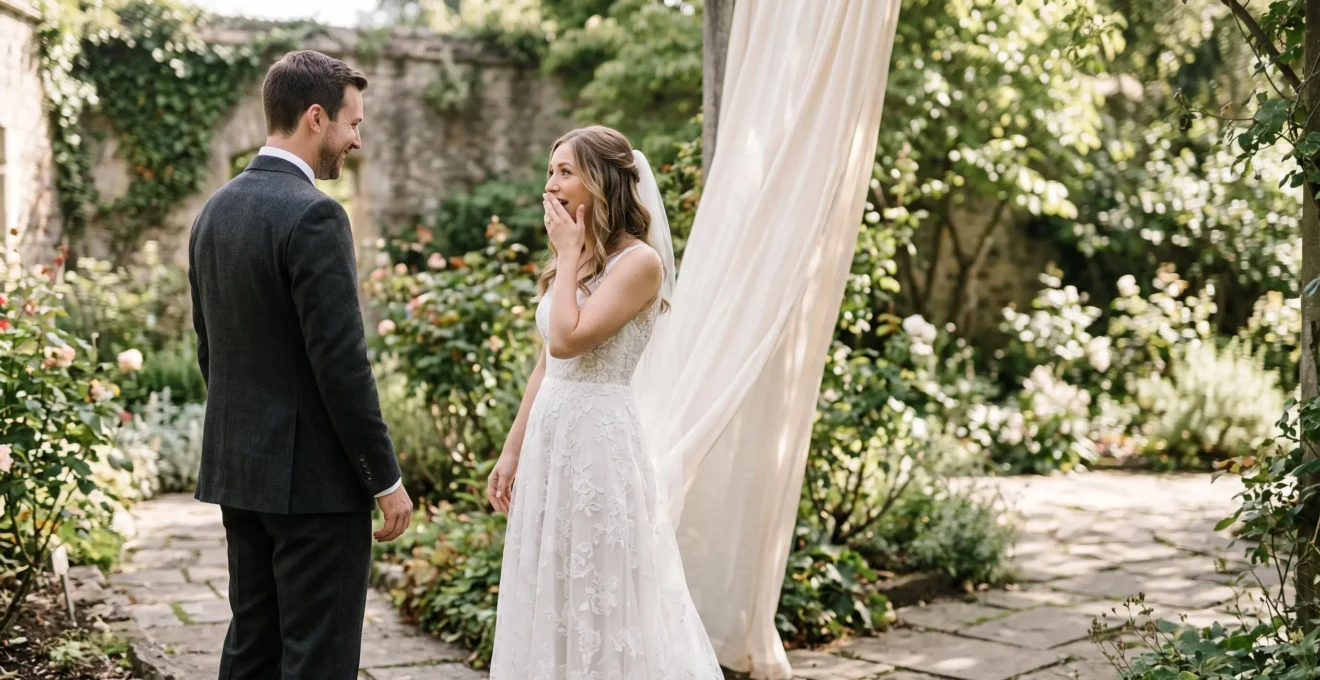
The secret to powerful first look photos isn’t better posing; it’s the radical decision to stop directing and start facilitating an “emotional sanctuary” for the couple.
- Authentic reactions emerge from private, interference-free environments where the photographer acts as a silent guardian, not a director.
- Anticipating emotion by learning to detect subtle facial micro-expressions allows you to capture the moment before it fully forms, preserving its genuineness.
Recommendation: Shift your mindset from “getting the shot” to architecting the space. Set the scene with gentle orchestration, then step back and let the real story unfold.
As a wedding photographer, you know the feeling. You’ve set up the perfect first look. The location is beautiful, the light is soft, but the resulting images feel… flat. Awkward. Despite the inherent emotional potential of the moment, the photos reflect a performance, not a genuine connection. You see the tension in their shoulders, the self-consciousness in their smiles. It’s a common frustration that leaves many photographers questioning their approach.
The standard advice often revolves around technicalities: use a long lens, find a secluded spot, or give the couple specific instructions like “walk towards each other and tap him on the shoulder.” While well-intentioned, this advice often misses the core issue. It treats the first look as a logistical step to be managed or a scene to be directed, rather than a deeply personal and vulnerable moment to be protected. The more you direct, the more the couple performs for the camera, and the further the authentic emotion recedes.
But what if the solution wasn’t about better direction, but about a fundamental shift in your role? What if the most powerful thing you could do was to become almost invisible? This guide proposes a different approach: one of gentle orchestration. It’s about moving beyond simply capturing a reaction and instead learning to architect a private, interference-free emotional sanctuary. Here, your job is not to direct the moment, but to become its silent guardian, preserving its integrity and allowing real, unscripted emotion to surface.
We’ll explore how to position yourself and your team to be physically and emotionally unobtrusive, when to schedule the session for maximum impact, and the critical mistake of over-direction that turns raw feeling into a staged play. By the end, you will have a new framework for transforming awkward first looks into the powerfully authentic moments your clients will cherish.
Summary: How to Photograph First Look Moments That Capture Authentic Emotion Without Feeling Staged
- Why 60% of Modern British Couples Now Choose Private First Looks Over Traditional Ceremony Aisle Reveals
- How to Position for First Look Photography Without Appearing in the Couple’s Sightlines or Emotional Space
- Both Partners Simultaneously or One Reaction at a Time: Which First Look Strategy Captures Better Emotion
- The Over-Direction Mistake That Turns First Looks Into Staged Performances Instead of Authentic Moments
- When to Schedule First Look Sessions: 90 Minutes Before Ceremony or Immediately Beforehand
- How to Position Yourself for Candid Moments Without Making Guests Self-Conscious or Aware
- How to Train Your Eye to Detect Subtle Facial Micro-Expressions 1 Second Before They Appear
- How to Direct Romantic Couple Sessions That Feel Authentic Instead of Awkward
Why 60% of Modern British Couples Now Choose Private First Looks Over Traditional Ceremony Aisle Reveals
The tradition of seeing each other for the first time at the ceremony aisle is being gracefully set aside by a growing number of modern couples. This shift isn’t just about logistics; it’s a deliberate choice to reclaim a moment of private intimacy amidst the beautiful chaos of a wedding day. While the title suggests a figure of 60%, a detailed 2023 study confirms that around 56% of couples now opt for a first look, underscoring a significant cultural change. They are choosing a quiet, personal reveal over a public performance.
Your role as a photographer begins long before the first look itself. It starts with educating your clients on what this moment truly represents. Frame it not as a convenient way to get photos done early, but as a chance to build genuine emotion and release pre-ceremony jitters in a safe space. When you explain it as their one guaranteed moment of quiet solitude on the wedding day, its value skyrockets. This private encounter allows them to connect, to speak freely, and to experience their initial reactions without the pressure of a hundred pairs of eyes watching.
To facilitate this, you must become a trusted advisor. Help them decide if a first look genuinely fits their personalities. For shy or anxious couples, it can be a profound relief. For traditionalists, it might not be the right fit. The goal is to scout a location that is not just pretty but genuinely secluded, shielding them from the eyes of early-arriving guests or venue staff. By championing the first look as an intimate, emotion-building experience, you transform it from a checklist item into a cornerstone of their wedding story.
How to Position for First Look Photography Without Appearing in the Couple’s Sightlines or Emotional Space
The goal of authentic first look photography is to become a ghost. Your physical position directly impacts the couple’s ability to remain present in their emotional sanctuary. Intrusive positioning, even with a long lens, can remind them they are being watched, instantly pulling them out of the moment. The key is anticipatory positioning, a coordinated strategy that ensures comprehensive coverage without ever entering the couple’s personal or emotional space. This requires meticulous planning, especially when working with a second shooter.
A triangulated setup is the industry standard for a reason. The lead photographer typically focuses on one partner’s reaction (often the one approaching), while the second shooter is strategically placed to capture the other partner’s face. The instruction is simple: shoot the opposite direction of the lead. If the lead is capturing the groom’s reaction over the bride’s shoulder, the second shooter should be positioned to capture the bride’s reaction over the groom’s. A third shooter, if available, can take a wider, central position to capture the entire scene for environmental context. This ensures that no single photographer is trying to do too much, which often leads to frantic movement and intrusion.
This wide, environmental perspective is crucial for storytelling, showing the couple alone in their chosen space. It visually reinforces the intimacy of the moment you’ve worked to create. As a second shooter, your primary role is discipline; you must anticipate the lead’s movements and take your cues from their behaviour, ensuring you are always complementing their angle, not competing with it. This disciplined dance minimizes your collective footprint and preserves the sanctity of the scene.
As this image illustrates, effective positioning is about creating distance. The photographer is merely a silhouette, a silent observer far removed from the central emotional exchange. To freeze the fleeting expressions that will occur, maintain a base shutter speed of at least 1/500th of a second and use a shallow depth of field (f/2.8 or wider) to isolate the subjects. Finally, a crucial but often-overlooked step: ensure all cameras are synced to an official time source before the day begins. This makes piecing together the exact sequence of reactions in post-production a seamless process.
Both Partners Simultaneously or One Reaction at a Time: Which First Look Strategy Captures Better Emotion
Once your team is in position, the next question is how to capture the cascade of emotions from two different people at once. Do you focus on one person’s reaction, then the other’s, or try to get both simultaneously? The answer, with a well-coordinated team, is both. When two photographers fire at the exact same instant from opposing angles, the resulting pair of images often reveals two distinct emotional truths of the same moment. One partner might show explosive joy, while the other reveals quiet, tearful relief. Capturing these simultaneous, contrasting reactions tells a much richer story than a simple sequential account.
This strategy hinges on your second shooter understanding their role is not to duplicate your shot. Their goal is to deliberately find a different angle, a different story beat. While you are tight on the groom’s face, they should be capturing the bride’s expression. This requires a shared understanding of lens choice and framing. Both shooters should aim for a shallow depth of field, using apertures between f/1.4 and f/2.8, to create that soft, emotion-focused look that isolates the couple from any background distractions. This consistency in aperture helps the final images feel like a cohesive set, even when captured from different perspectives.
The core principle for any second shooter is simple but powerful, a guideline that ensures you are always adding value rather than redundancy. As photographer Colleen’s Captures advises, it boils down to one essential rule of thumb.
If you’re unsure where to be, position yourself where the lead is not
– Colleen’s Captures, Second Shooter Wedding Guide
This simple mantra prevents photographers from clustering together and makes the most of having multiple cameras. By embracing this philosophy, your team can capture the full, 360-degree emotional narrative of the first look—his gasp, her tears, the wide shot of them embracing—all within the same fraction of a second. It transforms the coverage from a flat timeline into a rich, multi-layered emotional tapestry.
The Over-Direction Mistake That Turns First Looks Into Staged Performances Instead of Authentic Moments
The single greatest mistake a photographer can make during a first look is over-direction. It stems from a place of anxiety—a fear that the moment won’t be “good enough” without intervention. So we give instructions: “Okay, now walk slowly,” “Tap him on the shoulder in three, two, one,” “Now turn around and look surprised!” Each command chips away at the authenticity, turning a personal reunion into a scripted performance. The couple’s focus shifts from each other to you, the director. They are no longer experiencing a moment; they are trying to get it right for the camera.
The goal, as SLR Lounge reminds us, is to capture raw and authentic emotion. This cannot be manufactured through instruction. It can only be facilitated by creating an environment where the couple feels safe enough to be vulnerable. Your job is to blend in, to become part of the background, so they forget you are there. This requires a documentary-style mindset: you are there to observe and anticipate, not to create. You must stay ahead of the action, watching for the subtle cues that signal an emotional shift and being ready to capture it without saying a word.
Knowing the wedding timeline inside and out is crucial. It allows you to anticipate these key moments and be prepared, camera settings dialed in, so you don’t have to scramble and issue instructions. Your silence is a gift; it gives the couple the space they need for genuine reactions—whether it’s explosive laughter or quiet tears—to surface naturally. This hands-off approach is the essence of gentle orchestration.
Action Plan: Fostering Genuine Moments Through Non-Interference
- Set the Stage, Then Disappear: Give one simple, initial instruction (e.g., “John, face this way. Sarah, you can approach when you’re ready.”) and then remain silent and physically distant.
- Anticipate, Don’t React: Observe body language and listen for emotional cues. Position yourself for the hug, the tear, or the laugh *before* it happens, rather than moving once it starts.
- Know the Timeline Intimately: Be aware of what comes before and after the first look. This contextual knowledge helps you predict the couple’s emotional state and be ready for it.
- Embrace Imperfection: Do not interrupt to fix a stray hair or a wrinkled dress. The goal is an authentic moment, not a perfect portrait. The raw emotion is more valuable than technical perfection.
- Use Prompts, Not Poses: If interaction stalls, use a gentle prompt like “Tell him what you were most excited about this morning.” This prompts an action or feeling, rather than directing a static pose.
By adopting this non-interference policy, you shift your role from a director to a guardian of authenticity. You are protecting the moment from the one thing that can most easily ruin it: your own impulse to control it. The result is images that feel real, because they are.
When to Schedule First Look Sessions: 90 Minutes Before Ceremony or Immediately Beforehand
The timing of the first look is a critical decision that balances emotional energy with logistical reality. There are two primary schools of thought: scheduling it with a generous buffer (around 90 minutes before the ceremony) or immediately beforehand. Each has a distinct impact on the couple’s experience and your workflow. The most common driver for an early first look is logistical; a recent study found that more than 55% of couples choose a first look specifically to get photos out of the way, freeing them up to enjoy their cocktail hour with guests.
Scheduling the first look with a 90-minute buffer offers a relaxed pace. It allows the couple to fully immerse themselves in the moment without feeling rushed. This timing is excellent for releasing pre-ceremony nerves and provides ample time for the first look, followed by relaxed couple portraits and even wedding party photos. From a photographer’s perspective, it’s a dream scenario: you have control over the light and timeline, and you bank the most important portraits before the day’s events truly kick off. The emotional effect is one of calm and connection, setting a peaceful tone for the rest of the day.
Conversely, scheduling the first look immediately before the ceremony creates a different kind of energy. The moment is charged with raw, high-adrenaline anticipation. That potent emotional cocktail is then carried directly into the ceremony, often leading to an incredibly powerful walk down the aisle. However, this compressed timeline leaves little to no buffer for delays, reshoots, or travel between locations. It’s a high-risk, high-reward strategy that prioritizes peak emotional intensity over logistical safety.
The choice ultimately depends on the couple’s personality and the wedding day’s structure. The following table breaks down the core trade-offs.
| Timing Option | Emotional Effect | Logistical Benefit |
|---|---|---|
| 90-Minute Buffer | More relaxed, releases pre-ceremony nerves | Photos largely completed before the ceremony, more cocktail-hour time with guests |
| Immediate Beforehand | Raw, high-adrenaline energy carried into the ceremony | Compressed timeline, less buffer for reshoots or delays |
As their photographer, your job is to present these options clearly. Explain the emotional and practical implications of each, allowing them to make an informed decision that aligns with the kind of day they want to experience—be it relaxed and present, or charged with peak emotion.
How to Position Yourself for Candid Moments Without Making Guests Self-Conscious or Aware
The principle of being an unobtrusive, silent guardian extends beyond the first look to the entire wedding day. Capturing authentic candid moments with guests requires the same philosophy: you must make them forget you are there. The moment a guest becomes aware of the camera, their behaviour changes. They become self-conscious, their posture stiffens, and the genuine interaction you hoped to capture vanishes. The key to invisibility isn’t just a long lens; it’s social integration.
To truly blend in, you must become part of the day. Don’t just stand on the periphery like a security guard. Talk to people, smile, follow the flow of the crowd, and even join them on the dance floor (while shooting, of course). When guests see you as a friendly participant rather than a formal observer, they quickly grow comfortable with your presence and stop paying attention to the camera. This immersion is what allows you to capture the event from the inside out, making the viewers of the final photos feel like they were right there in the middle of the celebration.
Once you’ve earned this trust and established your “invisibility,” you can elevate your candid work. After you’ve captured the “safe” shot—the expected photo of someone laughing—take a moment to recompose. Look for an extra element to add to the frame. Can you shoot through a foreground object to add depth? Can you frame the laughing guest with another guest’s reaction in the background? This practice of adding a secondary layer turns a simple snapshot into a piece of the larger story, creating images with more complexity and narrative power. It’s about seeing beyond the primary subject to the interconnected web of moments happening all around them.
How to Train Your Eye to Detect Subtle Facial Micro-Expressions 1 Second Before They Appear
The difference between a good reaction shot and a breathtaking one is often less than a second. The most genuine emotions manifest first as micro-expressions—brief, involuntary facial movements that betray a person’s true feelings before they have time to process them. Pioneering psychologist Paul Ekman famously termed this phenomenon “involuntary emotional leakage.” These flickers of emotion are incredibly fast; research shows that micro-expressions last only 1/25 to 1/5 of a second. This is the holy grail for a documentary photographer. If you can train your eye to spot the “tell”—the subtle precursor to the main expression—you can capture the emotion as it’s being born.
This isn’t a superpower; it’s a learnable skill of intense observation. The tells are consistent: a slight parting of the lips just before a gasp, a faint furrow of the inner brow before tears well up, or a twitch at the corner of the mouth before a full-blown smile. By studying faces—not just in life but in films and documentaries paused frame-by-frame—you can build a mental library of these pre-emotion signals. You begin to see the tear before it falls, allowing you to press the shutter at the peak of the emotional wave, not after it has crashed.
Case Study: Proving Micro-Expressions Are Learnable
The consistency of these facial signals is so reliable that they can be taught to machines. A study on a machine learning system designed to read hidden emotions demonstrated this principle. The system, trained on a database of facial movements, achieved over 80% accuracy in recognizing core emotions from micro-expressions, significantly outperforming average human capability. This doesn’t mean robots are better photographers; it proves that the pre-emotion facial signals are consistent, detectable, and therefore, learnable. It reinforces that photographers can absolutely train their eyes to spot the same tells the machine was taught to see.
This skill transforms you from a reactive photographer to a predictive one. You’re no longer just documenting what happened; you’re anticipating what is *about* to happen. An extreme close-up of an eye can reveal everything. The subtle tension in the muscles and the pre-tear moisture are the tells that a powerful moment is imminent.
When you learn to see this, you stop chasing moments and start meeting them. Your finger is already on the shutter, waiting. You capture not just the smile, but the dawning of the smile. It’s a subtle distinction, but it’s the one that separates a snapshot from a truly profound portrait of human emotion.
Key Takeaways
- True authenticity comes from non-interference. The photographer’s job is to create a safe emotional space, not direct the action within it.
- Your technical setup—long lenses, coordinated shooters, fast shutter speeds—should always be in service of maintaining emotional distance and preserving the couple’s privacy.
- Learning to spot pre-emotion micro-expressions is the key to capturing, not just reacting to, the moment. It elevates your work from reactive to predictive.
How to Direct Romantic Couple Sessions That Feel Authentic Instead of Awkward
The philosophy of gentle orchestration isn’t limited to the first look; it should be the guiding principle for all your couple sessions. The goal is always the same: to short-circuit self-awareness and elicit genuine connection. The fastest way to create awkwardness is to put a couple in a static pose and say, “Now, look in love.” It’s an impossible task that makes them focus on performing for the lens. The solution is to prioritize action and interaction prompts over static posing. Give them something to *do* together.
Instead of posing, give them a simple, physical task. “Walk down this path and bump hips every few steps.” “Whisper a ridiculous joke in her ear.” “Spin her around and pull her in for a hug.” These actions serve a dual purpose. First, they create natural movement, which is always more dynamic and flattering than a stiff pose. Second, and more importantly, they give the couple’s minds a task, forcing them to focus on each other and the action rather than on the camera. In that moment of shared laughter or a genuine embrace, they become utterly unselfconscious. That is when the authentic moments happen.
Encourage genuine physical closeness. Prompts that involve embraces, hands on faces, or playful movement naturally trigger uninhibited expressions. These candid moments, born from directed action, bring couples back to the reality of their connection more vividly than anything staged. You are simply creating the container for their natural dynamic to emerge. As photographer Matilda Delves eloquently puts it, your role is to follow the narrative as it unfolds naturally.
Your job is to be a storyteller, and you can’t tell a story that isn’t happening. By giving prompts instead of poses, you set a story in motion. You become an observer of a moment you facilitated but did not dictate. You follow the laughter, the quiet looks, and the gentle touches that arise from the interaction. This approach yields images that don’t just show what a couple looks like, but what their love feels like.
Start applying this philosophy of gentle orchestration at your next wedding. Shift from being a director of moments to a facilitator of memories, and watch as your images transform, filled with the authentic, unscripted emotion you’ve been searching for.