
In summary:
- Stop reacting to forecasts; start planning with regional climate intelligence.
- Coastal, urban, and rural venues have fundamentally different weather systems that require distinct strategies.
- The “safe summer” is a myth; August often has more rain than earlier months, demanding year-round preparedness.
- Your gear and communication strategy must be built around weather flexibility, turning rain into a creative asset.
- Mastering landscapes in any weather involves balancing the couple as the subject against the atmospheric backdrop.
For any wedding photographer working in the UK, weather is the unpredictable variable that can define a day. We’ve all been there: refreshing a forecast app obsessively, hoping the rain clouds on the radar will magically part. The standard advice is to pack an umbrella and hope for the best. Some will even say that rain on a wedding day is romantic, a platitude that offers little comfort when your couple’s outdoor ceremony plans are washing away.
But this reactive approach is a rookie mistake. Relying solely on a 24-hour forecast ignores the fundamental truth of British weather: it’s governed by a complex system of regional microclimates. The conditions at a coastal wedding in Cornwall are driven by entirely different atmospheric dynamics than a celebration in the heart of London or the rolling hills of the Cotswolds. True professionalism isn’t about dodging the rain; it’s about anticipating the atmospheric potential of a location.
What if the key wasn’t simply checking the weather, but developing true climate intelligence? This guide moves beyond the generic advice. We will dismantle the seasonal fallacies that leave photographers unprepared and provide a strategic framework for planning based on regional weather patterns. We’ll explore why different locations behave differently and how to equip yourself, manage client expectations, and scout locations with meteorological insight.
This is your blueprint for transforming weather from a source of anxiety into a predictable and powerful creative tool. By understanding the ‘why’ behind the weather, you can deliver stunning images, no matter what the sky decides to do.
Summary: How British Regional Weather Patterns Affect Wedding Photography Planning
- Why Coastal Weddings Experience Different Weather Than Urban London or Rural Cotswolds Venues
- Which Weather Forecasting Services Provide Most Accurate Predictions for British Wedding Photography
- How to Pack Equipment Based on Seasonal Weather Probability for British Weddings
- The British Summer Assumption That Leaves Photographers Unprepared for Rain
- How to Set Realistic Weather Expectations With Couples Planning Outdoor British Weddings
- When to Advise Garden Ceremony Contingency Plans for British Weather Unpredictability
- How to Scout Scenic Landscape Viewpoints Within 10 Minutes of Wedding Venues
- How to Integrate Scenic Landscapes Into Wedding Photography Without Diminishing the Couple
Why Coastal Weddings Experience Different Weather Than Urban London or Rural Cotswolds Venues
The core of climate intelligence lies in understanding that “British weather” is not a monolith. A wedding’s location dictates its microclimate, a local atmospheric system with its own rules. The three primary archetypes a UK photographer will encounter are coastal, urban, and rural, each with distinct photographic challenges and opportunities. A coastal venue in Devon or Scotland is dominated by maritime influence. The weather can change in minutes, driven by sea breezes and Atlantic fronts. This brings risks of sudden rain, strong winds, and sea fog, but also the reward of dramatic, fast-moving clouds and ethereal, soft light.
In contrast, an urban wedding in London or Manchester exists within an “urban heat island.” Concrete and asphalt absorb more solar radiation, making the city several degrees warmer than its surroundings. This can reduce the chance of light frost in transitional seasons but can also intensify summer downpours, as the rising warm air creates more powerful convection. Finally, a rural Cotswolds or Yorkshire Dales wedding is subject to its own inland patterns. Sheltered valleys can be havens of calm, while exposed hillsides experience orographic lift, where air is forced upward, cooling and forming clouds. This is why a venue at the bottom of a valley can be sunny while the ridge above is shrouded in mist.
Understanding these dynamics is crucial for planning. For a coastal wedding, you must prepare for wind and moisture. For a city wedding, you need a plan for harsh, direct sun or sudden, heavy rain. As one Oxfordshire venue notes, the key is having flexible spaces that frame dramatic skies and weather as photographic assets rather than problems. This mindset shift from weather-fearing to weather-aware is the first step.
This visual contrast between a hazy, fog-laden coast and a sun-drenched valley perfectly illustrates the concept of microclimates. Your job is to know which environment you’re walking into and to have the right tools and techniques ready for either scenario. Anticipating the environment is more powerful than reacting to a forecast.
Which Weather Forecasting Services Provide Most Accurate Predictions for British Wedding Photography
Once you understand the ‘why’ of microclimates, the next step is to refine the ‘what’ and ‘when’ using forecasting tools. However, not all forecasts are created equal. For a wedding photographer, a simple app icon showing a sun or a cloud is dangerously insufficient. You need to look beyond consumer-grade apps and seek out services that provide hyperlocal, layered data. The goal is not a binary “rain or no rain” prediction, but a detailed understanding of timing, intensity, and atmospheric conditions.
Look for services that offer more than just a temperature. The most valuable tools for a photographer provide detailed hourly breakdowns, including cloud cover percentage, wind speed and direction, and precipitation probability. Models like the Met Office’s own app, or third-party services that allow you to compare different forecast models (like ECMWF vs. GFS), are far more powerful. They let you see the level of certainty. If all models agree on a 2 PM downpour, you can plan with high confidence. If they disagree, you know flexibility is paramount.
This level of detail is critical because the UK’s weather is relentlessly variable. Data shows that even in peak summer, photographers must be prepared for wet conditions. For instance, the UK sees an average of 12 days of rain in July. Knowing this statistic moves you from hoping for a dry day to strategically planning for the high probability of a wet one. Your job is to identify the potential dry windows for outdoor portraits, even on a day with a poor forecast.
The best strategy is to use a combination of tools. Start with a long-range forecast a week out to get a general sense of the weather system. Then, 48-72 hours before, switch to a detailed, hourly model. On the day itself, a live rain radar app is your best friend. It shows you exactly where the rain is and where it’s heading in real-time, allowing you to make tactical decisions like, “We have a 20-minute dry spell coming in 10 minutes; let’s go now.”
How to Pack Equipment Based on Seasonal Weather Probability for British Weddings
Developing climate intelligence is pointless if your gear can’t handle the conditions you’ve so expertly predicted. Packing for a British wedding isn’t about stuffing your bag with every piece of equipment you own; it’s about a targeted, weather-ready loadout. The foundation of this is weather-sealed equipment. While many professional camera bodies and lenses offer some degree of weather resistance, never assume they are fully waterproof. They are designed to resist dust and moisture, not a torrential downpour.
The most crucial items are high-quality, dedicated camera and lens rain covers. These are non-negotiable. They allow you to operate confidently in persistent rain, protecting your investment and ensuring you don’t miss a moment. Lens hoods are also essential, not just for flare but as a first-line defence against raindrops hitting your front element. Pack an arsenal of microfibre cloths—more than you think you’ll need—to keep lenses and viewfinders clear. A small change in your workflow can also make a huge difference. As documented in equipment guides, a simple and effective technique is to seal your gear in a plastic bag before moving from a cold outdoor space into a warm, humid interior. This allows the camera to acclimatize slowly, preventing the lens and internal components from fogging up.
Beyond protection, your gear list should include creative tools. Don’t just survive the rain—use it. A couple of off-camera flashes can be used to backlight raindrops, turning them into sparkling orbs of light behind the couple. A clear or stylish umbrella isn’t just for keeping the couple dry; it’s a prop that can frame a shot or add a touch of classic romance. The ability to embrace the conditions starts with having the right equipment ready to go.
Your Rain-Ready Gear Audit Checklist
- Vulnerability Audit: Before each season, inspect your primary and backup bodies and lenses. Where are the potential points of failure? Check the integrity of seals around battery doors, memory card slots, and lens mounts.
- Inventory Check: Lay out your dedicated rain kit. Do you have at least two professional-grade rain covers (one for each body)? Are your lens hoods packed? Do you have a minimum of five clean, dry microfibre cloths in your bag?
- Acclimatisation Protocol: Review your process for moving between environments. Have you packed large Ziploc bags or dedicated dry bags to manage condensation when entering a warm venue from the cold or rain?
- Creative Toolkit Review: Is your lighting kit rain-ready? Are your flashes and triggers protected? Do you have a plan for creating specific rain shots, such as backlighting or capturing reflections?
- Accessibility Plan: Where is your rain gear in your bag? It must be instantly accessible. If it takes you five minutes to find and fit a rain cover, you’ve already missed the shot and your gear is soaked.
The British Summer Assumption That Leaves Photographers Unprepared for Rain
One of the most dangerous mistakes a wedding photographer can make in the UK is falling for the “safe summer” myth. Couples and inexperienced photographers often assume that booking a wedding in July or August is a guarantee of sunshine. This seasonal fallacy is not just wrong; it’s a recipe for disaster. The reality, backed by climatological data, is that British summers are consistently and reliably wet. A mindset of year-round readiness is not pessimism; it’s professionalism.
The statistics are unambiguous. While June and July have their fair share of rain, it’s often August that takes the crown for summer precipitation. Across the UK, August averages around 13 days of rain, often totalling more rainfall than the preceding months. This is due to warmer sea temperatures and more energy in the atmosphere, which can lead to more intense, convective downpours. Believing that a late summer wedding is “safer” from rain is a gamble you cannot afford to take.
Experienced photographers know this instinctively. As one UK photographer recounts, she has photographed beautifully sunny weddings in February and November, and complete washouts in July and August. This lived experience confirms that the season is one of the least reliable predictors of wedding-day weather. Your planning and preparation must be the same for a wedding in May as it is for one in October. This means every wedding contract should have clauses about weather, and every pre-wedding consultation should involve a discussion about a contingency plan.
Ultimately, this is also a creative opportunity. As a venue like Worton Hall rightly points out, “Some of the most romantic wedding photographs are taken in unexpected weather.” A dramatic, stormy sky has more emotional weight than a plain blue one. Raindrops on a windowpane create a soft, intimate mood. The key is to be mentally and logistically prepared to capture this beauty, rather than being caught off guard by a predictable “surprise” shower.
How to Set Realistic Weather Expectations With Couples Planning Outdoor British Weddings
Your climate intelligence is only half the equation. The other half is communication. How you prepare your couples for the realities of British weather will directly impact their experience of the day and their perception of your work. The goal is to frame the weather plan not as a negative “Plan B,” but as a positive and flexible “Plan A/B” approach. This conversation must happen early in the booking process, not a week before the wedding when anxieties are high.
Start by treating a weather contingency plan as a sign of good planning, not pessimism. Explain that having a solid indoor or covered option doesn’t mean you’re giving up on their dream outdoor ceremony; it means you’re ensuring the day is stress-free and beautiful, no matter what. A UK documentary photographer advises helping couples feel excited about both possibilities. If the backup location is a beautiful, light-filled orangery or a rustic barn with dramatic beams, it stops feeling like a compromise and starts feeling like an equally wonderful alternative.
Show, don’t just tell. Curate a small portfolio of stunning images you’ve taken in the rain. Show them a dramatic portrait under a stormy sky, a joyful couple laughing under an umbrella, or an intimate shot framed by a rain-streaked window. This visually demonstrates that rain is not a disaster but a different kind of beautiful. This is where a quote from a fellow photographer can be powerful: “Rain adds emotion, mood, and drama to photos in a way that sunny skies can’t always match.” When couples see the evidence, their fear of rain diminishes.
The key is to create enough flexibility so the day feels calm and joyful. This means discussing options in advance. Will they be happy to wait 15 minutes for a shower to pass? Are they willing to embrace the rain with wellies and umbrellas for a few epic shots? By establishing this framework, you empower them to make calm decisions on the day, guided by your expert advice. The result is a couple who trusts you completely and is ready to embrace whatever the day brings, which is the perfect recipe for authentic, emotional photographs.
When to Advise Garden Ceremony Contingency Plans for British Weather Unpredictability
The decision to move a cherished garden ceremony indoors is one of the most emotionally charged choices on a wedding day. As the photographer, your role is to be a calm, expert voice who can help guide this decision based on practical realities, not just wishful thinking. The time to advise a contingency plan is always, but the moment to *activate* it requires a strategic framework. You should be discussing the “trigger points” for this decision with the couple and their coordinator well in advance.
The first factor is guest comfort. Even a light drizzle can make guests cold, wet, and miserable, which will kill the joyful atmosphere. A beautiful ceremony is pointless if nobody is comfortable enough to enjoy it. If the forecast shows persistent rain, even if it’s not heavy, activating the contingency plan is often the kindest and most sensible choice. Prioritising the experience of the couple’s loved ones is a decision nobody can argue with.
The second factor is photographic viability. Can you realistically capture high-quality images in the predicted conditions? Heavy, driving rain and strong winds can make it almost impossible to keep lenses clear and equipment safe, even with covers. In these scenarios, moving to a covered or indoor location isn’t admitting defeat; it’s choosing a location where you can guarantee beautiful results. One photography duo describes a clear decision-making framework: help the couple choose between fully embracing the rain, moving to a fully covered area, or a hybrid approach with clear umbrellas. Giving them structured options removes panic.
The key is to have scouted these alternatives beforehand. The indoor option should not be an afterthought. Identify the best light, the most beautiful backdrops, and plan your key shots for the indoor space just as you would for the outdoor one. When you can say, “The light in the Hayloft is stunning this time of day, and we can frame you against that beautiful oak beam,” you are not taking something away; you are offering an exciting new creative opportunity. Your confidence in the contingency plan becomes their confidence.
How to Scout Scenic Landscape Viewpoints Within 10 Minutes of Wedding Venues
Great wedding photography often hinges on a 15-minute window for couple portraits. You don’t have time to drive for half an hour searching for an epic viewpoint. This is where digital scouting becomes an indispensable part of your climate intelligence. Using modern location-planning apps and tools, you can identify the most promising landscape opportunities within a 10-minute walk or drive of the venue, long before you set foot on the property.
Tools like Google Earth, Ordnance Survey maps, and specialised photography apps (like PhotoPills or The Photographer’s Ephemeris) are your best friends here. Start with a satellite view of the venue. Look for interesting features in the immediate vicinity: a lone tree on a hill, a winding country lane, a small patch of woodland, or a bridge over a stream. Your goal is to find locations that offer compositional interest and good light at the likely time of your portrait session. Don’t just look for a “nice view”; look for leading lines, natural frames, and backdrops that will complement the couple.
Once you’ve identified a few potential spots, use a sun-tracking app. These apps allow you to place a pin on your chosen location and see the exact direction and angle of the sun at any time of day, on any date. This is game-changing. It lets you know if that beautiful valley will be in harsh, direct light or soft, open shade during the portrait session. It tells you exactly where the sun will set for those golden hour shots. You can plan your shots with a level of precision that was once impossible, saving precious time on the wedding day.
On the day before the wedding, or when you first arrive at the venue, do a quick physical scout of the locations you’ve pinpointed digitally. Check for practical issues like muddy ground, locked gates, or accessibility problems. This combination of digital foresight and on-the-ground confirmation is the professional standard. It means that when you take the couple out for their portraits, you’re not wandering aimlessly; you are executing a well-planned, efficient shoot that maximizes the beauty of the landscape and respects their limited time.
Key Takeaways
- Regional microclimates, not seasonal averages, should dictate your wedding photography planning and gear.
- Transition from simple weather forecasting to developing “climate intelligence” to anticipate conditions and identify creative opportunities.
- Actively debunk the “safe summer” myth with clients and build contingency plans into every wedding, regardless of the month.
How to Integrate Scenic Landscapes Into Wedding Photography Without Diminishing the Couple
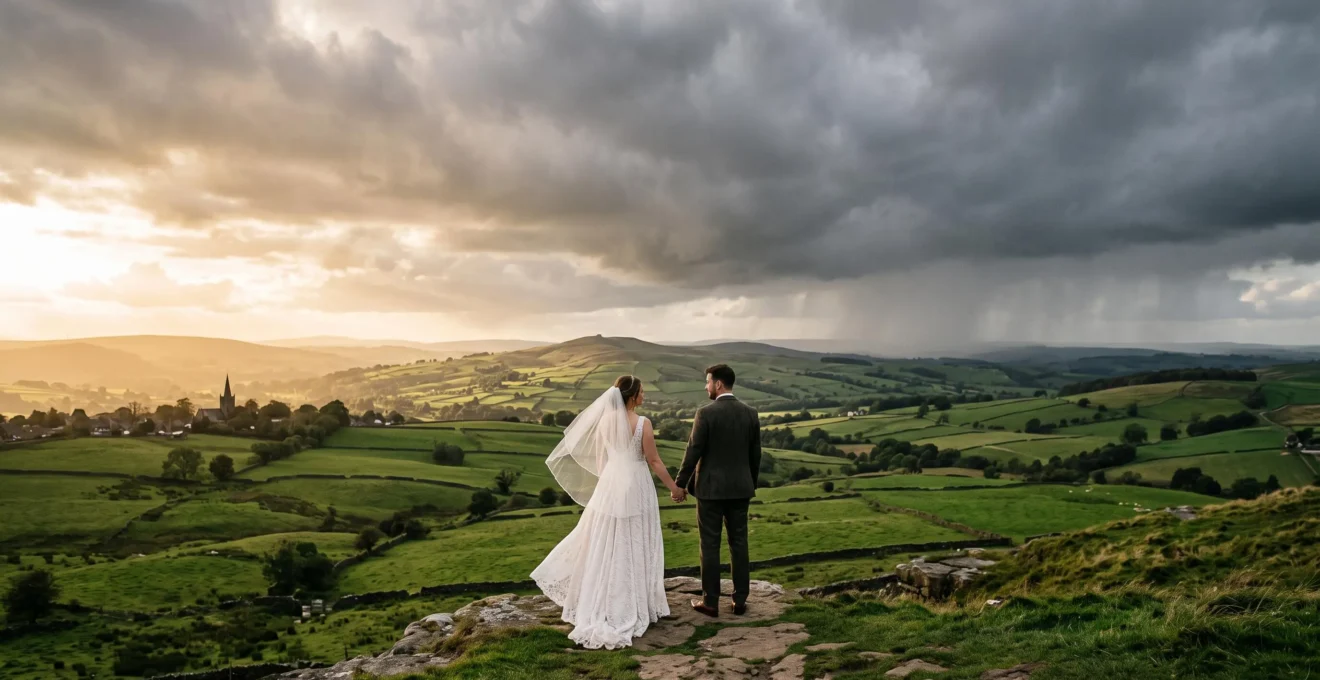
You’ve mastered the weather, you’ve found the perfect location—now for the final, crucial step: creating a portrait that harmonizes the couple with the landscape. The common mistake is to be so awestruck by a dramatic view that the couple becomes a tiny, insignificant part of the frame. The goal is not just to place two people in a landscape, but to create a connection between their story and the environment. The landscape should feel like an extension of their emotion, not a backdrop that dwarfs them.
This starts with your choice of lens and composition. While a wide-angle lens is tempting for capturing the scale of a vast landscape, it can also push your subjects away and distort their proportions. Often, a longer lens (like an 85mm or 70-200mm) is more effective. By stepping back and using a longer focal length, you can compress the background, making the distant hills or stormy sky feel larger and more present behind the couple, without diminishing them. Use compositional rules like the rule of thirds to place the couple off-centre, allowing their gaze to lead the viewer’s eye into the expansive view.
The weather is famously changeable and often overcast, but experienced photographers treat the soft, diffused light as an advantage.
– THE WED editorial team, THE WED, UK wedding photographer directory
Light is your most powerful tool for integration. In the unpredictable British weather, you’ll often be working with soft, diffused light from an overcast sky. As many editors note, this is a significant advantage. This light wraps around your subjects beautifully, eliminating harsh shadows and allowing the rich colours of the landscape to come through. For golden hour, position the couple so the low, warm sun acts as a rim light, separating them from the background and connecting them to the ambient glow of the scene. Even rain can be used to create connection, with reflections in puddles linking the couple to their environment.
Ultimately, the connection is emotional. Direct the couple to interact with each other rather than staring at the camera. A quiet moment looking out at the view together, a gentle touch, or an embrace—these are the actions that create a narrative. Their intimate connection becomes the focal point, and the grand landscape serves as the theatre for their personal story. It is in this balance that a good landscape portrait becomes an unforgettable wedding photograph.
By shifting your mindset from weather-avoider to climate-strategist, you transform the UK’s greatest photographic challenge into your most powerful creative ally. Start building your climate intelligence today to deliver consistently breathtaking results, come rain or shine.
Frequently Asked Questions on British Wedding Weather Photography
What is the rainiest month in the UK for weddings?
Contrary to popular belief, summer months are not the driest. While this can vary by region, data often shows that August is one of the rainiest months on average, sometimes receiving more rainfall than June or July. This underscores the need for photographers to be prepared for rain at any wedding, regardless of the season.
How do you take good wedding photos in the rain?
The key is preparation and creativity. Use professional rain covers for your gear, lens hoods to block drops, and plenty of microfibre cloths. Creatively, use the rain as an asset: use off-camera flash to backlight raindrops and make them sparkle, focus on reflections in puddles for unique compositions, and embrace the soft, diffused light that overcast skies provide for flattering portraits.