
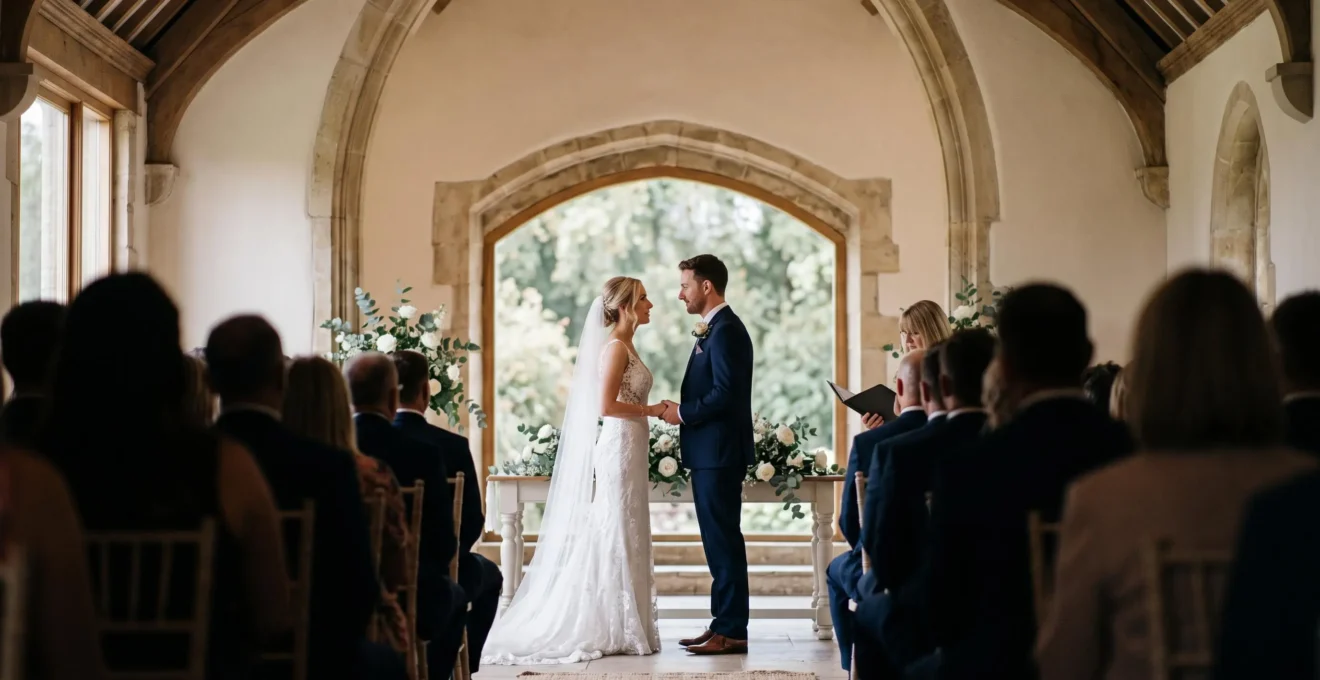
Capturing emotionally intimate vow photos from a distance is less about the lens you use and more about mastering the predictive art of reading emotion before it peaks.
- True intimacy is found in fleeting micro-expressions, which require anticipation, not just reaction.
- The most powerful shots often capture the listener’s reaction, a detail missed by focusing only on the speaker.
Recommendation: Shift your mindset from being a passive documentarian to a strategic orchestrator who predicts emotional beats by watching facial cues and listening for vocal shifts.
For the wedding photographer bound by strict ceremony rules, the vow exchange presents a profound paradox. You are tasked with capturing one of the most intimate moments of a couple’s life, yet you are often relegated to the back of the room, a silent observer separated by a sea of guests and the celebrant’s clear instructions to remain unseen and unheard. The common advice is simple: use a long lens. But every seasoned photographer knows that a 70-200mm lens, while essential for bridging physical distance, does little to bridge the *emotional* distance. It can frame a face, but it cannot, by itself, capture the soul of the moment.
The real challenge isn’t technical; it’s interpretive. It’s about transforming from a photographer into a silent interpreter of human connection. The goal isn’t just to document two people speaking; it’s to photograph a sacred conversation, capturing the unspoken words, the shared glances, and the fleeting expressions that tell the true story. This guide moves beyond the generic advice. It won’t just tell you which lens to use. Instead, it will provide a strategic framework for seeing, anticipating, and capturing the profound intimacy of wedding vows, turning your restricted position from a limitation into a source of focused, powerful storytelling.
This article provides a deep dive into the strategies that transform technically challenging vow photography into emotionally resonant art. We will explore the mindset, the techniques, and the subtle cues that allow you to capture treasured images, no matter your distance from the altar.
Summary: How to Photograph Ceremony Vows With Emotional Intimacy Despite Distance and Technical Constraints
- Why Ceremony Vow Photos Become the Most Treasured Images Despite Being Technically Challengallenging to Capture
- How to Capture Intimate Vow Expressions With 200mm+ Lenses From Restricted Photographer Positions
- Listening to Vow Content or Watching Facial Cues: Which Predicts Emotional Peaks During Ceremony Readings
- The One-Sided Mistake of Photographing Only the Speaking Person During Vows and Missing Reactions
- When to Shoot Through Foreground Obstructions During Vows Rather Than Waiting for Clear Sightlines
- How to Capture Intimate Emotional Moments With 135mm+ Lenses Without Feeling Distant or Detached
- Continuous Burst Mode or Single Decisive Release: Which Captures Better Micro-Expressions During Wedding Vows
- How to Recognise and Capture Micro-Expressions That Reveal True Emotion in Wedding Photography
Why Ceremony Vow Photos Become the Most Treasured Images Despite Being Technically Challenging to Capture
Long after the flowers have faded and the cake is gone, the photographs remain. Yet, not all images carry the same weight. While beautifully styled portraits have their place, the photos that couples return to year after year are almost always the unscripted, emotionally charged moments. The vow exchange is the absolute epicentre of this authenticity. It is a rare, unguarded window into a couple’s connection, where carefully chosen words become the soundtrack to a series of powerfully revealing expressions.
These images are treasured precisely because they are not for an audience; they are of a private moment happening in public. The slight tremble of a lip, a single tear escaping, the crinkle of eyes in a smile that fights to contain overwhelming joy—these are the details that formal portraits can never replicate. They are visual evidence of the promises made and the emotions felt. This is why mastering their capture is not just a technical exercise but a core responsibility of a wedding photographer.
Years from now, the images you’ll reach for again and again won’t be the stiff formal line-ups — they’ll be the tear on your father’s cheek, the grin you exchanged before the first dance, the tiny hand squeezing yours. Preparation, gentle prompting, and trusting your photographer help ensure these genuine scenes are preserved naturally, and the most treasured images often happen unplanned, reflecting true connection and vulnerability.
– Why unplanned emotional images become the most treasured wedding photos
The technical difficulty—the distance, the low light, the strict rules of movement—only adds to their value. A perfectly captured vow photo is a testament to the photographer’s skill, not just in operating a camera, but in understanding and anticipating human emotion. It demonstrates an ability to see beyond the logistical challenges and find the story within. It is this combination of raw emotion and photographic skill that elevates these images from mere documentation to cherished heirlooms.
How to Capture Intimate Vow Expressions With 200mm+ Lenses From Restricted Photographer Positions
When you’re positioned at the back of a church or the far end of an outdoor aisle, a telephoto lens in the 70-200mm range (or longer) is not a luxury; it’s a necessity. It is your primary tool for bridging the physical gap between you and the couple. However, simply zooming in is not a strategy. The real art lies in using the properties of the lens to create intimacy, not just magnification. The goal is to make the viewer feel like they are sharing a private moment, not looking through a telescope.
One of the key advantages of a long focal length is lens compression. This effect makes the background appear closer to the subject, which can be used to isolate the couple from distracting elements and create a beautifully blurred backdrop. Shooting at a wide aperture (like f/2.8 or f/4) at 200mm will render the background into a soft wash of colour and light, forcing the viewer’s attention directly onto the couple’s faces and their subtle interactions. This transforms a potentially busy scene into an intimate portrait.
Professional Workflow: Using a 70-200mm to ‘Touch’ the Ceremony from a Distance
A professional workflow analysis highlights the 70-200mm as indispensable for ceremony coverage. As one working photographer describes it, the lens is highly effective for capturing wedding ceremonies, allowing the photographer to maintain a respectful distance while still achieving intimate shots. It’s considered ideal for capturing candid moments from afar without disrupting the sacredness of the scene. This approach demonstrates how a restricted position can be strategically turned into an asset, using the lens’s properties to enhance the feeling of intimacy rather than diminish it.
Your positioning, even when restricted, must be strategic. Instead of standing directly in the centre of the aisle, try moving slightly to the left or right. This creates a more dynamic, three-quarter angle on the couple’s faces, revealing more of their expressions than a flat, head-on shot. From this off-axis position, you can capture the delicate interplay of a glance, a smile, or a tear on the curve of a cheek. You are using the distance not as a handicap, but as an opportunity to find the perfect, unobtrusive vantage point.
Listening to Vow Content or Watching Facial Cues: Which Predicts Emotional Peaks During Ceremony Readings
From your distant position, you have two primary streams of information: what you hear and what you see. Most photographers instinctively listen to the words of the vows, waiting for a poignant phrase to trigger a shutter press. This is a reactive approach, and it often means you’re already too late. The emotion has peaked and is receding by the time the words register. The strategic professional knows that the truer predictor of a photographable moment is not the words themselves, but the subtle facial cues that precede them.
The key is to become a student of body language. Before a person speaks an emotional line, their face will betray them. Watch for a slight intake of breath, a tightening of the jaw, or a glistening in the eyes. These are the tells. As the Tower Studios Photography Team notes, “Before a word is spoken, emotions are often communicated through eye contact alone.” These non-verbal signals are your early warning system. By focusing on the speaker’s face *before* and *during* their delivery, you shift from reacting to the past (the spoken word) to anticipating the future (the emotional peak).
This doesn’t mean ignoring the audio cues. The *cadence* of the vows is just as important as the content. People often pause unconsciously before delivering a line that carries significant personal weight. Listen for these hesitations. A pause is a coiled spring of emotion. Train your ear to recognize these shifts in rhythm and your eye to watch for the corresponding facial change. The most powerful combination is a vocal pause followed by a visible emotional shift—that is your golden moment to shoot.
Your Pre-Ceremony Cue-Mapping Checklist
- Consult the Officiant: Talk with the officiant before the ceremony. Your goal is to get a solid understanding of the sequence of events and the overall flow.
- Ask for a “Trigger Phrase”: Ask the officiant for a specific phrase they will say just before key moments like the vows or ring exchange. This gives your team a clear signal to get into position.
- Note the Reading Rhythm: During a rehearsal or briefing, pay close attention to the natural rhythm and pauses in any readings to anticipate moments that often precede emotional peaks.
- Brief Your Second Shooter: If you have a team, ensure everyone is aware of these same audio and visual cues so that multiple angles are covered and ready for the peak moment.
The One-Sided Mistake of Photographing Only the Speaking Person During Vows and Missing Reactions
One of the most common and costly mistakes in ceremony photography is becoming fixated on the person delivering the vows. While their emotion is important, it’s only half of the conversation. The vows are a dialogue, and the listener’s reaction is often the more powerful and revealing part of the story. A tear rolling down a cheek, a sudden wide-eyed grin, a hand brought to the mouth in surprise—these are the unscripted, unfiltered responses that give the moment its depth and context.
Your coverage must be a dynamic dance between speaker and listener. Don’t lock your focus on one person. As soon as the speaker begins a sentence, your mind should be on the listener. Your goal is to capture the *impact* of the words, not just their delivery. This requires you to be constantly scanning, ready to pivot your lens in a fraction of a second. A powerful technique is to shoot a tight shot of the speaker, and then immediately zoom out slightly or re-frame to include the listener’s face or their hands clenching.
Real Ceremony Case: Capturing an Unplanned Reaction
The importance of this dual focus is perfectly illustrated in a real-world scenario. A wedding photographer recounts a fast-moving ceremony where he was focused on the registrar. The bride reacted with pure joy before the shot was fully composed, forcing the photographer to fire off a few quick frames to catch her expression. This example highlights why constantly scanning both parties is essential; had the photographer been locked onto the speaker, the most poignant image of that moment—the reaction—would have been missed entirely.
To avoid one-sided coverage, create a mental checklist for compositional variety. During each person’s vows, aim to capture:
- A tight shot of the speaker’s face.
- A tight shot of the listener’s face.
- A shot of their clasped hands.
- A wider shot that includes both partners in the frame, showing their interaction.
- A quick scan of the immediate family for secondary reactions.
This systematic approach ensures you are telling the complete story of the vow exchange, not just one person’s monologue.
When to Shoot Through Foreground Obstructions During Vows Rather Than Waiting for Clear Sightlines
The conventional wisdom for photographers is to seek a clear, unobstructed view of the subject. In the context of a restricted ceremony, however, this is often impossible. But rather than seeing guests’ heads, floral arrangements, or candle stands as frustrating obstacles, a strategic photographer can transform them into powerful compositional tools. Shooting *through* a foreground element can create a profound sense of intimacy and voyeurism, as if the viewer is getting a secret, stolen glimpse of a private moment.
The technique works by using a wide aperture (e.g., f/1.8 – f/2.8) to render the foreground element into a soft, abstract blur of colour and shape. This frames the couple in the distance, who remain in sharp focus. The blurred foreground communicates to the viewer that they are not at the altar; they are observing from afar, which paradoxically makes the moment feel more private and authentic. A shoulder of a guest, the edge of a pew, or the soft petals of a floral display can all be used to add layers and depth to your composition.
This is not a technique to be used constantly, but a powerful tool to deploy when a clear shot is unavailable or when you want to add a specific emotional tone to an image. It’s particularly effective during the most emotional parts of the vows. The soft frame around the couple can feel like a protective bubble, enhancing the sense that they are in their own world. This approach requires confidence. You must intentionally place an “obstruction” in your frame, trusting that it will add to the story rather than detract from it. It’s a move that separates the documentarian from the visual artist.
How to Capture Intimate Emotional Moments With 135mm+ Lenses Without Feeling Distant or Detached
Using a long lens like a 135mm or 200mm is a technical necessity from the back of a venue, but it comes with a creative risk: detachment. An image can feel cold or clinical if the technology used to capture it is too apparent. The challenge, then, is to use these tools of distance to create a feeling of closeness. This is achieved not just through technical settings, but through a photographer’s intentionality and understanding of human perception.
The flattering properties of telephoto lenses are a significant asset. As the SLR Lounge editorial team notes, telephoto lenses in the 85mm to 200mm range naturally compress features in a way that is highly flattering for portraits. This same principle applies to candid moments. The compression and shallow depth of field help to isolate the subject, creating a portrait-like quality even from a distance. By focusing intently on the eyes and letting everything else fall into a soft blur, you guide the viewer’s attention directly to the source of the emotion. The image feels intimate because it directs the viewer to look at the one thing that matters most.
The feeling of intimacy is also a product of timing. It’s about capturing not just a face, but a fleeting moment of connection. A shared glance between the couple, a hand squeezing a little tighter, a smile that appears only for a second. These are the moments that bridge the distance. Your job as the photographer at the back is to be a patient hunter of these micro-moments. You are not just taking pictures; you are waiting for the precise instant that the emotional connection between the couple becomes visible.
Telephoto Case Study: Feeling Present While Photographing from a Respectful Distance
As a professional photography team explains, there’s immense value in using a telephoto lens to zoom in on emotions, even when you have permission to be closer. They emphasize that wedding ceremonies are sacred events, and their primary goal is to capture the best images possible without being disruptive. This mindset is key: the lens isn’t for spying, but for participating in the emotional landscape of the day from a position of respect. The feeling of presence in the final image comes from the photographer’s focused emotional intent, not their physical proximity.
Continuous Burst Mode or Single Decisive Release: Which Captures Better Micro-Expressions During Wedding Vows
The debate between using continuous high-speed burst mode versus timing a single, decisive shot is central to capturing fleeting emotions. The “spray and pray” approach of holding down the shutter button can feel like a safety net, ensuring you don’t miss *something*. However, it often results in a mountain of near-identical frames to sift through and can paradoxically cause you to miss the true peak moment because you’re focused on shooting rather than observing.
The single, decisive release, in the tradition of Henri Cartier-Bresson’s “decisive moment,” is an act of confidence and anticipation. It requires you to have done the work of watching, listening, and predicting. When you press the shutter once, at the perfect instant, it’s because you knew the moment was coming. This approach often yields a stronger, more intentional photograph. However, the sheer unpredictability of human emotion means that even the best prediction can be off by a fraction of a second.
Therefore, the most effective strategy is not to choose one method, but to employ a hybrid approach. The answer isn’t burst vs. single; it’s about using the *right tool for the situation*.
- Use Single Shots for Anticipated Moments: When you see the emotion building—the quivering lip, the deep breath—prepare for a single, well-timed shot. This is for the moments you can predict.
- Use Short, Controlled Bursts for Unpredictable Reactions: When one person says something funny or deeply moving, the listener’s reaction can be a rapid cascade of expressions. A short burst of 2-3 frames here is not “spraying and praying”; it’s a strategic tool to capture the evolution of an expression from surprise to joy to tears in under a second.
Real Ceremony Case Study: The Unpredictability of Emotion
A veteran wedding photographer emphasizes this point, noting that no one can truly predict how a couple will feel or react on their wedding day. He observes that even the most stoic individuals can, and often do, break down in tears when the moment arrives. It is this inherent unpredictability that makes a hybrid single-shot and short-burst strategy so vital. Committing entirely to one method is a gamble; using both is a professional strategy that protects against missing the peak micro-expression, no matter when or how it appears.
Key Takeaways
- Anticipate, Don’t React: The best vow photos are captured by predicting emotional peaks through facial cues and vocal cadence, not by reacting to spoken words.
- Tell the Whole Story: Avoid the one-sided mistake. Your coverage must be a dynamic dance between the speaker’s delivery and, more importantly, the listener’s reaction.
- Use Distance Creatively: A long lens bridges physical distance, but strategic composition—isolating subjects, using compression, and even shooting through foregrounds—bridges the emotional distance.
How to Recognise and Capture Micro-Expressions That Reveal True Emotion in Wedding Photography
We have discussed strategies for positioning, listening, and framing. We have debated capture techniques. But all these elements serve a single purpose: to capture the truest possible emotion. And the purest form of this emotion is found in micro-expressions. These are the rapid, involuntary facial movements that reveal a person’s genuine feelings, often before they are even consciously aware of them. For the wedding photographer, developing literacy in micro-expressions is the final frontier of emotional storytelling.
Unlike a sustained smile or a posed look, micro-expressions are impossible to fake. Research on facial recognition confirms that micro-expressions are unconscious facial reactions that cannot be deliberately disguised. They are fleeting, often lasting for less than 0.5 seconds, which is why a reactive approach to photography will always miss them. They include subtle movements like a slight quiver of the chin, a momentary furrowing of the brow, a quick flash of surprise in the eyes, or a tiny, unilateral lift of a lip corner into a smirk of pure joy.
Recognizing these signals is a skill that requires intense, dedicated observation. It means you stop looking for the big, obvious “cry shot” and start looking for the tiny tells that precede it. You watch the space around the eyes for the tell-tale crinkling of a Duchenne smile (a genuine smile). You watch the corners of the mouth for a downward pull of sadness or an upward twitch of amusement. These are the building blocks of the larger emotional moments.
Micro-expressions are hidden emotions derived by the neural system and expressed in as little as 0.25 seconds, described as ‘involuntary emotional leakage’ that exposes a person’s genuine emotions.
– Paul Ekman, The Eyes Have It!: Using Human-Selected Features for Predicting Athletes’ Performance
Capturing them requires you to be in a state of predictive readiness. With your camera settings locked in and your composition framed, your entire focus is on the face in your viewfinder. You are not waiting for a word; you are waiting for a twitch. When you see it, you fire your short, controlled burst. This is the culmination of all the strategies: using your distant position to achieve a tight, isolated frame that allows you to see nothing but the landscape of the human face, and using your knowledge of human emotion to capture its most honest and fleeting truths.
The ultimate goal is to move beyond simply documenting the event. By applying these strategies, your next step is to consciously practice this art of anticipation at your next ceremony, transforming your role from a photographer at a distance to an intimate storyteller.