
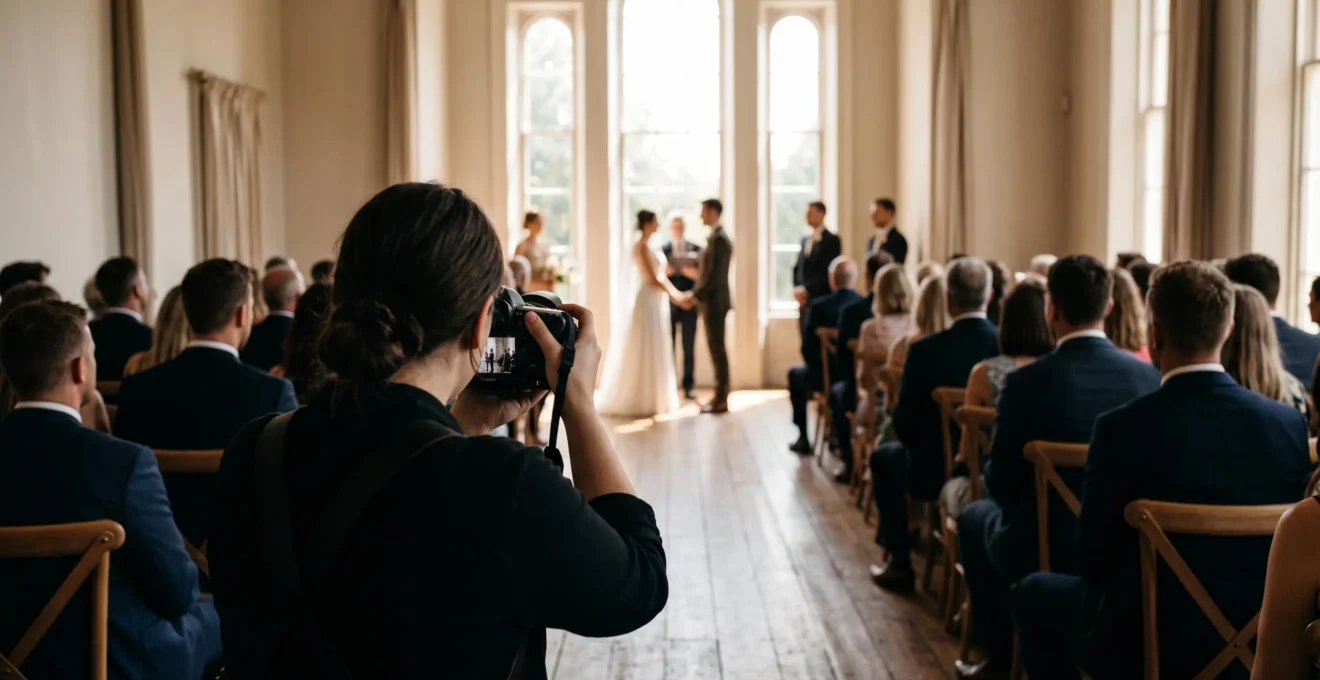
The true purpose of wedding photography is not technical image creation but the profound responsibility of serving as a family’s cultural archivist and relational storyteller.
- This role demands a shift from being a passive observer to an empathic witness, capturing the entire emotional ecosystem of the day.
- Success lies in abandoning templated shot lists to document the unique, unrepeatable moments that form a generational legacy.
Recommendation: Begin every wedding not by asking “What shots do you want?” but by asking “What relationships and traditions are most important to document for the future?”
If you’re a wedding photographer, you’ve likely spent countless hours mastering your craft. You know your camera inside and out, you understand light, and you can compose a beautiful portrait under pressure. We are taught that technical excellence is the goal. But what if the relentless pursuit of the “perfect shot” causes us to miss the point entirely? The industry is filled with advice to “capture real moments” and “tell the story of the day,” but these phrases have become hollow platitudes. They don’t address the profound weight and purpose of our work.
The true evolution of your artistry and your business begins when you shift your perspective. It’s about moving beyond the role of a service provider who creates images and embracing the responsibility of a cultural archivist who preserves legacies. This isn’t about abandoning your hard-won technical skills; it’s about channeling them toward a deeper purpose. It’s the difference between documenting an event and capturing a piece of anthropology, between photographing two people and mapping an entire family’s emotional ecosystem at a singular moment in time. This is the transition from technician to storyteller.
This guide offers a philosophical framework for that transition. We will explore why our work is more akin to anthropological preservation than simple portraiture. We will dismantle the idea of the photographer as a passive observer and rebuild it as an empathic participant. By understanding the profound responsibility we carry, we can finally move beyond the checklist and begin creating work that is not just beautiful, but truly meaningful and irreplaceable for generations to come.
This article is structured to guide you through this philosophical shift, moving from the ‘why’ to the ‘how.’ The following sections break down the core responsibilities and mindset adjustments needed to elevate your work from technical execution to holistic documentation.
Summary: A Guide to Wedding Photography’s Deeper Purpose
- Why Wedding Photography Serves Anthropological Cultural Preservation Beyond Personal Memory
- How to Balance Artistic Vision With Documentary Responsibility to Photograph All Family Connections
- How Wedding Photographers Should Engage as Celebration Participants Rather Than External Observers
- The Template Approach That Treats All Wedding Celebrations as Identical Events
- Why Wedding Photographers Should Feel Privileged to Witness Life’s Most Joyful Celebrations
- Why Wedding Photography Carries Heavier Responsibility Than Commercial, Portrait or Event Photography
- Why Ceremony Vow Photos Become the Most Treasured Images Despite Being Technically Challenging to Capture
- The Profound Responsibility of Photographing Irreplaceable Unrepeatable Wedding Moments
Why Wedding Photography Serves Anthropological Cultural Preservation Beyond Personal Memory
We often think of wedding photos as personal mementos for the couple. This is a limited view. In reality, we are acting as cultural archivists, documenting a significant human ritual that transcends the individuals involved. A wedding is a convergence of family histories, cultural traditions, and social bonds. The images we create are not just for the couple’s album; they are historical records for future generations. They answer the questions a great-grandchild might have: “What did our family look like? How did they celebrate? What did joy look like for them?” This perspective elevates our work from a commercial service to an anthropological act.
This isn’t a niche, localized practice; it’s a global phenomenon. An analysis of the worldwide market shows that the Asia-Pacific region alone drives over a third of the global wedding photography market, demonstrating how deeply ingrained this form of documentation is across diverse cultures. Each wedding, whether it follows ancient traditions or forges new ones, is a data point in the story of a family and its culture. Your photographs become primary source documents for that family’s history.
Embracing this role changes everything. It means the photograph of a grandparent’s hands, the shared laugh between cousins, or the specific details of a cultural ceremony are just as important as the perfectly lit portrait of the couple. As veteran documentary photographer Kevin Mullins notes after a career spanning hundreds of weddings:
It has been my privilege to tell over 800 wedding stories.
– Kevin Mullins, Kevin Mullins Photography — The Documentary Wedding Photographer’s Approach
This “privilege” comes from understanding that you are not just taking pictures. You are entrusted with capturing a piece of living history, creating a generational artifact that will gain value and significance long after the wedding day is over.
How to Balance Artistic Vision With Documentary Responsibility to Photograph All Family Connections
Many photographers are torn between two poles: creating their signature “artistic” shots and fulfilling the documentary duty of capturing everything. The holistic approach argues this is a false dichotomy. Your artistic vision should serve the documentary responsibility, not compete with it. This means moving beyond a focus on the couple as isolated subjects and beginning the work of relational cartography: mapping the entire web of connections present on the day.
The real story of a wedding is not just “two people got married.” It’s about the merging of two families, the reunion of old friends, and the complex emotional ecosystem that surrounds the central event. As one insightful analysis explains, true documentary work captures this full picture: it tells the story of “the relationships between people that aren’t the couple. A grandmother at the reception table… these are the frames that make a gallery feel lived-in rather than curated.” Your camera should be looking for these subplots, these quiet but powerful interactions that give the main story its depth and context.
Happily, clients are evolving in this direction as well. There is a growing trend where 2026 couples are requesting shorter lists of must-have family portraits, placing more trust in the photographer to capture the day authentically. They want fewer stiff lineups and more genuine moments. This doesn’t mean abandoning artistry. On the contrary, it’s about applying your unique eye to these candid moments. As photographer Masha Sakhno describes the trend, “Fashion and documentary are blending in fascinating ways… Think candid moments captured through an editorial lens — art direction without stiffness.” This is the sweet spot: using your artistic skills to elevate the reality of the moment, not to fabricate a new one.
How Wedding Photographers Should Engage as Celebration Participants Rather Than External Observers
The old guard of documentary photography often championed the idea of the invisible photographer, “a fly on the wall.” The philosophy, as described by many, is that “the photographer works as an observer, close to the action, as unseen as possible.” Another practitioner notes, “The photographer becomes an observer first and a director almost never.” While this hands-off approach is a vast improvement over intrusive, stage-managed photography, it still positions the photographer as an outsider, a detached extractor of images.
A more profound and effective approach is to evolve from a passive observer to an empathic witness. This doesn’t mean becoming the life of the party or inserting yourself into the action. It means allowing yourself to be emotionally present. It’s about cultivating an attuned presence where guests feel you are part of the celebration’s positive energy, not a voyeur. When you are perceived as a warm, respectful presence, people relax. They forget you are “the photographer” and see you as someone who is sharing in the significance of the day. It is in this state of shared emotion that the most authentic and vulnerable moments unfold.
Look at the interaction in this scene. This is not a “fly on the wall.” This is a human being connecting with other human beings during a peak emotional moment. By lowering the camera and sharing a genuine reaction, this photographer has built a bridge of trust. The guests no longer see a lens; they see a fellow participant who is just as moved as they are. This empathetic connection is what grants you access to the truly intimate moments that a detached observer will always miss. You are not there to simply see; you are there to feel with the family, and your images will be infinitely richer for it.
The Template Approach That Treats All Wedding Celebrations as Identical Events
The single greatest enemy of meaningful wedding photography is the template. The moment we start thinking in terms of a standardized shot list—”the dress hanging in the window,” “the ring on the bible,” “the jumping groomsmen”—we stop seeing the unique reality in front of us. We are no longer documenting a specific couple’s story; we are forcing their day into a pre-conceived mold of what a wedding “should” look like. This is not only a creative failure but also a disservice to the client.
The market itself is rejecting this approach. Data shows that candid photography now dominates the wedding photography style segment, capturing over 40% of the market. Clients are actively seeking photographers who can capture the authentic, unscripted nature of their day, not a generic facsimile. As photographer Greg Thomas powerfully states, the philosophy should be clear from the start: “This is your wedding day, not my photoshoot. You don’t have to perform.” This simple phrase liberates the couple and their guests, giving them permission to be fully present in their own celebration, which is the very essence of documentary work.
To break free from the template, we must train our eyes to see beyond the obvious. Instead of hunting for the “big” moments from a shot list, we must become attuned to the small, sensory details that make this day unique. Look at the texture of a dress, the way two hands rest together, the steam rising from a traditional dish, a few scattered grains of rice on a table. These close-up, textural shots tell a deeper, more intimate story than any staged portrait. They are the visual poetry of the day, the details that evoke memory and feeling. They are, by their very nature, un-template-able. By focusing on these unique fingerprints, we ensure that every wedding gallery is as unique as the celebration itself.
Why Wedding Photographers Should Feel Privileged to Witness Life’s Most Joyful Celebrations
In a world often saturated with cynicism, the wedding photographer is granted a rare and precious front-row seat to unadulterated joy, commitment, and hope. This is not a small thing. To be invited into one of the most significant and intimate days in a family’s life is an immense privilege. It’s a role that carries the weight of a journalist and the heart of a poet. As former photojournalist Greg Thomas reflects on his transition to weddings: “For 20 years, I was a photojournalist; I spent two decades in the military learning to pay attention, to find the truth in a moment, and to capture it before it disappeared.” We are truth-finders in the midst of celebration.
This sense of privilege is the fuel that sustains a long and fulfilling career. It’s what prevents burnout. One photographer, reflecting on two decades in the industry, notes, “After twenty years photographing weddings… I’ve developed an instinct for the rhythm of booking season.” That instinct and longevity are not built on technical skill alone; they are built on a deep appreciation for the vicarious joy the job provides. You are professionally required to surround yourself with people on the best day of their lives. This recurring exposure to peak human happiness is a unique and powerful perk of the profession.
This is not just a philosophical or emotional reward. The market recognizes and values the immense skill and trust required for this work. According to a 2024 Zenfolio report surveying over 7,600 professionals, self-employed wedding photographers ranked among the highest earners in the industry. This financial viability is a direct reflection of the value clients place on having a skilled, trustworthy professional to steward the memory of their most important day. The privilege is twofold: the emotional privilege of witnessing joy and the professional privilege of being compensated for a responsibility well-shouldered.
Why Wedding Photography Carries Heavier Responsibility Than Commercial, Portrait or Event Photography
A commercial shoot can be redone. A portrait session can be rescheduled. A corporate event has a certain level of documentation, but its emotional stakes are comparatively low. A wedding, however, is a singular, unrepeatable event. There are no do-overs. This fundamental truth places a weight of responsibility on the wedding photographer that is unlike almost any other genre of the craft. The trust placed in us is nearly universal; data from The Knot Worldwide’s 2024 report indicates that professional photographers are engaged by nearly nine in ten couples. We are not an optional accessory; we are considered an essential component of the day.
This responsibility is magnified by the fact that the work is not for the present moment alone. We are creating what will become a family’s primary visual heirloom. As Kevin Mullins articulates, the true client is the future: “I know that the children, grandchildren, and great-grandchildren will have real moments of real people to look back on in celebration of the day.” We are creating for an audience that hasn’t been born yet. This generational responsibility is a profound weight that a commercial photographer, focused on the next quarter’s sales, simply does not carry.
The stakes are further raised by an increasingly competitive market. Between 2014 and 2024, the number of photography businesses in the US grew by 51%, while the number of weddings remained flat. This means that for every wedding, there are more photographers competing for the job. In this environment, technical competence is merely the price of entry. The photographers who thrive are those who understand and deliver on this deeper responsibility. The pressure is on not just to take good photos, but to create a meaningful, irreplaceable generational artifact that justifies the immense trust—and investment—the couple has placed in you.
Why Ceremony Vow Photos Become the Most Treasured Images Despite Being Technically Challenging to Capture
The wedding ceremony, and specifically the exchange of vows, is the heart of the entire day. It is the moment when the celebration’s purpose is made explicit. All the planning, expense, and gathering of people culminate in this public proclamation. Capturing this moment is notoriously difficult: lighting is often poor, movement is restricted, and the emotional pressure is immense. Yet, the images from these few minutes consistently become the most treasured of the entire collection. They are the visual anchor of the couple’s commitment, the frozen frame of the promise.
The immense value placed on this moment is proven by the rising demand for video. Data shows that videography is growing, with 68% of couples now hiring a professional videographer, up from 57% just five years ago. The primary driver for this is the desire to capture the audio and motion of the vows and speeches. This trend doesn’t diminish the role of the still photograph; it magnifies it. While video captures the linear flow of the moment, the still photograph has the unique power to distill its entire emotional essence into a single, iconic image. It is the definitive artifact of the promise.
Consider the scene. From the back of the room, we witness a public act unfolding in a space filled with loved ones. Yet, within that public space, an intensely private moment is occurring between two people. Our job is to capture both the grand scale and the intimate detail simultaneously. These images are treasured because they operate on multiple levels: they are proof of a public legal and social commitment, and they are a window into a deeply personal emotional exchange. They are the apex of the story we are there to tell.
Key Takeaways
- Shift your identity from “image creator” to “cultural archivist”; you are documenting history, not just an event.
- Your artistic vision should serve a documentary purpose, focusing on the web of family relationships, not just the couple.
- The most profound responsibility is capturing the singular, unrepeatable moments that will become a family’s visual legacy.
The Profound Responsibility of Photographing Irreplaceable Unrepeatable Wedding Moments
We’ve established the philosophical underpinnings: we are cultural archivists, relational cartographers, and empathic witnesses. Now we must confront the raw reality of the job: every key moment is a one-take-only opportunity. The tear that falls during a father’s speech, the spontaneous embrace between a grandmother and her grandson, the look on the groom’s face as the bride appears—these moments are fleeting, unscripted, and absolutely irreplaceable. This is the profound and terrifying responsibility of our work.
This responsibility demands a state of hyper-awareness and anticipation. It’s not passive waiting; it’s an active search. As photographer Robin Goodlad describes it, “Documentary wedding photography is about waiting, anticipation, actively seeking the moments. Often this only comes with the experience and instinct of knowing what is likely to happen, and when.” This is a skill honed over hundreds of hours of observation. It’s about knowing when to be in the right place, understanding the flow of human emotion, and being ready to capture a moment that may last only a fraction of a second.
The consequences of failing to capture these moments are significant. Across multiple surveys, a consistent theme emerges: couples who did not book a videographer commonly say afterward that they wish they had captured moving footage of vows and speeches. This regret is a powerful indicator of the value placed on these irreplaceable moments. While we are still photographers, this data speaks directly to our role. It is our job to ensure that our clients never feel that regret about their still images. We are their insurance against the fading of memory.
Your Pre-Ceremony Attunement Checklist: Preparing for the Irreplaceable
- Review the Relational Map: Re-read your notes. Who are the key family members (grandparents, siblings, estranged relatives)? Remind yourself of the important dynamics you need to document.
- Anticipate Emotional Peaks: Visualize the ceremony timeline. Identify the likely emotional flashpoints: the walk down the aisle, the exchange of rings, personal vows. Plan your position and lens choice for each.
- Perform a Sensory Check-in: Just before the ceremony begins, stop. Listen to the music. Observe the light. Feel the energy of the room. Attune your senses to the environment to heighten your awareness.
- Silence the Technical Brain: Your camera settings should be second nature by now. Trust your preparation. Shift your focus from f-stops to faces, from histograms to heartbeats. Your job now is to see, not to calculate.
- Commit to Witnessing: Make a conscious decision to be fully present. Put your phone away. Don’t think about your next booking. Be there, with the family, as an empathic witness ready to receive and preserve the moments as they come.
Ultimately, embracing this profound responsibility is not a burden; it is the source of the job’s deepest satisfaction. It transforms the work from a series of technical tasks into a meaningful quest to preserve human connection.
By adopting this holistic philosophy, you move beyond being just another photographer. You become an indispensable part of a family’s history, the trusted steward of their most precious memories. Your next step is to integrate this mindset into every client interaction, every shutter click, and every gallery you deliver.