
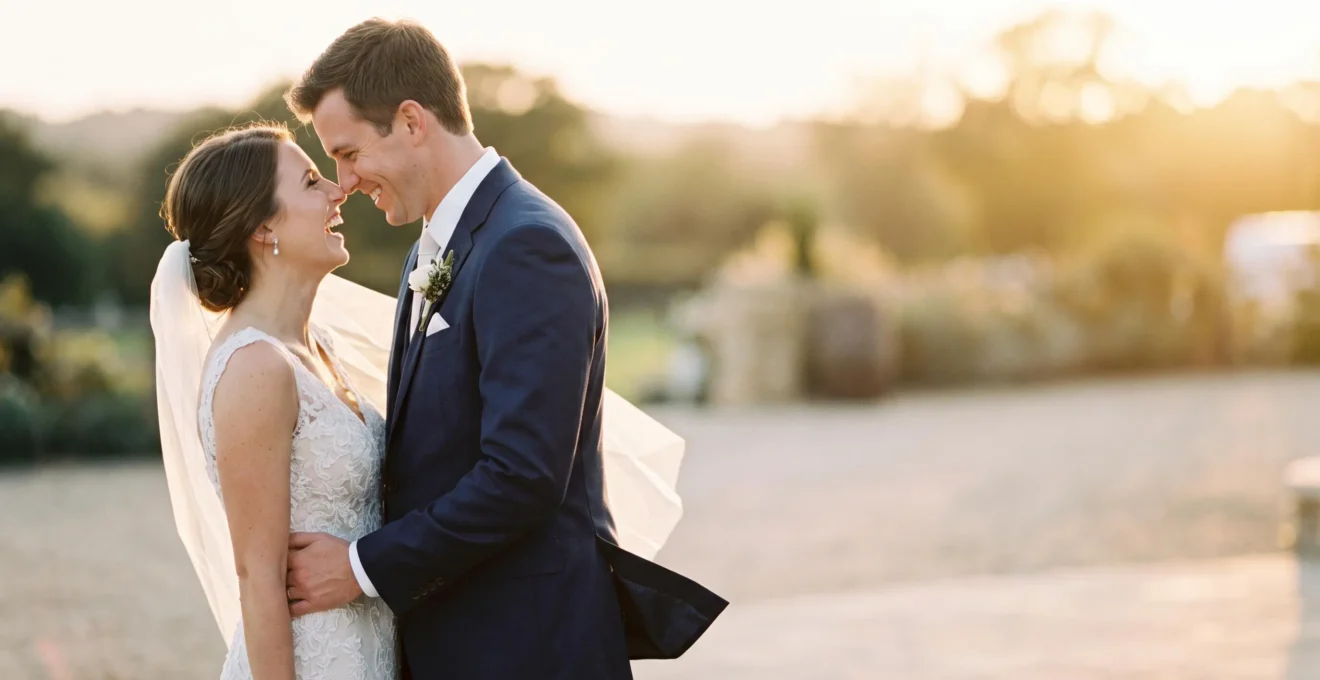
The greatest myth in portraiture is that glamour and authenticity are opposites; in reality, true editorial glamour is the art of meticulously engineering the conditions for authentic connection to flourish.
- Directing for emotion isn’t about telling a couple what to feel, but creating a space where they feel safe enough to be vulnerable, guided by subtle, specific cues.
- Technical choices in lighting and retouching are not just for polish; they are narrative tools that must serve the story of the couple’s connection, not overpower it.
Recommendation: Shift your focus from simply finding perfect poses and light to building an “emotional architecture” for every shot, where your technical skill supports, rather than dictates, the moment.
As a wedding photographer, you exist in a state of constant tension. Your clients are drawn to the polished, high-fashion imagery of magazines like Vogue, yet what they treasure most are the photographs that feel undeniably *them*. This creates a familiar struggle: your directed portraits feel too stiff and formal, while your candid moments lack the intentional artistry and impact of a composed shot. The standard advice often falls short. We are told to “find the golden hour” or “just let them be natural,” but this doesn’t help a camera-shy couple who feels awkward and exposed, nor does it elevate a simple snapshot into a piece of legacy art.
What if the solution isn’t to choose between glamour and authenticity, but to understand that one is the key to unlocking the other? The secret to creating magazine-worthy portraits that resonate with genuine emotion lies not in faking moments, but in mastering the craft of engineered authenticity. This is an approach where the photographer acts as a director, not of poses, but of feelings. It’s about building a framework of trust, light, and composition so meticulously that the couple’s true connection can’t help but shine through. It is a conscious, deliberate process that transforms you from a documentarian into a visual storyteller.
This guide moves beyond the platitudes to provide a strategic framework for achieving this delicate balance. We will deconstruct the financial and emotional value of these sessions, explore advanced techniques for directing, lighting, and editing, and provide actionable systems for delivering artistic results efficiently. By mastering this ethos, you will not only elevate your portfolio but also the perceived value of your entire service.
Summary: How to Create Glamorous Couple Portraits That Look Like Vogue Without Losing Authentic Connection
- Why High-Net-Worth Couples Invest £5,000+ in Glamorous Portrait Sessions Beyond Standard Wedding Coverage
- How to Direct Couples Into Flattering Poses When They Feel Awkward and Camera-Shy
- Off-Camera Flash for Drama or Natural Light for Romance: Which Suits Glamorous Couple Portraits at Sunset
- The Over-Retouching Mistake That Makes Glamorous Couple Portraits Look Fake and Over-Processed
- When to Scout Glamorous Portrait Locations at Venues Versus Allocating Travel Time to Nearby Landmarks
- Why Fine Art Wedding Photographers Charge £12,000+ While Documentary Shooters Average £3,500 in the UK
- How to Direct Brides Into Elegant Flattering Posture Without Creating Stiffness in Restrictive Gowns
- How to Master Efficient Wedding Portraiture That Delivers Artistic Results in Under 20 Minutes
Why High-Net-Worth Couples Invest £5,000+ in Glamorous Portrait Sessions Beyond Standard Wedding Coverage
In the premium wedding market, a glamorous portrait session is not merely an add-on; it’s a core component of the experience. High-net-worth couples aren’t just paying for more photos; they are investing in a curated artistic collaboration that standard wedding coverage often cannot provide. This investment is driven by a desire for a visual legacy—timeless, art-directed images that feel like a campaign for their own life story. These sessions offer the luxury of time, allowing for more creative setups, wardrobe changes, and travel to iconic locations, elements that are impossible to fit into a packed wedding day schedule.
The financial distinction is significant. While standard UK wedding photography has its own pricing tiers, the world of fine art and editorial work operates on a different scale. In this sphere, premium fine art photography packages exceeding £3,500 are the entry point, with top-tier services commanding five-figure sums. This price reflects a fundamental difference in the service model: it moves beyond reactive documentation to proactive creative direction. The photographer becomes a stylist, a location scout, and an emotional guide, all dedicated to crafting a small, perfect collection of heirloom art.
Ultimately, the investment is in expertise and vision. As the UK Institute of Photographers notes, it’s about more than just the final product. Their perspective clarifies the value proposition perfectly:
You are investing in a comprehensive service, a creative partnership, and the creation of a visual legacy you will cherish forever.
– UK Institute of Photographers, Average Wedding Photographer Cost: A Complete UK Guide for 2026
This is the mindset you must adopt and communicate. You are not selling photographs; you are offering the co-creation of a personal art collection that celebrates the couple’s relationship at its most iconic.
How to Direct Couples Into Flattering Poses When They Feel Awkward and Camera-Shy
The term “posing” is often the problem. It implies an artificial arrangement of limbs, a static shape to be held. To achieve genuine glamour, you must reframe your role as a director of emotion, not just bodies. The goal is to build an “emotional architecture”—a framework of prompts and micro-adjustments that allows for authentic connection to emerge naturally. This process of engineered authenticity begins with creating a sense of safety and intimacy, even with a camera present.
Start by moving in close. Don’t direct from afar with a long lens. Position yourself within a few feet of the couple, speaking in a calm, encouraging tone. Your proximity builds trust and allows you to focus on the subtle micro-expressions that make a portrait powerful. Instead of “smile,” try a prompt like, “Close your eyes, and I want one of you to think of the single funniest thing the other has ever done. When you have it, whisper it in their ear.” This creates the conditions for an involuntary, genuine laugh, which is infinitely more compelling than a forced smile.
Pay meticulous attention to details that signal real emotion: the delicate flutter of eyelashes, the crinkle of laugh lines, the gentle pressure of a hand on a jaw. These are the elements that transform a pose into a moment. Begin by placing the couple in soft, even light, which naturally relaxes facial muscles, and guide them with simple, physical cues that inspire connection.
The image above is not the result of telling a couple to “laugh naturally.” It is the culmination of a guided interaction. Foundational cues for this kind of direction include:
- Focus on Proximity: Get within two to three feet to capture the subtle expressions that convey powerful emotion.
- Mind the Details: Pay meticulous attention to the eye area. Even with eyes closed, the details around them reveal the most authentic feelings.
- Set the Mood with Light: Begin in soft, even lighting, such as during the golden hour, to help the couple relax before you start shooting.
- Use Cues, Not Commands: A skilled director transforms a composition through prompts and angles that inspire genuine emotion, rather than just instructing on where to stand.
Off-Camera Flash for Drama or Natural Light for Romance: Which Suits Glamorous Couple Portraits at Sunset
The classic debate between natural light and off-camera flash (OCF) at sunset presents a false dichotomy. The most sophisticated editorial portraits don’t choose one or the other; they masterfully blend both. The goal is not simply to illuminate the couple but to sculpt with light, using each source for its unique narrative purpose. Natural sunset light provides the warm, romantic ambience and the beautiful rim light, while a carefully controlled flash adds the pop, dimension, and polished feel of a high-end fashion shoot.
Relying solely on natural light, especially with a strong sunset, often leads to two compromised outcomes: either the sky is perfectly exposed and the couple is a dark silhouette, or the couple is properly exposed and the vibrant sky is completely blown out. OCF is the tool that solves this technical problem, but its use requires nuance. The mistake many photographers make is overpowering the ambient light, resulting in a “flash-lit” look that feels disconnected from the romantic environment. The key is to use the flash as a subtle fill or key light, balancing its power to just lift the shadows on the couple without killing the sunset’s natural glow.
As expert Pye Jirsa of SLR Lounge emphasizes, the quality of that flash is paramount. To avoid a harsh, direct look, you must shape it. He states simply, “There is only one option to get the aforementioned quality of light: bounce.”
Bouncing the flash off a large modifier like an umbrella or softbox, or even a nearby neutral-colored wall, creates a soft, flattering light that mimics the quality of a large window, seamlessly blending with the ambient softness of the sunset.
Action Plan: Sculpting the Perfect Sunset Portrait
- Establish Ambient Exposure First: Before turning on your flash, set your camera’s exposure for the sunset sky. Get the background colours and brightness exactly where you want them. This is your canvas.
- Introduce a Key Light: Position an off-camera flash with a large diffuser (like a softbox or umbrella) at a 45-degree angle to the couple. Start with the flash power at its lowest setting.
- Balance Flash Power: Take a test shot. Gradually increase the flash power until the couple is gently and beautifully illuminated, but the light still feels motivated by the scene. The goal is for the flash to be felt, not seen.
- Add a Separator/Rim Light: Use the natural setting sun as a powerful rim light behind the couple to create separation and a romantic glow. If the sun is too low, use a second, unmodified flash behind them for a similar effect.
- Incorporate Reflectors: For an extra touch of glamour, position a gold or silver reflector to bounce the warm sunset light back onto the couple’s faces, enhancing their natural glow and filling in any remaining shadows.
The Over-Retouching Mistake That Makes Glamorous Couple Portraits Look Fake and Over-Processed
In the quest for Vogue-level polish, the editing suite is where many photographers falter. The temptation is to equate “glamorous” with “flawless,” leading to over-retouching that strips the humanity from a portrait. The most common mistake is over-smoothing the skin, erasing natural texture until subjects look like plastic dolls. True high-end retouching is not about removing imperfections but about subtly enhancing features while preserving the skin’s natural pores and lines. This is the principle of textural integrity.
Another frequent error is distorting the reality of the day’s light. Drastically over-brightening a photo to make it look “light and airy” or crushing the blacks to achieve a “dark and moody” vibe can destroy the subtle nuances of the lighting you worked so hard to sculpt on location. The edit should feel like an authentic representation of the atmosphere, enhanced for impact, not completely replaced. A glamorous portrait should still feel like it belongs to the same day and the same moment as the rest of the wedding gallery.
The ethos of an expert retoucher is to make it look like they were never there. The goal is to guide the viewer’s eye, clean up minor distractions (like a stray hair or a temporary blemish), and enhance colour and contrast to serve the photo’s mood. It’s a process of a thousand tiny, almost invisible adjustments, not a few heavy-handed slider moves. As photographer Geoff Wilkings wisely cautions, the pursuit of perfection can be a trap:
More retouching does not mean higher quality. Over edited images often age poorly and can look artificial over time.
– Geoff Wilkings, Do Wedding Photographers Retouch Photos? Editing Explained
To avoid these pitfalls, focus your retouching on what truly matters:
- Don’t Erase, Diminish: Instead of cloning out wrinkles or laugh lines, use frequency separation or a gentle healing brush to reduce their intensity while keeping the texture intact.
- Balance the Light, Don’t Replace It: Use dodging and burning to enhance the natural contours and shapes created by your lighting, rather than globally changing the exposure.
- Prioritize Color Harmony: Focus on creating a cohesive color palette that enhances the mood, ensuring skin tones remain natural and flattering.
When to Scout Glamorous Portrait Locations at Venues Versus Allocating Travel Time to Nearby Landmarks
The search for the “perfect” location can often be a distraction. While an epic, pre-scouted landmark can provide a stunning backdrop, it comes at the cost of valuable time and logistical complexity on a wedding day. The true mark of an editorial photographer is the ability to create a world within any location, transforming an ordinary corner of a venue into a glamorous setting through masterful composition, lighting, and direction.
The decision to travel should be made strategically. An off-site landmark is best suited for a dedicated engagement or post-wedding session where time is abundant. On the wedding day itself, a 30-minute drive to a viewpoint can easily consume over an hour of the couple’s time, adding stress and disrupting the flow of the event. Instead, the most efficient and often most creative approach is to scout the existing venue with an editorial eye. Look for pools of light, interesting textures, clean architectural lines, and areas of deep shadow. A simple, ivy-covered wall or a stark, modern hallway can become a powerful backdrop when framed correctly.
The secret lies in seeing potential where others see nothing. It’s about using your lens and perspective to isolate compelling elements and eliminate distractions. This is where your skill as a photographer truly shines, proving that you don’t need a mountain range to create a majestic portrait.
Even in a vast landscape, the principles of composition are what create the story. The same is true for a small space. By mastering a few key techniques, you can turn almost any spot into a viable portrait location:
- Shoot from Above: A slightly high angle can elongate the body, emphasize elegant details in a gown, and clean up a distracting background.
- Shoot from Below: A low angle can create a sense of majesty and scale, making the couple look powerful and heroic even in an otherwise mundane setting.
- Use Sideways Angles: Shooting from the side highlights the couple’s silhouette and can give the composition a more dynamic, unconventional, and editorial feel.
Why Fine Art Wedding Photographers Charge £12,000+ While Documentary Shooters Average £3,500 in the UK
The significant price disparity between different styles of wedding photography is not arbitrary; it reflects a fundamental difference in service, skill set, and time investment. While a documentary or “reportage” photographer excels at capturing candid moments as they unfold, a fine art or editorial photographer is actively involved in curating and creating those moments. Their role expands to that of a creative director, meticulously planning shots, styling details, and guiding the couple to produce a gallery that feels like a cohesive collection of art.
This proactive approach demands a vastly different level of pre-production and on-the-day involvement. The time commitment extends far beyond the wedding day itself. A fine art photographer might spend hours on location scouting, creating detailed mood boards, and consulting on timelines to ensure the best light. The post-production process is also far more intensive, involving bespoke, hand-editing of each image rather than applying a uniform preset. Research from Bridebook confirms this; for a UK photographer in the upper-mid tier, it’s estimated that they might spend 40–60 hours total on a single wedding. For a fine-art specialist, that number is often even higher.
The following table, based on recent UK market analysis, illustrates how the service model directly influences the price point. The shift from a reactive to a proactive service is what defines the leap into the luxury tier.
| Tier | Typical UK Price Range | Service Model |
|---|---|---|
| National Average / Documentary | £1,400–£1,600 | Reactive coverage of the day’s events |
| London Full-Day Standard | £1,800–£2,100 | Broader coverage with some direction |
| Fashion / Fine-Art Specialist | £3,000–£5,000+ | Proactive creative direction, styling, curated art |
This data, highlighted in a comparative analysis of London photography costs, shows that charging a premium is a direct result of delivering a more intensive, hands-on, and artistically-driven service. You are not just charging for your time on the day, but for the culmination of years of artistic development, planning, and meticulous post-production.
How to Direct Brides Into Elegant Flattering Posture Without Creating Stiffness in Restrictive Gowns
Photographing a bride in her gown presents a unique challenge: the dress is both a stunning centerpiece and, often, a restrictive garment. The key to creating elegant, flattering portraits without stiffness is to work *with* the dress’s structure, not against it. Your direction should be designed to showcase the gown’s best features while ensuring the bride looks comfortable and poised. This requires an understanding of both human anatomy and fashion design.
Forget static, rigid poses. The most compelling bridal portraits often incorporate a sense of movement and flow. Even in a restrictive mermaid gown, subtle shifts in weight can create beautiful, dynamic lines. Encourage the bride to walk gracefully, to interact with her dress by holding the train, or to gently turn, allowing the fabric to catch the light. Your prompts should focus on creating elegant posture from the inside out. Instead of “stand up straight,” try “imagine a string is gently pulling you up from the crown of your head.” This cue naturally lengthens the spine and opens the chest without creating tension in the shoulders.
The gown itself should inform your posing strategy. A dress with a dramatic train calls for poses that display its full length, while a gown with an intricate back demands shots from behind or over the shoulder. It’s about seeing the dress as a second subject in the portrait and composing your shots to tell its story alongside the bride’s.
Understanding the fabric and cut is essential. By adapting your direction to the gown’s design, you can create variety and elegance:
- Showcase the Train: An “over the shoulder” pose allows the photographer to capture the full cascade of the train, adding drama and a classic sense of elegance.
- Highlight Intricate Skirts: For dresses with a slit or detailed lower half, directing the bride to pose with one leg slightly forward adds a touch of modern confidence and visual interest.
- Incorporate Graceful Movement: Capturing the bride as she walks, either alone or with her partner, brings a sense of romance and dynamism, showcasing how the dress flows and moves in real life.
Key Takeaways
- True editorial glamour comes from “engineered authenticity”—creating the perfect conditions for real emotion to emerge, not faking it.
- Lighting should be a sculptural tool. Masterfully blend natural and artificial light to create portraits with both romantic ambience and professional polish.
- Authenticity is preserved in post-production. The goal of retouching is to enhance, not erase, maintaining the textural integrity of skin and the atmosphere of the day.
How to Master Efficient Wedding Portraiture That Delivers Artistic Results in Under 20 Minutes
On a wedding day, time is the ultimate luxury. The ability to create a diverse gallery of stunning, artistic portraits in under 20 minutes is not just a desirable skill; it’s a competitive advantage. This level of efficiency doesn’t come from rushing, but from having a deliberate, systematic workflow. It’s about maximizing variety from a single location and a few core poses, a concept known as a shot-type funnel.
The system is simple: once you have your couple in a beautifully lit spot and a foundational pose, you work through a sequence of shots without moving them significantly. This creates a mini-gallery from one setup, giving the impression of a much longer session. The goal is to think like a film director, capturing an “establishing shot,” a “medium shot,” and a “close-up” for every core moment. This method ensures you have a rich variety of images for storytelling in an album or blog post.
This efficient workflow not only serves the wedding day timeline but also keeps the couple’s energy high. A short, dynamic, and productive session feels fun and exciting, whereas a long, drawn-out one can lead to fatigue and forced smiles. Your confidence in your system will translate to the couple, helping them relax and trust your direction, which ultimately leads to more authentic and compelling images.
To implement this, follow a clear shot-list in your mind for each setup:
- Capture 3-4 Shot Types: From every single setup, aim to get a wide full-body shot, a three-quarter length shot, a tight crop focusing on expression, and a shot incorporating motion.
- Mix Static Poses with Movement: Without changing location, alternate between a classic, static pose and a prompt that creates movement (e.g., “walk toward me,” “sway gently”). This instantly builds editorial range.
- Vary Your Distance and Angle: Constantly adjust your position. Zoom out for context, then move in close for texture and intimacy. This simple act builds a dynamic gallery quickly and efficiently.
By shifting your mindset from capturing moments to architecting them, you can consistently produce glamorous, Vogue-worthy portraits that pulse with the authentic connection your clients will treasure forever. The next step is to take these strategies and begin integrating them into your very next shoot, starting with the art of directing for emotion.