
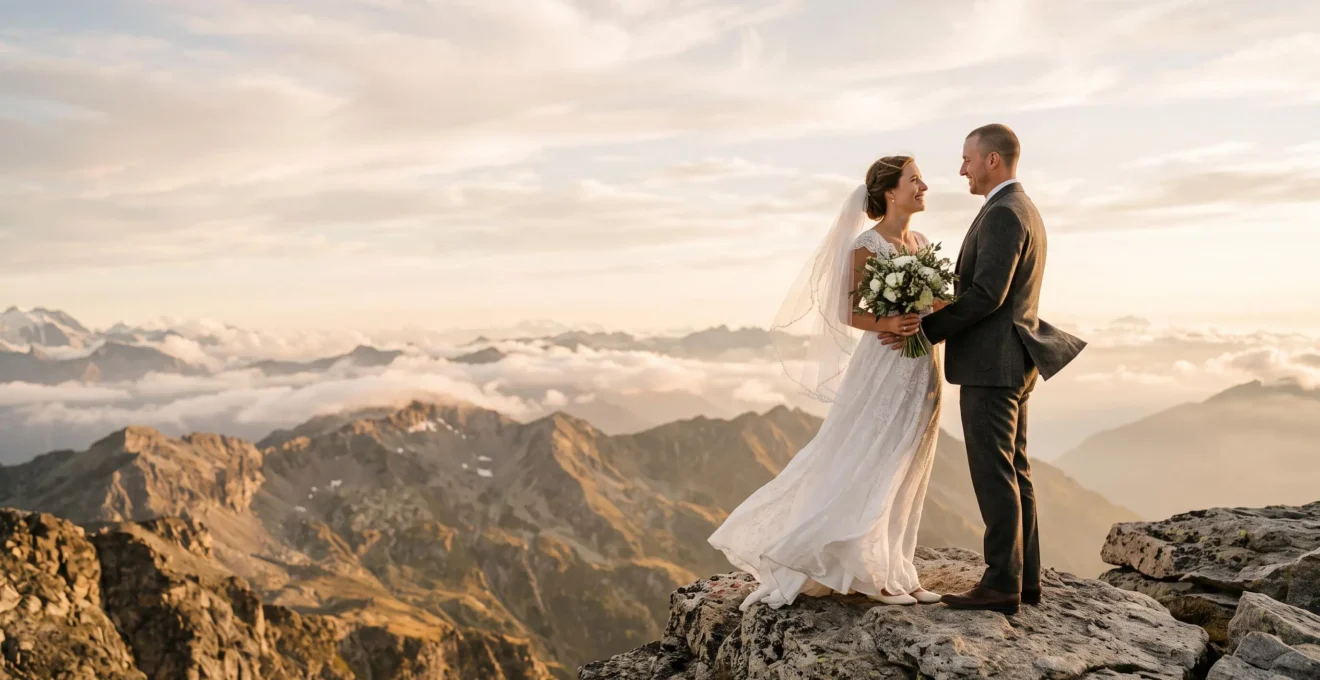
Mastering alpine wedding photography is less about gear and more about adopting an expeditionary mindset to manage environmental physics, compositional scale, and inherent risk.
- Altitude and cold don’t just feel different; they fundamentally alter equipment performance (like 40%+ faster battery drain) and the quality of light.
- Composition in the mountains is a battle against scale; advanced techniques and careful subject placement are essential to keep the couple as the focus, not the landscape.
Recommendation: Stop thinking like a wedding photographer who happens to be in the mountains, and start operating like a mountain professional who photographs weddings.
The allure is undeniable. Scroll through any high-end wedding photographer’s feed, and you’ll see them: couples silhouetted against jagged peaks, sharing a kiss in the ethereal light of an alpine dawn. The mountains call, promising drama, scale, and unparalleled beauty. For a wedding photographer looking to elevate their portfolio, expanding into destination mountain weddings seems like a natural next step. Many approach it by simply packing their usual gear, adding a wide-angle lens and a warm jacket, and hoping for the best.
This approach is not only naive; it’s a recipe for failure and, in some cases, danger. The common advice—”pack layers,” “bring extra batteries”—barely scratches the surface of the unique challenges this environment presents. A high-altitude wedding is not a studio session with a prettier background. It’s a wilderness expedition where you are responsible for logistics, safety, and creating art under extreme, rapidly changing conditions.
The real key to success is a fundamental shift in mindset. You are no longer just an artist; you are an expedition leader. The secret isn’t in what lens you use, but in understanding why your batteries are dying, how to read the landscape for both composition and safety, and how to command a scene where nature is overwhelmingly powerful. It’s about mastering the physics of altitude and the psychology of scale.
This guide will walk you through the critical strategies that separate seasoned alpine photographers from the unprepared. We will dissect the science behind equipment failure at altitude, explore compositional techniques to ensure your subjects remain the heroes of the story, and establish the non-negotiable safety protocols that protect you, your clients, and your career. Prepare to go beyond the basics and learn the craft of high-altitude wedding photography from the ground up.
Summary: A Guide to High-Altitude Mountain Wedding Photography
- Why Camera Batteries Drain 40% Faster at Alpine Altitudes Above 2,000 Metres
- How to Use Dramatic Alpine Landscapes as Backdrops While Keeping Couples Prominent
- How to Prepare Contingency Plans for Sudden Alpine Weather Changes During Mountain Weddings
- The Safety Negligence That Risks Lives for Dramatic Alpine Wedding Photo Locations
- How to Transport Photography Equipment to Remote Alpine Wedding Locations Accessible Only by Hiking
- Why Some Landscape-Integrated Wedding Photos Feel Majestic While Others Make Couples Look Insignificant
- Which Weather Forecasting Services Provide Most Accurate Predictions for British Wedding Photography
- How to Integrate Scenic Landscapes Into Wedding Photography Without Diminishing the Couple
Why Camera Batteries Drain 40% Faster at Alpine Altitudes Above 2,000 Metres
One of the first and most jarring lessons the mountains teach is that your gear’s performance is no longer guaranteed. A fully charged battery that lasts for hours in a temperate climate can die in under an hour above 2,000 metres. This isn’t a faulty battery; it’s physics. The primary culprit is the cold. Lithium-ion batteries rely on a chemical reaction to produce power, and this reaction slows dramatically as temperatures drop. The internal resistance of the battery increases, making it harder for it to deliver the necessary voltage, causing your camera to shut down even when the battery isn’t truly “empty.”
The impact is significant, as cold-weather photography research confirms a temperature drop of just 10°C can effectively cut a battery’s life in half. At alpine altitudes, where temperatures can plummet without warning, this effect is compounded. While keeping batteries warm is the common advice, it’s not a perfect solution. As arctic photographer Joe Klementovich notes, once you’re in a truly cold environment, your batteries eventually “drain faster no matter how warm you store them.” The simple act of putting a cold battery into a camera and exposing it to the elements is enough to start the rapid decline.
This means you must adopt a professional-grade battery management strategy. It’s not about just bringing more batteries; it’s about a constant, active rotation system to maximize every ounce of power.
- Keep Spares Warm, Not the Camera: Your primary focus should be on the spare batteries. Store them in an insulated pouch or, even better, in an inner pocket close to your body. Your body heat is the most reliable power source you have.
- Swap Early and Often: Don’t wait for the battery indicator to flash red. As soon as you notice a significant drop (e.g., down to 50%), swap it for a warm spare. This prevents you from running a battery to the point of failure.
- Revive “Dead” Batteries: A battery that dies in the cold isn’t necessarily empty. Once you remove it from the camera, put it back in your warm inner pocket. After 20-30 minutes, it will often recover enough charge to be used again for a short burst of shots, which can be a lifesaver.
Mastering this rotation gives you a critical advantage. While other photographers are fumbling with dead gear, you’ll be able to continue shooting through the most crucial moments, secure in your understanding of the mountain’s harsh physics.
How to Use Dramatic Alpine Landscapes as Backdrops While Keeping Couples Prominent
The biggest compositional challenge in the mountains is scale. You are surrounded by epic vistas, and the temptation is to use a wide-angle lens to capture it all. This often leads to a common mistake: the couple becomes two insignificant specks in a vast landscape. The goal is a wedding portrait, not a landscape photo with people in it. To keep the couple prominent while retaining the grandeur of the backdrop, you need to be deliberate with your lens choice and technique.
One of the most powerful and professional techniques for achieving this is the Brenizer method (also known as a “bokeh panorama”). As defined by Wikipedia, the Brenizer method is a photographic technique that creates an image with both a shallow depth of field and a wide angle of view. In practice, you use a longer portrait lens (like an 85mm or 135mm) with a wide aperture (like f/1.8) to take a series of overlapping photos of your scene, which you later stitch together in post-production. The result is a wide, panoramic-style shot where the couple is sharp and “pops” against a beautifully compressed and blurred background, a look that’s impossible to achieve in a single frame.
The Brenizer method…is a photographic technique characterized by the creation of a digital image exhibiting a shallow depth of field in tandem with a wide angle of view
– Wikipedia contributors, Wikipedia – Brenizer method
This technique is not just for specialists. As a case study from a working wedding photographer shows, the method was used to capture images framed beautifully by surrounding foliage at a standard park wedding. In the mountains, this effect is amplified. It allows you to use a towering peak as a compositional element without it overwhelming your subjects. You get the best of both worlds: the intimate, flattering look of a portrait lens and the epic scope of a wide-angle view. Mastering this transforms the landscape from a distracting background into a purposeful, integrated part of a majestic portrait.
How to Prepare Contingency Plans for Sudden Alpine Weather Changes During Mountain Weddings
In the mountains, the weather forecast is not a promise; it’s a suggestion. Conditions can change from brilliant sunshine to a full-blown blizzard in under thirty minutes. A photographer who relies on a single, “perfect weather” plan is destined for failure. An experienced alpine photographer operates with a “contingency-first” mindset, understanding that the backup plan is often the one you’ll use. This isn’t about having a Plan B; it’s about having a Plan B, C, and D, all scouted and ready to go.
Your contingency planning starts long before the wedding day. It involves deep communication with the couple to manage their expectations and studying the terrain for a variety of options. These should include:
- The “High-Risk, High-Reward” Plan A: The summit ridge at sunset. This is the dream shot, achievable only under perfect conditions.
- The “Sheltered” Plan B: A location in a thick pine forest or the leeward side of a large rock formation. This spot is chosen because it offers protection from wind and light rain, allowing you to shoot even when the peaks are socked in.
- The “Dramatic Weather” Plan C: An open valley or accessible lower ridge with a clear view of the incoming weather. Instead of hiding from the storm, you use the dramatic clouds, mist, and even rain to create moody, atmospheric images.
- The “Indoor/Vehicle” Plan D: A backup plan that involves a nearby cabin, a car with a scenic view, or even just a set of clear umbrellas and a willingness to get a little wet.
The key is to shift your mindset from fighting the weather to working with it. Embrace the elements as a creative tool. As Heather Dodge Photography advises, you should “fully embrace the elements, and always add a little extra travel time and flexibility to allow for a passing rain shower.” The wind isn’t a problem; it’s a tool to add movement and volume to hair and veils. Mist isn’t a failed shot; it’s an opportunity for soft, ethereal portraits. This proactive approach not only saves the photoshoot but often produces the most unique and memorable images of the day, turning a potential disaster into a creative triumph.
The Safety Negligence That Risks Lives for Dramatic Alpine Wedding Photo Locations
There is a dangerous trend in mountain wedding photography, fueled by social media: the relentless pursuit of the “epic shot” at any cost. This often translates to photographers, and the couples they are responsible for, taking unjustifiable risks. The most common and dangerous form of negligence is ignoring the photographer’s duty of care. While you are not a mountain guide, you are the professional in charge of the situation. Encouraging a couple to stand on a slippery, exposed cliff edge in inappropriate footwear is not just unprofessional; it’s a serious ethical and legal breach.
This negligence manifests in several key areas. First is the complete disregard for acclimatization. Dragging a couple who flew in from sea level yesterday up to a 3,000-metre location for a sunset shoot is a recipe for altitude sickness, which can be debilitating and dangerous. Second is the issue of inappropriate attire. A bride in high heels and a groom in dress shoes have no place on a rocky trail or a snowy ridge. As the photographer, you must insist on practical, safe footwear for transit, even if they change into something else for the photo itself. Finally, there’s the “location over logic” mentality, where a visually stunning spot is chosen without any assessment of objective hazards like rockfall, avalanche risk, or exposure to lightning.
Your responsibility is to conduct a thorough risk assessment for every location. You are the director of the shoot, and that includes the authority to say “no.” No photo is worth a life or a serious injury. A true professional knows that the most breathtaking images are born from careful planning and a deep respect for the mountain’s power, not from reckless gambles.
Your Alpine Safety Pre-Shoot Checklist
- Client Assessment: Honestly evaluate the couple’s fitness level, experience in the mountains, and any medical conditions. Plan the location and timeline accordingly.
- Footwear & Attire Briefing: Mandate appropriate footwear (e.g., hiking boots with good grip) for transit to all locations. Ensure they have warm layers, even on a sunny day. This is a non-negotiable part of your contract.
- Location Risk Assessment: Scout locations not just for beauty, but for hazards. Check for loose scree, cliff exposure, and avalanche paths. Have a designated “safe zone” for gear and non-shooting periods.
- Weather Window Analysis: Consult multiple, mountain-specific forecasts. Identify your weather window and plan to be off exposed ridges well before afternoon thunderstorms typically build. Know your “turn-around” time.
- Emergency Plan: Have a fully charged phone, a backup power bank, a basic first-aid kit, and know the local emergency number. Inform a third party of your exact route and expected return time.
How to Transport Photography Equipment to Remote Alpine Wedding Locations Accessible Only by Hiking
When the wedding location is a two-hour hike from the nearest road, your standard rolling Pelican case is useless. Transporting thousands of dollars of sensitive equipment into the backcountry requires adopting an expeditionary mindset. Every item must justify its weight, and your packing system must be optimized for three things: safety of the gear, accessibility, and your own physical well-being. The solution lies in a modular system built around a high-quality technical hiking backpack.
Forget branded camera bags that scream “expensive gear inside.” You need a real hiking pack from a reputable outdoor brand (like Osprey, Deuter, or Gregory), sized for your torso length, with a capacity of 40-50 litres. These packs are designed to distribute weight properly onto your hips, saving your shoulders and back. The magic happens inside. Instead of dumping gear loosely into the main compartment, you use padded modular camera cubes or Internal Camera Units (ICUs). These are self-contained, padded boxes that hold your camera bodies and lenses securely.
This modular approach offers several advantages. First, it protects your gear from both impact and the elements. You can wrap the ICU in a waterproof bag inside your pack for total protection. Second, it’s efficient. You can pre-pack cubes for different scenarios (e.g., a “ceremony” cube with zooms, a “portrait” cube with primes). Third, it allows you to pack other essential hiking gear—like a rain jacket, water, first aid, and extra layers—around the camera cube, creating a balanced and stable load. Your tripod should be strapped securely to the outside, and critical items like batteries and memory cards should be in a small, accessible pocket. This system transforms you from a photographer struggling with awkward bags into a self-sufficient, mobile, and efficient mountain professional.
Why Some Landscape-Integrated Wedding Photos Feel Majestic While Others Make Couples Look Insignificant
The difference between a majestic environmental portrait and a photo where the couple looks like lost tourists lies in compositional intent. In a weak photo, the couple is simply placed *in front* of a view. In a strong photo, the couple is purposefully *integrated* with the landscape, using compositional elements to guide the viewer’s eye directly to them, even when they are physically small in the frame. The landscape becomes an active part of the story, not just passive scenery.
One of the most common failures is scale mismanagement. A wide-angle lens can capture a huge vista, but it also pushes backgrounds further away and can distort figures, diminishing their presence. More effective techniques often involve using a standard or short telephoto lens from further away, which compresses the background and makes distant peaks feel larger and more immediate, wrapping around the couple. Other powerful techniques include:
- Using Leading Lines: A winding path, a ridgeline, or the curve of a valley can be used as a powerful visual arrow pointing directly to the couple.
- Framing: Using natural elements like overhanging tree branches or a rock arch to create a frame within the frame draws focus to the subjects.
- Leveraging Negative Space: Placing a small couple against a vast, empty sky or a monochromatic wall of rock can create a feeling of serene isolation and make them the undeniable focal point.
The terrain itself can be a powerful posing tool. As photographer Heather Dodge points out, “One of the best parts about photographing in the mountains is the uneven terrain which turns traditionally stiff poses into an instant adventure!” Having a couple navigate a rocky outcrop or stand on different levels creates dynamic, natural body language that feels far more authentic and engaging than a static pose. By consciously directing the viewer and using the environment, you ensure that even in the most immense landscapes, the human connection remains the heart of the photograph.
Which Weather Forecasting Services Provide Most Accurate Predictions for British Wedding Photography
When shooting in the mountains of the UK, relying on a generic weather app is a critical mistake. For the specific and volatile conditions of areas like the Scottish Highlands, the Lake District, or Snowdonia, you need to use the same specialized forecasting services that mountaineers and rescue teams depend on. The general consensus among UK-based outdoor professionals is that a combination of two services provides the most accurate picture.
The first is the Met Office. As the UK’s national weather service, it offers detailed, location-specific forecasts, including dedicated “Mountain” forecasts for major peaks and parks. Their detailed rain radar and hour-by-hour predictions are invaluable for planning your shoot timeline. The second, and arguably more critical, service is the Mountain Weather Information Service (MWIS). MWIS provides detailed, plain-English reports specifically for mountain regions, focusing on elements crucial for safety and photography: cloud-free Munro probabilities, wind speed at different elevations, and freezing levels. Checking both the Met Office for granular timing and MWIS for the broader mountain-specific outlook is the gold standard for UK alpine photography.
This principle of seeking out specialized, local sources is a universal rule for mountain photography worldwide. While the specific services change, the strategy does not. If you are shooting in the French or Swiss Alps, you should be consulting services like MeteoSwiss or Chamonix-Meteo. In the US Rockies, you would turn to the National Oceanic and Atmospheric Administration (NOAA) point forecasts and the local avalanche center’s reports. The key takeaway is to identify and trust the forecasting tools used by local mountain experts. They provide the nuanced data—like valley cloud, inversion risks, and summit-specific wind speeds—that a standard weather app will never have, giving you the critical information needed to make safe and creative decisions.
Key Takeaways
- Mastering alpine wedding photography is an exercise in risk management and environmental physics, not just aesthetics.
- The “expeditionary mindset” is paramount: you are a logistics manager and safety officer first, an artist second.
- True mastery lies in using the mountain’s harshness—the cold, the scale, the weather—as a creative tool, rather than seeing it as an obstacle.
How to Integrate Scenic Landscapes Into Wedding Photography Without Diminishing the Couple
The modern mountain wedding aesthetic is one of epic scale and adventure. As photographer Amy Galbraith observes for the JPEGmini Blog, “I feel like every time I sit down to scroll my Instagram feed there’s a couple hanging off a cliff, standing on a mountaintop, or standing knee-deep in a mountain lake.” While this trend produces stunning visuals, it walks a fine line. The ultimate goal of a wedding photo is to celebrate the couple and their connection. When the landscape’s drama overshadows the human element, the photo, no matter how beautiful, has failed in its primary purpose. True integration is about making the landscape a character in the couple’s story, not the main character.
Achieving this balance requires a synthesis of all the techniques we’ve discussed. It’s about using a longer lens to compress a distant mountain range, making it feel like a protective embrace around the couple rather than a distant backdrop. It’s about finding leading lines—a winding trail or a sunbeam—that guide the eye directly to the couple, reinforcing their importance. It’s about understanding light, waiting for that moment when a single shaft of golden hour light illuminates the couple, making them “pop” from a shadowed, moody background.
This is where your role as a director becomes crucial. You must guide your couple, using the uneven terrain to create dynamic poses that feel adventurous and authentic. You position them at the precise point where the light hits, where the ridgeline leads the eye, and where their small forms are given compositional weight against the vastness of the scene. You are not just capturing a view; you are curating it. You are telling a story of two people beginning their adventure together, supported and amplified by the majesty of the world around them. This intentional, thoughtful approach ensures the final image is not just a landscape photo, but a powerful, meaningful portrait that feels both epic and deeply intimate.
Ultimately, becoming a proficient alpine wedding photographer is a journey of continuous learning and profound respect for the environment. By applying these principles of preparation, safety, and compositional intent, you can confidently create the breathtaking images your clients dream of while ensuring everyone returns safely, ready for the next adventure.