
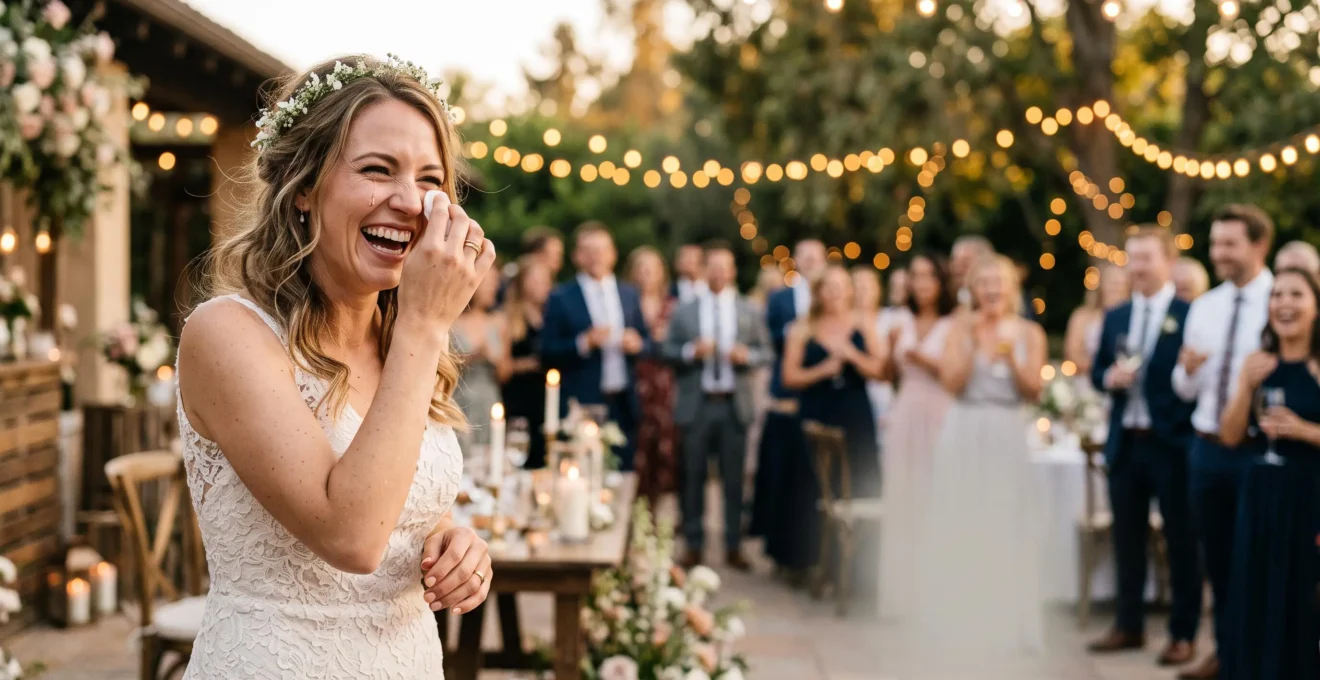
Most wedding photographers focus on capturing smiles, but this often results in images of performed happiness, not genuine emotion. This guide reveals that the most treasured photographs are born from understanding psychological cues, not just technical settings. We’ll explore how to read the subtle language of micro-expressions, use distance to foster intimacy, and direct movement to unlock the authentic emotional truth that turns a picture into a timeless heirloom.
As a wedding photographer, you’ve likely felt it. You deliver a gallery of beautiful, well-lit, technically perfect images filled with smiling faces, yet something feels missing. The photos are pleasing, but they lack the profound emotional weight that turns a simple picture into a family heirloom. You’re capturing happiness, but is it the genuine, unguarded emotion that tells a story, or is it a polite, fleeting performance for the camera? The industry is saturated with advice on being a “fly on the wall” or using long lenses, but these are tactical suggestions that miss the fundamental point.
The challenge isn’t about being invisible; it’s about becoming a skilled and empathetic observer of human connection. The real craft lies not in your gear, but in your ability to differentiate between a posed smile and a moment of authentic joy, between a staged tear and a flicker of true vulnerability. This requires a shift in perspective—from being a director of moments to a witness of emotional truth. It involves learning a new language, one spoken not in words, but in the subtle cues of the human body and face.
But what if the key to unlocking these moments wasn’t a secret technique, but a deeper understanding of human psychology? This guide moves beyond the surface-level tips. We will explore the science behind why certain moments become cherished memories, how to read the body language that signals an impending emotional peak, and how to use your presence—even from a distance—to create a space where authenticity can flourish. This is about learning to see what’s truly there, capturing the micro-expressions that last less than a second but hold more truth than a five-minute pose.
This article provides a structured path to developing that emotional sensitivity. By exploring the principles of emotional psychology and applying them to the craft of wedding photography, you will learn to anticipate, recognise, and preserve the moments that truly matter.
Table of Contents: A Deep Dive into Capturing Genuine Wedding Moments
- Why Some Emotional Moments Become Treasured Heirlooms While Others Are Forgotten Within Months
- How to Capture Intimate Emotional Moments With 135mm+ Lenses Without Feeling Distant or Detached
- Black and White or Colour: Which Intensifies Authentic Emotion in Father-Daughter Dance Moments
- The Intrusive Mistake That Violates Trust When Photographing Tears and Vulnerable Wedding Emotions
- How to Read Body Language Cues That Signal Emotional Moments 10 Seconds Before They Peak
- Why Micro-Expressions Captured in 0.5 Seconds Carry More Emotional Truth Than 5-Second Posed Smiles
- How to Use Movement Prompts That Generate Authentic Intimacy Instead of Static Pose Instructions
- How to Recognise and Capture Micro-Expressions That Reveal True Emotion in Wedding Photography
Why Some Emotional Moments Become Treasured Heirlooms While Others Are Forgotten Within Months
Have you ever noticed how a wedding gallery of a thousand photos can often be distilled down to just two or three images that the couple truly treasures forever? It’s rarely the perfectly posed group shot. More often, it’s a fleeting glance, a burst of laughter, or a single tear during the vows. This phenomenon isn’t random; it’s explained by a psychological principle known as the Peak-End Rule. This rule states that our memory of an experience is not an average of every moment, but is instead disproportionately shaped by the most emotionally intense point (the “peak”) and the final moment (the “end”).
Case Study: Kahneman’s 1993 Cold-Pressor Study
In a landmark 1993 experiment, participants submerged a hand in cold water twice: once for 60 seconds, and once for 60 seconds plus an extra 30 seconds during which the water was made slightly less cold. Despite the longer total discomfort, most participants preferred to repeat the longer trial. This revealed that our memory of an experience is dominated by its peak intensity and its ending rather than its total duration. This principle is directly transferable to why certain wedding moments—a peak laugh, a tender final glance—become the photographs couples treasure most.
For a wedding photographer, this is a profound revelation. Your job is not to document every single second with equal importance, but to become an expert at identifying and capturing these “peak” emotional moments. A posed smile is emotionally flat; it has no peak. Therefore, it’s forgettable. A spontaneous, uncontrollable laugh during a speech, however, is a powerful emotional peak. That image becomes the anchor for the entire memory of that moment. As psychologist Daniel Kahneman noted, subjects chose the longer, less pleasant experience simply because they “liked the memory of it better.” Your goal is to create the photographs that anchor the best possible memories.
How to Capture Intimate Emotional Moments With 135mm+ Lenses Without Feeling Distant or Detached
The standard advice for capturing candid moments is to use a long lens, like a 135mm or 200mm, to make yourself less conspicuous. While tactically sound, this approach carries a significant risk: physical distance can easily lead to emotional detachment. You become a sniper, hunting for moments rather than connecting with them. The secret to using a long lens effectively isn’t about hiding; it’s about practicing empathetic distance. This means using the physical space your lens provides not to disconnect, but to give subjects the safety to express themselves without feeling watched, while you remain emotionally invested.
This is where the concept of mirror neurons comes into play. These are brain cells that fire both when we perform an action and when we observe someone else performing that same action. They are the neurological basis of empathy. As one study on the topic explains, “We may understand the thoughts, emotions, and sensations of others by simulating them in ourselves.” Even from across the room, when you see a father welling up with tears, your mirror neurons allow you to feel a shadow of that emotion. Instead of just seeing it as a “shot to get,” you connect with the feeling behind it. This empathetic connection changes how you shoot. You’re no longer just composing a frame; you are waiting for the emotional apex because you can feel it building.
Black and White or Colour: Which Intensifies Authentic Emotion in Father-Daughter Dance Moments
The father-daughter dance is a crucible of complex emotions: pride, nostalgia, joy, and a touch of melancholy. When deciding how to edit these moments, the choice between color and black and white is not merely aesthetic; it’s a decision about emotional direction. Color provides literal information—the shade of a dress, the warmth of the lighting. Black and white, however, strips this information away, forcing the viewer’s brain to engage on a different level. It abstracts the scene, emphasizing form, texture, and, most importantly, emotional content.
When you remove color, you remove a layer of reality that the brain automatically processes. This forces a more interpretive viewing experience. As fine art photographer Julia Anna Gospodarou notes, “When deprived of color, the brain compensates by projecting deeper personal meaning onto an image.” The viewer is no longer just seeing a father and daughter dancing; they are feeling the weight of the moment. Without the distraction of color, the focus shifts to the language of emotion: the gentle pressure of a hand on a shoulder, the crinkle of a smile line, the glistening of a tear. This interpretive space is where a photograph’s emotional power is amplified. Another expert, David Schmid, confirms that “Without color, perception becomes less automatic and more interpretive, which often leads to a deeper connection with the image.”
The Intrusive Mistake That Violates Trust When Photographing Tears and Vulnerable Wedding Emotions
Tears during a wedding are liquid gold for an emotion-focused photographer. But there is a fine line between bearing witness to a vulnerable moment and exploiting it. The single most intrusive mistake a photographer can make is to interrupt or direct an emotional moment. Rushing in with a camera, asking someone to “hold that,” or trying to recreate a moment that just passed instantly shatters the authenticity and violates the trust you’ve built. Genuine emotion is shy; it retreats under a spotlight. As one photographer puts it, “A relaxed couple is more likely to show their true emotions on camera.” That relaxation is built on trust, not direction.
The right to capture vulnerability must be earned, not taken. This trust is built long before the wedding day and reinforced through your actions during the event. It’s about setting clear, collaborative expectations and then behaving in a way that honors that agreement. True candid photography is not about being sneaky; it’s about being so trusted that your presence no longer registers as a threat to authenticity. Here are some key strategies for earning that trust:
- Set Collaborative Goals: Align with the couple beforehand on an achievable candid-coverage goal so expectations around vulnerability are set together.
- Use a Point Person: Assign one trusted friend or family member as a quiet point person who can discreetly signal you when an emotional moment is about to unfold, preventing you from having to “hunt.”
- Avoid Over-Posing: When subjects are standing stiffly waiting for your next instruction, genuine emotion retreats. Prioritize flow and interaction over static poses.
- Prioritize, Don’t Script: Ask for coverage priorities (e.g., “focus on our grandparents”) rather than a rigid, frame-by-frame shot list. This allows you to follow the natural flow of the day, where real moments live.
How to Read Body Language Cues That Signal Emotional Moments 10 Seconds Before They Peak
The most powerful emotional photographs are rarely a surprise to the prepared photographer. Genuine emotion doesn’t just appear; it builds. There is a subtle, non-verbal preamble that occurs in the seconds before an emotional wave crests. Learning to read these signals transforms you from a reactive picture-taker into a proactive moment-anticipator. It’s the difference between catching the tail-end of a laugh and capturing its glorious, uninhibited peak. The key is to stop looking for the obvious and start noticing the subtle precursors.
The face, in particular, offers a roadmap. While a posed smile can be summoned in an instant, authentic, emotionally driven smiles are involuntary and build organically. You need to train your eye to spot the difference before it’s fully formed. Focus on these cues:
- The Eyes Tell the Story: Look at the eyes first, not the mouth. A flat, unchanged eye region paired with a smiling mouth is a classic sign of a performed expression. True joy engages the muscles around the eyes.
- Watch the Cheeks Rise: A genuine reaction, like a Duchenne smile, involves the zygomatic major muscle (pulling the mouth corners up) and the orbicularis oculi muscle (crinkling the eyes). This coordinated action pushes the cheeks upward.
- Note the Timing: Authentic expressions tend to build gradually, hold for a moment, and then fade slowly. Posed expressions, by contrast, often snap on and off abruptly, like a light switch.
- Check for Symmetry: Genuine emotional expressions tend to be more symmetrical across the face than posed, often one-sided, social smiles.
By constantly scanning for these clusters of cues—not just a single one—you can predict with remarkable accuracy when an emotional moment is imminent, positioning yourself for the perfect shot before it even happens.
Why Micro-Expressions Captured in 0.5 Seconds Carry More Emotional Truth Than 5-Second Posed Smiles
We are socially conditioned to perform. At a wedding, guests and even the couple will offer countless polite, camera-aware smiles that last for several seconds. These are gestures of social cohesion, not windows into the soul. The real emotional truth lies in micro-expressions—involuntary flashes of feeling that cross the face in a fraction of a second. These fleeting expressions are a form of “emotional leakage,” revealing genuine feelings before the conscious brain can suppress or mask them.
The most famous example is the genuine smile, or “Duchenne smile,” named after the 19th-century neurologist who first identified it. Its defining characteristic, or “Duchenne marker,” is the involuntary contraction of the *orbicularis oculi* muscle, which raises the cheeks and creates crow’s-feet around the eyes. As the Paul Ekman Group, leaders in facial expression research, cite, “The orbicularis oculi muscle is recruited in smiles that occur with spontaneously experienced enjoyment but not in smiles that are posed.” This muscular action is nearly impossible to fake on command. Furthermore, research on facial behavior shows that genuine smiles, or Duchenne smiles, typically last between 0.5 to 4 seconds, while posed, social smiles can be held for much longer.
This is your signal. When you see those crinkles around the eyes, you are witnessing an authentic moment of joy. Your job is to be ready for it. This means keeping your camera in burst mode during high-potential moments (like speeches or the first look) to ensure you don’t miss an expression that lasts less than a second. It’s these half-second flashes that contain more emotional truth than a five-second “say cheese” smile ever will.
How to Use Movement Prompts That Generate Authentic Intimacy Instead of Static Pose Instructions
The phrase “Ok, now look at each other and smile” is the death of authentic intimacy. Traditional posing freezes people into unnatural effigies of themselves. As one professional observes, “When everyone stands stiffly waiting to be told where to look, genuine emotion retreats.” To break this cycle, you must replace static instructions with dynamic, movement-based prompts. The goal is to create a scenario where the couple can have a genuine interaction, and you become the observer of that reality.
Instead of telling them *how to be*, give them something *to do*. This shifts their focus from the camera to each other, allowing their natural dynamic to emerge. The prompt doesn’t have to be complicated. It can be as simple as, “Walk towards me, holding hands, and tell each other what you’re most excited about for your honeymoon.” The act of walking, talking, and thinking about a shared future will generate far more authentic smiles and tender glances than any pose you could construct. Here’s how to make your prompts effective:
- Direct the Interaction, Not the Pose: Instruct the couple to interact in natural ways. Prompts like “Whisper a secret you’ve never told them” or “Take a moment to just breathe each other in” are powerful catalysts for intimacy.
- Reflect Their Story: Learn the couple’s personal story beforehand. If they love to dance, a prompt involving movement and music will feel more meaningful than a generic one.
- Embrace Play and Tenderness: Favor prompts that are playful, tender, or reflective. These interactions reveal a couple’s true dynamic in a way that static shots cannot replicate.
- Be a Fly on the Wall (After the Prompt): Once you’ve given the prompt, step back and be quiet. Adopt a fly-on-the-wall approach and let the moment unfold without further direction. Your job is to witness the result, not to micromanage it.
Key Takeaways
- Our memory of an event is disproportionately shaped by its most emotional ‘peak’ and its ‘end’, not its duration. Your goal is to capture these peaks.
- Genuine, involuntary smiles (Duchenne smiles) are defined by the engagement of the muscles around the eyes, creating crow’s-feet, and are nearly impossible to fake.
- Replace static posing with movement-based prompts that encourage natural interaction, shifting the couple’s focus from the camera to each other.
How to Recognise and Capture Micro-Expressions That Reveal True Emotion in Wedding Photography
Mastering the art of capturing emotional truth is a journey from being a photographer to becoming a student of human expression. It culminates in the ability to not only recognise but anticipate the fleeting micro-expressions that betray genuine feeling. This isn’t a mystical talent; it’s a trainable skill built on a foundation of observation and an understanding of how emotions are physically manifested. The Facial Action Coding System (FACS) provides a scientific framework for this.
Case Study: FACS and the Duchenne Marker
Facial Action Coding System (FACS) research identifies the Duchenne marker as the most reliable sign of true enjoyment. It’s a precise, unfakeable muscular pattern absent from posed, non-enjoyment smiles. When a person feels genuine joy, the skin above and below the eye is pulled toward the eyeball, the cheeks rise, the lower eyelid lifts, and crow’s-feet wrinkles appear at the outer eye corner. For a wedding photographer, this provides a concrete, checkable pattern to watch for in the front row during vows or among parents during speeches.
Recognising these signs in real-time is the final piece of the puzzle. It requires you to be fully present and intentional in your observation. You are no longer just looking for “a moment”; you are scanning for a specific set of physiological cues that tell you an authentic moment is happening right now. This is where all the previous concepts—the Peak-End Rule, empathetic distance, and the knowledge of body language—come together into a cohesive practice.
Action Plan: Spotting Genuine Emotion in Real Time
- Pre-focus on emotional hotspots: identify key areas like the front row during vows or parents during speeches, where fleeting genuine expressions are most likely to surface.
- Read expressions as clusters: combine eye engagement, cheek movement, and timing before judging authenticity. Don’t rely on just one cue.
- Watch for asymmetry: be wary of one-sided or lopsided expressions, as posed emotions are more often asymmetrical than genuine, symmetrical ones.
- Keep burst mode active: ensure your camera is set to continuous shooting in these hotspots so a 0.5-second genuine flash is never missed between frames.
- Trust your empathy: pay attention to your own emotional response. Your mirror neurons are a powerful tool for detecting what is real.
The transition from capturing posed happiness to preserving authentic emotional truth is the most significant leap a wedding photographer can make. Start applying this observational mindset on your next shoot and see the profound difference it makes in the emotional depth and timeless value of your work.