
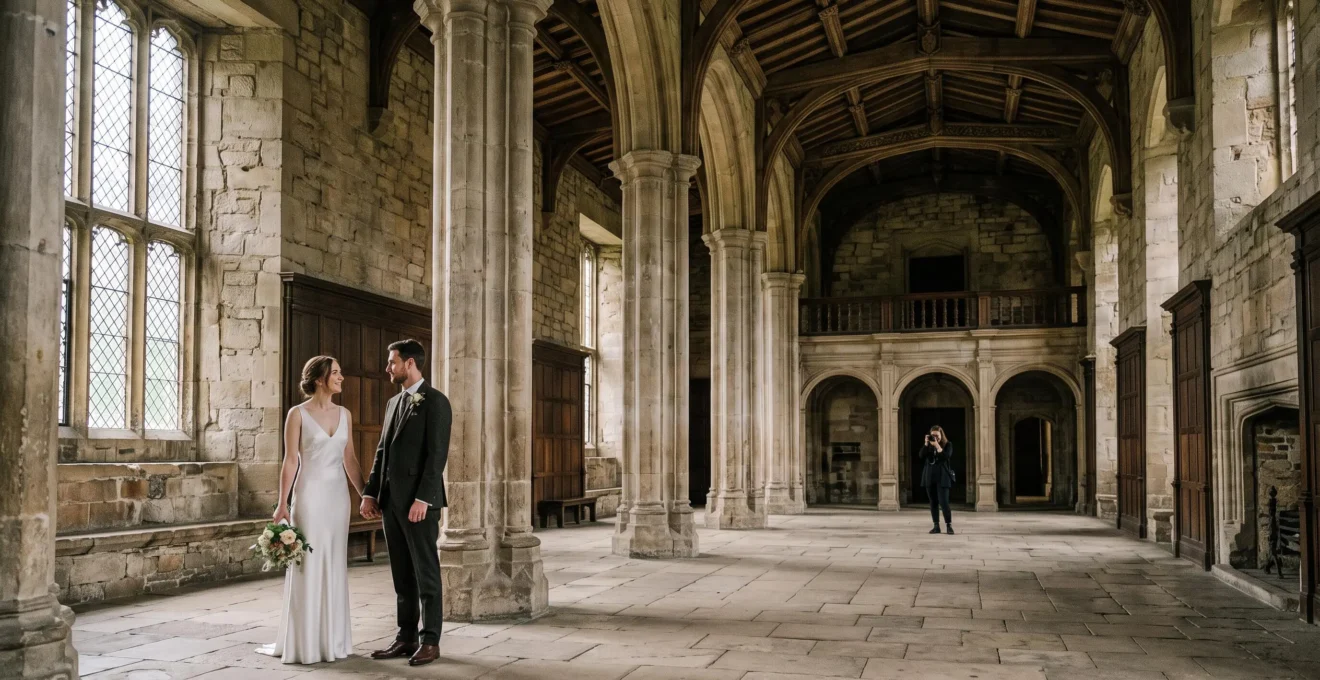
The key to stunning photos in heritage venues isn’t fighting the rules, but mastering the art of diplomatic collaboration and becoming a trusted conservation partner.
- Understand the conservation science behind flash and tripod bans to inform your technique and build trust with coordinators.
- Proactively “light-map” the venue before the wedding day to identify the best natural light pockets and plan your key shots.
Recommendation: Approach the venue coordinator well in advance not as a vendor seeking permissions, but as a specialist partner dedicated to capturing the day while protecting their historic space.
There is a unique sense of awe that comes with stepping into a National Trust manor or an English Heritage castle for a wedding. The weight of history hangs in the air, promising a backdrop of unparalleled character and romance. But for the professional photographer, that awe is often quickly followed by a familiar, sinking feeling upon reading the venue’s regulations: no flash photography, no tripods, restricted movement. The immediate challenge seems technical—how do you get the shot in a dimly lit, 500-year-old great hall?
The standard advice to simply use a fast lens or push your ISO is a starting point, but it’s an incomplete solution for a professional. It tackles the symptoms, not the cause. These technical fixes alone don’t address the core of the issue, which is a fundamental disconnect between the photographer’s need to create and the venue’s duty to conserve. This guide is built on a different premise, a perspective honed from years of working within these prestigious and delicate environments.
The true mastery of heritage venue photography isn’t about finding clever ways to break the rules. It’s about becoming a ‘conservation partner’. It’s about understanding the *why* behind the restrictions—the science of light-fading on ancient textiles, the risk of structural damage from equipment, the imperative to maintain the visitor experience. By shifting your mindset from adversarial to collaborative, you unlock a new level of creative freedom. This article will guide you through the art of diplomatic negotiation, the technical skills for ambient-light mastery, and the creative vision needed to tell a story that honours both the couple and the history that surrounds them.
This comprehensive guide provides a strategic framework for navigating the unique challenges of heritage locations. You’ll learn how to build trust with coordinators, master difficult lighting scenarios, and use the architecture itself to create unforgettable images.
Table of Contents: A Photographer’s Guide to British Heritage Venues
- Why Historic Venues Ban Flash and Tripods and How to Work Successfully Within Restrictions
- How to Photograph Dark Historic Church Interiors Without Flash or Tripod
- How to Negotiate Photography Access With Historic Venue Coordinators Before the Wedding Day
- The Damage Mistake That Gets Photographers Banned From Historic Venues Permanently
- Which Architectural Features to Emphasise in Historic Venue Wedding Photography
- How to Use 16mm Ultra-Wide Lenses to Capture Venue Scale Without Distorting Architecture
- When to Abandon Ambient Light and Introduce Flash as Reception Venues Transition From Dusk to Dark
- How to Photograph Wedding Venue Grandeur That Showcases Architectural Scale and Splendour
Why Historic Venues Ban Flash and Tripods and How to Work Successfully Within Restrictions
The dreaded “no flash, no tripods” rule isn’t arbitrary; it’s rooted in the science of conservation and risk management. For a photographer, understanding these reasons is the first step from being seen as a problem to being seen as a professional partner. The primary concern with flash is cumulative light damage. Intense bursts of UV and visible light, repeated over time, cause irreversible fading and degradation to organic materials. This process, known as photobleaching, is particularly damaging to the delicate pigments in ancient tapestries, watercolour paintings, and historic wallpapers that are the very soul of these venues. It’s not your single flash that’s the problem; it’s the cumulative effect of hundreds of flashes from countless events over many years.
The official position of heritage organisations is clear and non-negotiable. As the National Trust states in its guidelines, “Using a flash or tripod indoors is not permitted.” Tripod and light stand restrictions are about physical risk. Heavy, sharp-footed equipment can easily scratch or gouge centuries-old wooden floors or flagstones. In tight, crowded spaces, they also present a significant trip hazard for guests, creating a liability issue the venue is keen to avoid. The problem is so common that a 2024 study of wedding vendors found that nearly 40% of clergy ask photographers to stop using flash mid-ceremony, causing a major disruption.
Instead of viewing these rules as limitations, see them as creative constraints. They force you to master the most powerful tool you have: ambient light. Success comes not from fighting the rules, but from demonstrating that you understand and respect them. When you can articulate *why* you won’t be using a flash near a certain tapestry, you instantly build credibility with the venue coordinator. This shared understanding is the foundation for a successful working relationship and, ultimately, better photographs.
How to Photograph Dark Historic Church Interiors Without Flash or Tripod
Photographing a ceremony in a dark, historic church without a flash or tripod is one of the ultimate tests of a wedding photographer’s skill. The solution isn’t found in your camera bag on the day; it’s found in strategic preparation. The most critical task is to conduct a pre-wedding ‘light-mapping’ visit at the same time of day as the ceremony. This reconnaissance mission allows you to observe how natural light behaves within the space. Look for where it pools, where it reflects, and where the deepest shadows lie. A single beam from a high stained-glass window can become your key light if you know where and when it will appear.
On a technical level, this scenario demands a specific gear and settings combination. A full-frame camera with excellent high-ISO performance (like a Sony A7S III or Canon R5/R6) is invaluable. Pair it with a fast prime lens (e.g., 35mm f/1.4, 50mm f/1.2, or 85mm f/1.4). Your goal is to open the aperture as wide as possible to gather maximum light. Set your shutter speed to a minimum of 1/125s to avoid motion blur from your own movement, and let the ISO float as high as needed, trusting that modern noise reduction is superior to a blurry, unusable image. Always shoot in RAW, as this gives you the latitude in post-production to lift shadows and correct the challenging mixed white balance from candles and daylight.
The image above demonstrates what’s possible by embracing the shadows. By placing the couple in a small pocket of natural light, the darkness becomes an asset, creating a moody, intimate, and timeless portrait that a flash-blasted scene could never replicate. Your job is not to eliminate the dark but to find the light within it.
Your 5-Step Low-Light Scouting Plan
- Points of contact: Identify and establish a rapport with the key personnel who control the environment, including the venue coordinator, vicar, or on-site heritage officer.
- Collecte: During a pre-visit, inventory all available light sources (windows, skylights, candles, permanent uplighters) and photograph all designated ‘no-go’ zones or sensitive artefacts.
- Cohérence: Assess how the quality and direction of natural light at the exact ceremony time either complements or conflicts with the venue’s historic atmosphere you aim to capture.
- Mémorabilité/émotion: Instead of seeking even light, pinpoint the specific ‘pools of light’ where key moments (the kiss, ring exchange) can be framed for maximum emotional impact.
- Plan d’intégration: Create a physical or mental map of 2-3 primary shooting positions that maximize the available light while remaining fully compliant with all positional restrictions.
How to Negotiate Photography Access With Historic Venue Coordinators Before the Wedding Day
The most important meeting you’ll have for a heritage venue wedding often isn’t with the couple, but with the venue coordinator. This is where you transform from a mere supplier into a trusted ‘conservation partner’. The key is to frame this conversation not as a list of demands, but as a collaborative effort to achieve two shared goals: a happy couple and a protected historic site. Schedule this meeting well in advance and come prepared to listen more than you talk.
Begin by acknowledging their responsibility. A simple opening like, “I’m so excited to shoot here; it’s a stunning property. I completely understand the need to protect its heritage, and I want to work with you to ensure we do everything right.” This immediately signals respect and partnership. Come prepared with your public liability insurance certificate and a small portfolio (on a tablet) showcasing your work in other low-light or historic venues. This provides tangible proof of your professionalism and capability.
Instead of asking “Can I use flash?”, try asking “Could you show me the areas that are most sensitive to light? I want to make sure I stay well away from them.” This proactive approach demonstrates you’re on their side. You can then collaboratively identify safer spots where a heavily diffused, off-camera flash bounced off a modern, non-historic ceiling might be permissible during the reception. As the experts at ShootDotEdit note, this approach has long-term benefits:
Consider how beneficial it may be to your business to establish relationships with the venue staff for future referrals.
– ShootDotEdit, Should Wedding Photographers Negotiate Their Prices?
By building this rapport, you’re not just negotiating for one wedding day; you’re building a reputation as the go-to photographer for that venue. The coordinator will remember the professional who made their job easier and will be far more likely to recommend you to future couples. This diplomatic approach often yields more creative freedom than any technical argument ever could.
The Damage Mistake That Gets Photographers Banned From Historic Venues Permanently
While most photographers are aware of the risks of flash and tripods, the single mistake that can lead to a permanent ban and a significant financial claim is often more subtle: misunderstanding liability for equipment. It’s not just about your own camera gear. The real danger lies in anything you bring into the venue, especially items under your control that don’t belong to you, such as hired lighting, props, or even a photo booth.
The critical concept to understand is ‘Care, Custody & Control’. Your standard Public Liability Insurance is designed to cover injury to third parties (like a guest tripping over your bag) or damage to their property. However, it often excludes property that is in your direct care. A photographer might assume their insurance covers a hired £2,000 light stand if it falls and damages a 16th-century floor, but this is a dangerous and often incorrect assumption. The liability for that hired equipment, and the damage it causes, may fall directly on you.
This is a specialist area of insurance that many photographers overlook. As UK-based insurance experts Williamson Carson clarify, the distinction is crucial:
Although Hired Equipment and Props, Sets & Wardrobe are Third Party property they are NOT covered under your Public Liability Cover. They are considered to be under your Care, Custody & Control.
– Williamson Carson, Public Liability for Photographers – what to check?
The lesson is twofold. First, you must have a frank conversation with your insurer to ensure you have a policy that explicitly covers ‘Care, Custody & Control’ for hired equipment. Second, exercise extreme caution with *any* equipment you bring on-site. Secure light stands with sandbags, tape down cables in low-traffic areas (only if the venue permits the tape), and keep your equipment consolidated in a designated safe zone. Damaging a priceless piece of history is a career-ending mistake, and ignorance of your insurance policy is no defence.
Which Architectural Features to Emphasise in Historic Venue Wedding Photography
When faced with the grandeur of a historic venue, the temptation is to capture everything in wide, sweeping shots. However, the true story of the building—and a more unique wedding album—is often found in the details. Adopting a mindset of ‘architectural empathy’ means looking beyond the scale and focusing on the textures, patterns, and imperfections that reveal the building’s age and history. This is where you can create truly distinct images that feel tied to the specific location.
Train your eye to see the venue as a curator would. Instead of just a staircase, see the smooth, concave dips in ancient stone steps, worn down by centuries of footsteps. Instead of a wall, look for the intricate patterns in the wood panelling, the texture of exposed brickwork, or the subtle shimmer of a silk wallpaper. These details provide incredible backdrops for close-up shots of rings, flowers, or the couple’s hands. A macro or close-focusing lens can be your best friend here, turning a small section of the building into an abstract, beautiful canvas.
Another powerful feature to highlight is the play of light itself. Look for the way sunlight streams through a mullioned window, creating a pattern of light and shadow on the floor. Use this natural geometry to frame the couple. The vibrant colours of a stained-glass window can be used to cast a colourful glow, adding a layer of dreamlike beauty to a portrait. By focusing on these smaller, often-overlooked elements, you are not just using the venue as a backdrop; you are making the building an active character in the couple’s wedding story. This approach of ‘curatorial storytelling’ results in a gallery that is richer, more personal, and deeply connected to the heritage of the space.
How to Use 16mm Ultra-Wide Lenses to Capture Venue Scale Without Distorting Architecture
An ultra-wide lens, such as a 16-35mm, is an essential tool for capturing the breathtaking scale of a vaulted ceiling or a long gallery. However, in inexperienced hands, it can quickly turn majestic architecture into a distorted mess of leaning walls and unnaturally stretched corners. The key to using these lenses effectively in historic venues is discipline and an understanding of perspective control.
The number one rule to avoid the dreaded ‘keystoning’ effect (where vertical lines appear to converge) is to keep the camera’s sensor perfectly parallel to the architectural plane you are photographing. This means you must resist the urge to tilt the camera up to get the whole ceiling in. Tilting is what causes the distortion. Instead, you need to physically change your position. If you need to capture a high ceiling, find a way to get higher (like a balcony, if accessible and permitted) or simply move further back. Using your camera’s built-in digital level is absolutely critical here; your goal is to have the horizontal and vertical lines perfectly centred.
Subject placement is also vital. Distortion is always most pronounced at the extreme edges of an ultra-wide frame. Avoid placing the couple or important guests at the very edge, as they will appear stretched and warped. A better approach is to compose your shot with the couple positioned closer to the centre third of the frame, using the grand architecture to surround them. Finally, while lens correction profiles in Lightroom or Capture One are powerful tools, they should be used for fine-tuning, not for fixing a fundamentally flawed composition. A well-shot image will require minimal correction. Get it right in-camera, and you will preserve the true, undistorted grandeur of the architecture.
When to Abandon Ambient Light and Introduce Flash as Reception Venues Transition From Dusk to Dark
There comes a point in every wedding day when even the most beautiful ambient light fades into darkness. During the reception, as dusk turns to night, relying solely on high ISO will result in muddy, noisy images, especially for crucial moments like speeches and the first dance. This is the strategic moment to abandon a purely ambient approach and carefully introduce artificial light. The goal, however, is not to overpower the venue’s atmosphere but to augment and enhance it.
The transition should be gradual and thoughtful. As the sun sets, the quality of light changes. Your first step should always be to take test shots without flash to assess the existing ambiance. The venue may have its own beautiful uplighting, candles, or string lights that create a wonderful mood. Your job is to complement this, not erase it. One creative idea is to incorporate existing light sources into your shots. As ShootDotEdit suggests, “One idea is to use candles or string lights to create some stunning light trails.” This embraces the venue’s character rather than fighting it.
When you do introduce flash, the key is subtlety. A single, low-powered, off-camera flash, bounced off a neutral-coloured ceiling or wall (if permitted), can lift the subjects out of the darkness without killing the mood. This technique fills in the shadows on faces during speeches while preserving the warm glow of the room’s candlelight. Remember these core principles:
- Always check the venue’s rules for flash use during the reception, which may be different from the ceremony.
- Let the room’s ambient lighting be your primary light source; use your flash as a gentle fill.
- Aim to brighten the people in the frame, not the entire room.
- Avoid washing out the beautiful, carefully crafted ambiance that the couple and venue have created.
This balanced approach ensures your reception photos feel authentic to the experience—warm, celebratory, and full of life, not like they were taken in a sterile, brightly-lit studio.
Key Takeaways
- Adopt the mindset of a ‘conservation partner’ by understanding and respecting venue rules, transforming restrictions into a foundation for trust and collaboration.
- Proactive negotiation and strategic pre-wedding ‘light-mapping’ are more critical for success in heritage venues than any piece of equipment.
- Master the art of ambient light first, and when flash is necessary, use it as a subtle, surgical tool to augment—not overpower—the venue’s unique atmosphere.
How to Photograph Wedding Venue Grandeur That Showcases Architectural Scale and Splendour
Capturing the true grandeur of a historic venue is the final piece of the puzzle. It goes beyond a simple wide-angle shot; it’s about telling a story of scale, context, and human emotion within a monumental space. The most effective way to showcase splendour is to deliberately contrast the immense architecture with the intimacy of the couple. By positioning the couple as a small, central element within a vast hall or against a towering facade, you create a powerful visual narrative about their moment in history.
This technique requires a conscious shift in composition. Instead of filling the frame with the couple, you must embrace negative space. Use the soaring arches, long colonnades, and ornate ceilings to create strong leading lines that draw the viewer’s eye towards the couple, even if they are small in the frame. A low shooting angle can further enhance the sense of height and majesty. This approach isn’t just about showing how big the room is; it’s about creating a feeling of awe and wonder, allowing the viewer to share in the couple’s experience of being in such a magnificent setting.
Ultimately, all the principles of heritage venue photography converge in these final, epic shots. Your diplomatic negotiations grant you the access, your mastery of ambient light allows you to capture the scene authentically, and your understanding of composition enables you to tell a powerful story. By respecting the building’s history, you earn the right to capture its splendour, creating images that are not only beautiful wedding photos but also timeless tributes to the architectural legacy itself.
To put these strategies into practice, your next step is to schedule a pre-visit and open a dialogue with the venue coordinator, positioning yourself as the expert partner they can trust.