
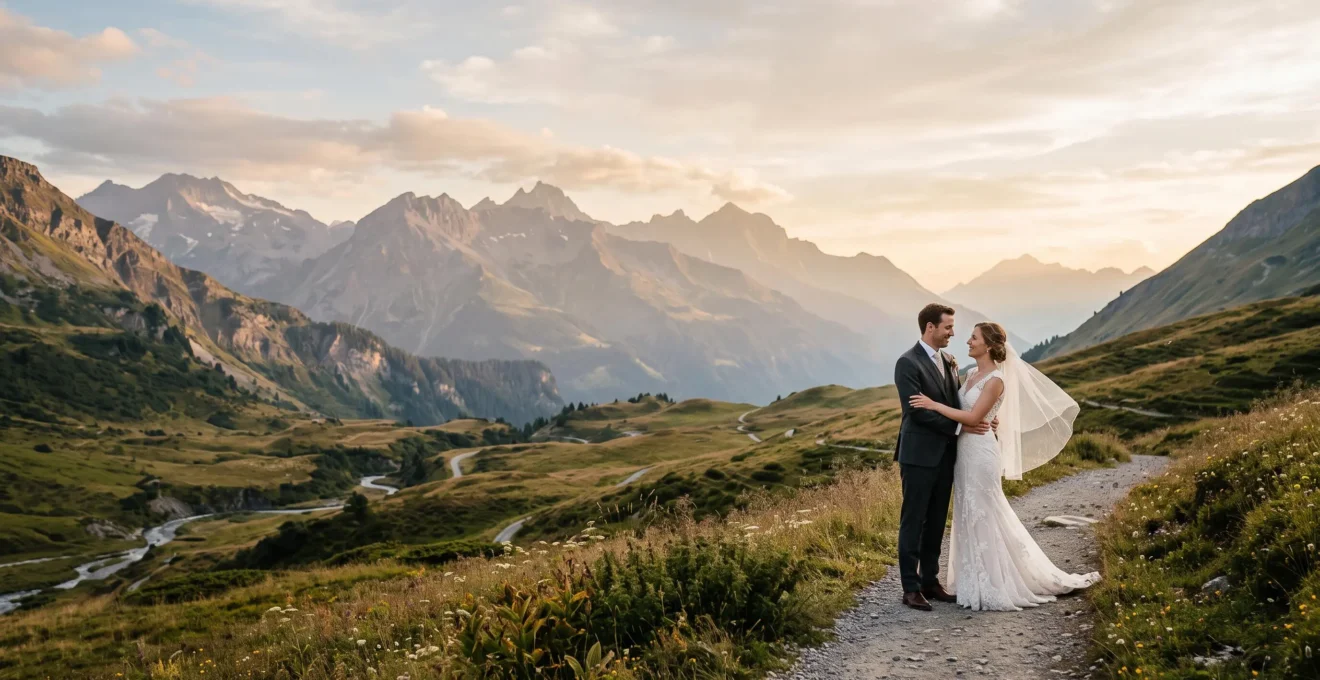
The key to majestic environmental wedding photos isn’t the landscape itself, but your intentional control over the couple’s relationship to it.
- Use compositional scale to dictate emotion: a tiny subject can evoke awe, while balanced proportions create intimacy.
- Master lens dynamics like telephoto compression to create a powerful connection between the couple and distant scenery without risking their safety.
Recommendation: Shift your mindset from being a landscape photographer who shoots people to an environmental storyteller who uses scenery to amplify the couple’s connection.
As a wedding photographer working in spectacular settings, you face a constant creative tension. You see a breathtaking mountain range, a dramatic coastline, or a vast, golden valley and feel compelled to capture its grandeur. Yet, the heart of the day is the couple’s intimate story. The common advice—use a wide-angle lens, wait for the golden hour—often leads to a frustrating outcome: photos where the couple is either lost in the scenery or the epic landscape is reduced to a generic backdrop. This forces a false choice between a powerful portrait and a stunning landscape shot.
Many photographers attempt to solve this by simply placing the couple in front of the view, hoping the combination works. They might experiment with different compositions, like the rule of thirds, but still feel that the human element and the environmental context are competing rather than collaborating. The result can feel accidental, leaving you with a gallery that oscillates between close-ups and wide shots, never truly integrating the two into a cohesive narrative.
But what if the solution wasn’t about choosing between the couple and the landscape? What if the true art lies in using compositional scale, lens choice, and negative space as intentional narrative tools? The most powerful environmental wedding portraits don’t just place a couple in a landscape; they define the relationship between them. This guide moves beyond the basics to provide a strategic framework for creating images where the environment becomes an active and emotional part of the couple’s story, ensuring that every majestic vista serves to amplify, not diminish, their connection.
This article provides a complete framework, from scouting and client communication to the technical and emotional nuances of composition. We will explore how to make strategic decisions that honour both the couple and the environment they chose for their day.
Summary: A Photographer’s Guide to Environmental Storytelling
- Why Some Landscape-Integrated Wedding Photos Feel Majestic While Others Make Couples Look Insignificant
- How to Scout Scenic Landscape Viewpoints Within 10 Minutes of Wedding Venues
- Foreground Landscape Framing or Background Scenic Context: Which Integration Approach Creates Stronger Images
- The Dangerous Positioning Mistake That Risks Couple Safety for Scenic Cliff-Edge Photos
- Which Couples Treasure Scenic Landscape Integration and Which Prefer Intimate Portrait-Focused Coverage
- Tiny Subject in Vast Space or Balanced Proportions: Which Minimalist Approach Suits Emotional Wedding Moments
- The Architectural Dominance Mistake Where Leading Lines Overpower the Wedding Couple
- How to Use Negative Space in Wedding Photography to Create Minimalist Images With Maximum Impact
Why Some Landscape-Integrated Wedding Photos Feel Majestic While Others Make Couples Look Insignificant
The difference between a powerful environmental portrait and a photo where the couple seems lost is rarely about the beauty of the landscape itself. It’s about the intentional control of visual hierarchy and compositional scale. A majestic image makes a deliberate choice about what the viewer should feel, using the environment to create a specific emotional context for the couple. When a couple appears insignificant, it’s often because the composition is accidental, with the vastness of the scene overwhelming them rather than amplifying their presence.
The core principle at play is the relationship between positive space (the subjects) and negative space (the surrounding environment). When this relationship is balanced, the eye is naturally guided. As photographer Alan Ranger notes, this balance is a key storytelling tool. An image can intentionally render a couple as a tiny element to evoke feelings of awe, wonder, or the beginning of a grand journey. In this case, their smallness is the point. Conversely, an image fails when it *unintentionally* makes the couple small, simply because the photographer stood too far back with a wide lens, creating a snapshot rather than a story.
As Alan Ranger explains in his guide on the subject, the balance of space is fundamental to visual storytelling.
The balance between positive and negative space creates a hierarchy of importance within the image. Effective photographers use this balance to guide the viewer’s eye through the composition, telling their story in the most compelling way possible.
– Alan Ranger, What is Negative Space in Photography: A Guide for Beginners
This image of a couple in a vast valley perfectly illustrates this idea. Their small scale isn’t a mistake; it’s a deliberate choice to emphasize the grandeur of their surroundings and the intimacy of their embrace within it. The vast negative space makes their connection the magnetic focal point.
Ultimately, a successful shot is a result of a clear decision: are you using the landscape to frame an intimate moment, or are you using the couple’s presence to give scale and emotion to a grand vista? Both are valid, but the choice must be conscious. Without this intentionality, the couple risks becoming just another detail in a cluttered scene.
How to Scout Scenic Landscape Viewpoints Within 10 Minutes of Wedding Venues
The most breathtaking landscape shots on a wedding day are rarely happy accidents. They are the result of meticulous planning and efficient scouting. With the tight timelines of a wedding, you often have a very small window to get to a location, capture the shot, and return. Mastering the art of digital and on-site scouting within a 10-minute radius of the venue is therefore a non-negotiable skill for an environmental wedding photographer.
Your scouting process should begin weeks before the wedding day, using a combination of mapping tools and specialized photography apps. Start with Google Maps in Satellite and Terrain view to identify potential clearings, viewpoints, interesting rock formations, or waterfronts near the venue. Look for access roads and pull-offs. Once you have a list of potential spots, switch to a photo planning app. This is a critical step that elevates your planning from basic geography to precise photographic execution.
Case Study: Pre-Visualizing the Perfect Shot with PhotoPills
A photographer planning a shot for a wedding day used PhotoPills to determine the exact time and location needed to capture the sun setting behind a specific mountain peak, with the couple positioned perfectly in the foreground. By using the app’s augmented reality and planning features, they were able to pre-visualize the final image from their office. This allowed them to direct the couple to the precise spot at the right moment, turning a potentially chaotic scouting session into a single, perfectly executed, and dramatic shot. This demonstrates how dedicated apps transform guesswork into a guaranteed outcome.
A professional scouting workflow combines these digital tools with on-the-ground reality checks. A location that looks perfect on a map might be on private property, inaccessible, or cluttered with distracting elements like power lines. If possible, visit your top spots in person at the same time of day you plan to shoot. If an in-person visit isn’t feasible, use Google Street View for a virtual walkthrough. Always have a backup location in mind. This structured approach ensures you can confidently guide your couple to an epic spot and capture a stunning image, all within the tight constraints of their special day.
Foreground Landscape Framing or Background Scenic Context: Which Integration Approach Creates Stronger Images
Once you’ve found your scenic location, you face another crucial creative decision: how to integrate the couple with the environment. There are two primary approaches, each creating a vastly different emotional tone. The first is foreground landscape framing, where you use natural elements close to the lens to frame the couple. The second is using a background scenic context, where you position the couple within the scene and use your lens to manage their relationship with a distant, grand backdrop. Neither is inherently “stronger,” but choosing the right one depends entirely on the story you want to tell.
Foreground framing creates a sense of intimacy, discovery, and depth. By shooting through leaves, flowers, or tall grasses, you create soft, out-of-focus layers that draw the viewer’s eye toward the couple. This technique makes the viewer feel like they are peeking into a private moment. It uses the environment not as a grand statement, but as a soft, textural element that adds color and a sense of place. This approach works best with standard or macro lenses at wide apertures (like f/2.8) to achieve that shallow depth of field that separates the layers.
The background context approach, on the other hand, aims for majesty and scale. This is where you place the couple in the mid-ground and use a telephoto lens to compress the perspective. This technique makes distant elements, like mountains or a city skyline, appear larger and closer to the couple than they are in reality. This creates a powerful, layered image where the couple is clearly the subject, yet they are visually connected to the epic scale of the background.
A telephoto lens completely changes how you capture nature: by compressing perspective, it makes distant elements stack together and pulls out tiny details, causing mountain ranges to stack into layers.
– DIYPhotography Editorial Team, Telephoto Lens for Landscape Photography: Compression Techniques
Choosing between these two methods comes down to your narrative goal. Do you want to create a sense of quiet, hidden intimacy? Choose foreground framing. Do you want to create a feeling of epic, shared adventure? Choose background context with a telephoto lens. The strongest photographers have both techniques in their arsenal and know precisely when to deploy each one.
The Dangerous Positioning Mistake That Risks Couple Safety for Scenic Cliff-Edge Photos
The desire for a “wow” shot can sometimes lead photographers to make a dangerous mistake: placing couples in precarious positions, such as on unstable cliff edges or too close to a steep drop, for the sake of a dramatic photo. This not only puts your clients at unnecessary risk but is also often creatively limiting and technically unnecessary. The most common justification for this is to “get the whole view in,” but this often stems from a misunderstanding of how lens choice can manipulate perspective for you.
The secret to achieving those dramatic, edge-of-the-world shots without the actual danger lies in mastering telephoto lens compression. Instead of placing the couple at the edge, find a safe, stable location further back from the precipice. Then, move yourself further back and use a longer lens (e.g., 85mm, 135mm, or 70-200mm). This technique has a powerful optical effect. As noted by photography experts, a telephoto lens creates an illusion of proximity between different elements in your frame.
The narrow angle of view on a telephoto lens means that the relative size and distance between objects appears smaller, creating the illusion that elements might be closer together than they really are.
– Arizona Highways Editorial Team, Telephoto Compression
By using this compression, you can make a dramatic background feature appear as if it’s right behind the couple, even if they are a safe distance from the edge. You get the epic scale and the connection to the landscape without any of the risk. This approach prioritizes safety while simultaneously producing a more refined, professional, and compositionally strong image. It separates the pros from the amateurs. No shot is worth risking your clients’ safety, especially when a better, safer creative solution is available.
Cliff-Edge Safety Checklist for Photographers
- Use Telephoto Lenses: Step back and use a long lens to compress the background. This creates drama without requiring you or the couple to be near the edge.
- Favor Stable Ground: Always choose open, elevated vantage points on solid ground over crumbling ledges or loose rock.
- Assess the Drop: If you cannot clearly see the area below the edge you are considering, you are too close. Step back immediately.
- Respect Barriers: If you find yourself on the ocean or cliff side of any man-made fence, railing, or barrier, you are in a dangerous zone. Step back to a safe area.
- Communicate Clearly: Always maintain clear communication with the couple about where they can and cannot stand safely. Their comfort and safety are your primary responsibilities.
Which Couples Treasure Scenic Landscape Integration and Which Prefer Intimate Portrait-Focused Coverage
Not every couple who gets married in a beautiful location wants their photos to be dominated by epic landscapes. Understanding your clients’ expectations is just as crucial as mastering your compositional techniques. A key part of your job as a photographer is to guide a conversation that reveals what kind of imagery will truly resonate with them. Some couples are adventurous and see the landscape as a major character in their story, while others are more focused on the intimate, emotional moments, with the location serving as a gentle, supportive backdrop.
The trend in the wedding industry provides a helpful starting point. A recent analysis of the wedding photography market shows that a majority of couples are moving away from overly posed, formal shots. In fact, over 70% of couples prefer a candid style, with 60% looking for narrative-driven, storytelling coverage. This indicates a general desire for authenticity and emotion over pure spectacle. However, “candid” and “narrative” can mean different things to different people. For one couple, it might mean capturing a quiet laugh against a vast mountain range; for another, it’s a tight shot of an emotional embrace where the background is completely blurred.
Furthermore, cultural context and regional preferences can play a significant role in shaping a couple’s vision. What is popular in one part of the world might be less common in another. This highlights the importance of not making assumptions based on general trends alone.
| Region | Dominant Wedding Photography Style |
|---|---|
| North America | Candid photography (largest segment) |
| Asia-Pacific | Fine art photography (rapidly gaining traction) |
The best approach is to be direct during your consultation. Show them examples from your portfolio that represent both ends of the spectrum: the epic, “tiny-couple-in-a-vast-landscape” shots and the intimate, “portrait-focused” shots. Ask them which images they feel more drawn to and why. Questions like, “When you picture your wedding photos on the wall, do you see a grand, scenic piece of art, or a close-up, emotional moment?” can be incredibly revealing. This conversation doesn’t just manage expectations; it builds trust and ensures that the final gallery you deliver is one they will treasure.
Tiny Subject in Vast Space or Balanced Proportions: Which Minimalist Approach Suits Emotional Wedding Moments
Within minimalist composition, the decision to portray a couple as a tiny element in a vast space or as a more proportionally balanced subject is a powerful one. Each approach communicates a different emotional story. The “tiny subject” approach is not about diminishing the couple, but about using the overwhelming scale of the environment to evoke feelings of awe, solitude, and the sublime. It places the couple’s relationship within a context that is grand and timeless, suggesting the start of a great adventure together.
This technique is most effective during quiet, contemplative moments: the couple looking out over a valley at dawn, walking hand-in-hand on an empty beach, or sharing a quiet moment under a vast, starry sky. The emotional core of this approach, as noted by PhotoArtMag, is the relationship between the subject and the surrounding emptiness. The emptiness isn’t truly empty; it’s filled with emotion and potential.
Small element in huge space feels different from moderate element with less space — that difference is the emotional core, as the subject feels small, isolated, vulnerable through its relationship to surrounding emptiness.
– PhotoArtMag Editorial Team, Negative Space and Minimalism in Photography
In contrast, a more balanced minimalist composition, where the couple occupies a more significant portion of the frame but is still surrounded by clean, uncluttered negative space, creates a feeling of intimacy, calm, and connection. Here, the focus is more on the couple’s interaction with each other, with the negative space serving to eliminate distractions and create a peaceful, serene atmosphere. This approach is perfect for capturing a tender embrace, a shared laugh, or a quiet vow exchange.
Achieving a successful minimalist composition, regardless of scale, requires discipline. The key is to relentlessly eliminate distractions from the frame. Here’s a simple workflow for building these types of shots:
- Find a simple subject: Start by identifying your couple as the primary subject and look for a clean, uncluttered background (a clear sky, an open field, a calm body of water).
- Position with intention: Place the couple off-center using principles like the rule of thirds. This creates visual interest and allows the negative space to breathe.
- Ensure zero distractions: Scan every corner of your frame. The smallest distracting element—a stray branch, a sign in the distance—will pull the viewer’s eye and ruin the minimalist effect.
The Architectural Dominance Mistake Where Leading Lines Overpower the Wedding Couple
Leading lines are one of the first compositional tools photographers learn: use lines in the environment to guide the viewer’s eye to the subject. In both natural and architectural settings, you can find powerful lines in pathways, fences, riverbanks, or building facades. However, a common mistake, especially in architecturally rich environments, is allowing these lines to become so dominant that they overpower the couple or, worse, lead the viewer’s eye right past them.
This “architectural dominance” happens when the lines are too strong, too numerous, or converge on a point that isn’t your subject. Imagine a grand staircase in a historic venue; if the couple is placed awkwardly to the side, the powerful lines of the banisters might draw all the attention, making the couple feel like an afterthought. The purpose of a leading line is to serve the subject, not to become the subject itself. When the architecture starts screaming for attention, the intimate human story gets lost in the noise.
The solution is to reclaim control and make the lines work for you. There are several ways to do this:
- Position the couple at the convergence point: The most straightforward solution is to place the couple at the exact point where the lines converge or intersect. This makes them the undeniable destination of the visual journey.
- Use the lines as frames: Instead of just leading to the couple, can the lines frame them? Think of using an archway, a window frame, or two parallel lines (like a path) to create a natural container for the couple within the composition.
- Break the line with your subject: Position the couple directly on a strong line to interrupt its flow. Their form will act as a “stop sign,” capturing the viewer’s attention and establishing their importance in the scene.
- Soften the lines with depth of field: If the lines in the foreground or background are too distracting, use a wider aperture to create a shallower depth of field. This can soften the lines, reducing their dominance while still allowing them to provide compositional structure.
As one high-impact tip for wedding photographers suggests, the goal is always to maintain the couple’s dominance. In visually busy scenes, this often means simplifying your composition and consciously deciding how every line serves the primary subjects. Before you click the shutter, ask yourself: “Where are my eyes going?” If the answer isn’t “the couple,” you need to recompose.
Key takeaways
- Scale as an Emotional Tool: The size of the couple relative to the landscape isn’t just a compositional choice; it’s a narrative one. Use it intentionally to evoke awe, intimacy, or solitude.
- Telephoto is Your Friend: Master telephoto lens compression to create dramatic, layered images that connect your couple to the scenery safely and creatively, eliminating the need for risky positioning.
- The Style Conversation is Key: Never assume a couple wants “epic” shots. A direct conversation using visual examples is the only way to align your creative vision with their personal desires.
How to Use Negative Space in Wedding Photography to Create Minimalist Images With Maximum Impact
Negative space—the area around and between your subjects—is one of the most powerful and often misunderstood elements in composition. In the context of wedding photography, it’s the quiet that makes the emotion audible. Rather than filling the frame with information, intentionally using negative space allows you to strip away distractions, focus the viewer’s attention, and create images that feel calm, elegant, and deeply impactful. It’s the visual equivalent of a whisper in a loud room; it commands attention precisely because of its subtlety.
The function of negative space is to give your subject breathing room. An open sky, a calm sea, a clean wall, or a vast, empty field can all serve as a canvas that isolates and elevates the couple. This technique is especially effective for highlighting a gesture, a glance, or a quiet embrace. By removing all other competing visual elements, you amplify the emotional weight of that single moment. The emptiness itself becomes a frame, guiding the eye directly to the heart of the image: the human connection.
Think of your subject (the couple) as the noun in your visual sentence. As photographer Jimmy Marble so eloquently put it, the negative space then becomes the adjective. It describes the noun, giving it context and emotional coloring.
The Negative Space is the adjective if the model or performer is the noun.
– Jimmy Marble, Negative Space In Photography: From Nothing To Something
Is the negative space vast and open? The couple feels adventurous and free. Is it soft, serene, and minimal? The couple feels peaceful and intimately connected. By consciously choosing and shaping the negative space in your compositions, you move beyond simply documenting a scene. You begin to sculpt it, using simplicity as a tool to create minimalist images with maximum emotional resonance. It’s a shift from showing everything to showing only what truly matters.
Apply this framework of intentional scale, lens choice, and narrative tension on your next shoot. By shifting your perspective from merely documenting to actively storytelling, you can transform your environmental portraits from simple records into emotionally resonant works of art.