
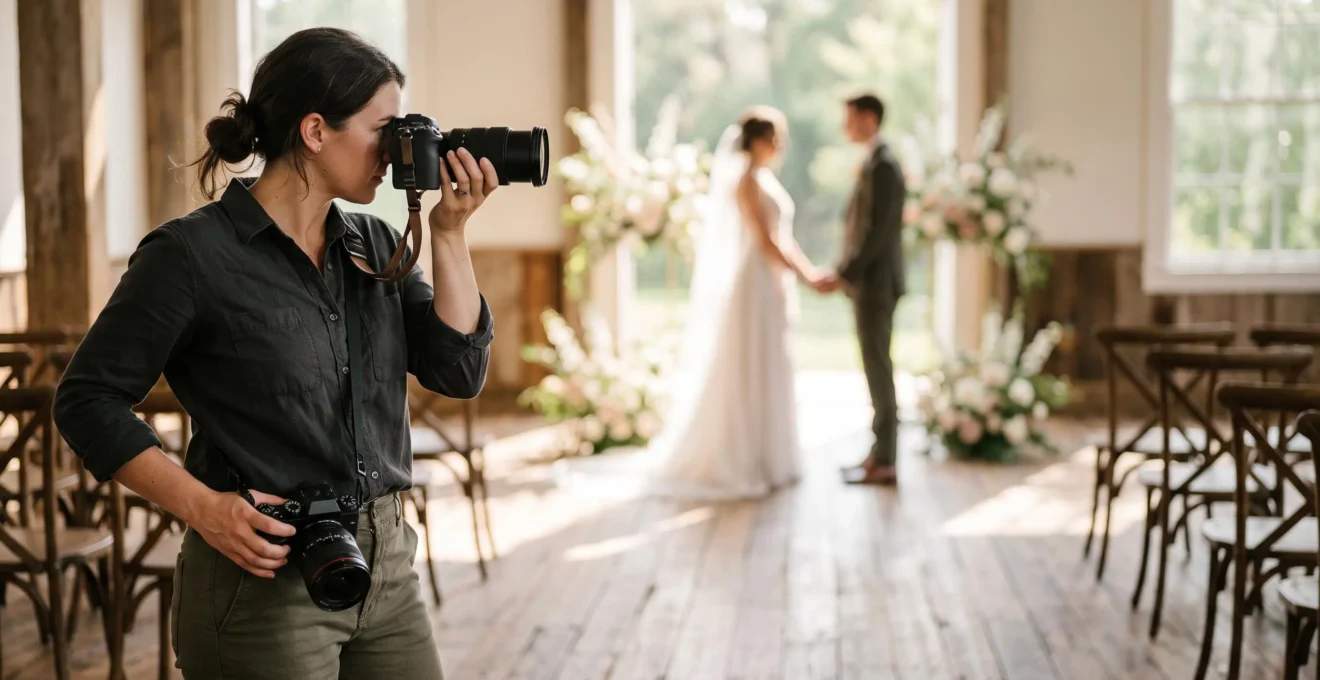
The secret to successful hybrid wedding photography isn’t just offering two styles; it’s mastering the operational shift between two distinct mindsets—the Observer and the Director—without creating a disjointed final gallery.
- Effective hybrid work demands up to 30% more contracted time to accommodate both spontaneous capture and directed sessions.
- Gallery cohesion is achieved not during the shoot, but through a consistent post-production philosophy that acts as a “stylistic bridge” between candid and posed images.
Recommendation: Stop thinking in terms of clashing styles and start structuring your timeline, workflow, and editing process around these two complementary operational modes.
As a wedding photographer, you’ve likely faced a familiar dilemma. One couple wants unscripted, raw, photojournalistic coverage that captures the authentic spirit of their day. The next wants polished, beautifully lit, editorial-style portraits that look like they belong in a magazine. Many modern couples, paradoxically, want both. This leaves you navigating a creative tightrope, trying to be an invisible storyteller one moment and a confident director the next. The common advice is to simply “offer a mix,” but this often leads to rushed timelines, missed moments, and a final gallery that feels stylistically confused.
The challenge isn’t a lack of skill but a lack of a cohesive operational framework. Trying to simply bolt a “posed” session onto a “reportage” day is a recipe for friction. But what if the solution wasn’t about blending styles, but about mastering the rapid, seamless transition between two distinct professional roles? What if the key to a harmonious gallery lies not in how you shoot, but in a unifying philosophy applied long after the camera is put away? This is the core of the modern hybrid approach: a method that embraces the dual demands of today’s clients by treating reportage and portraiture as different modes of execution, not opposing artistic identities.
This guide moves beyond the generic advice. We will break down the strategic, mental, and technical shifts required to excel at hybrid wedding photography. We’ll explore why more time is non-negotiable, how to mentally switch from observer to director in seconds, and how to build a final gallery that feels intentional and unified, satisfying every client expectation.
To navigate this complex but rewarding approach, this article provides a structured roadmap. The following sections break down each component, from time management and mental preparation to gear choices and post-production strategies, giving you a complete system for mastering hybrid coverage.
Summary: How to Master Modern Hybrid Wedding Coverage That Satisfies Both Reportage and Portrait Expectations
- Why Successful Hybrid Coverage Requires 30% More Contracted Time Than Pure Reportage or Traditional Approaches
- How to Switch Between Photojournalist and Portrait Director Mindsets in Under 60 Seconds
- Dual Camera Bodies or Single Body With Fast Lens Changes: Which Hybrid Workflow Misses Fewer Moments
- The Stylistic Inconsistency That Makes Hybrid Wedding Galleries Feel Disjointed and Confusing
- Which Wedding Moments to Shoot Pure Reportage and Which to Gently Direct for Better Results
- Why Educated Urban Couples Increasingly Request Pure Reportage Over Posed Wedding Photography
- Why Couples Expect 25+ Portrait Variations When You Only Have 15 Minutes of Their Attention
- How to Master Reportage Wedding Photography Without Any Posed Intervention
Why Successful Hybrid Coverage Requires 30% More Contracted Time Than Pure Reportage or Traditional Approaches
The single most common mistake in offering hybrid wedding photography is underestimating the time required. It is not simply an 8-hour day with a “mix” of photos; it is effectively two distinct shoots running concurrently, and that requires a significant time buffer. While an 8-hour package is a common industry standard, it’s a standard built for a single-style approach. A hybrid photographer must budget time for both observing spontaneous moments and creating directed ones. This dual role means you cannot be in two places—or two mindsets—at once.
Consider the getting-ready portion of the day. A pure photojournalist can focus entirely on the candid interactions. A hybrid photographer, however, must capture those moments *and* find a 30-45 minute window for controlled detail shots of rings, attire, and invitations. The same principle applies to the reception; capturing candid guest reactions, speeches, and dances already requires 1.5-2 hours. Adding directed portraits with special lighting or creative concepts means you need to build that time into the schedule from the start. When the timeline is too tight, it’s these directed, creative moments or the quiet, candid interactions that get sacrificed first.
Successfully executing a hybrid wedding means adding a buffer of at least 25-30% more time compared to a single-style shoot. For a standard 8-hour day, this means booking a 10-hour package is the realistic minimum. This extra time isn’t a luxury; it’s a fundamental requirement. It’s the resource that allows you to transition between the Observer and Director modes without rushing, to set up for a portrait without missing a key candid moment, and to deliver on the dual promises made to your clients.
How to Switch Between Photojournalist and Portrait Director Mindsets in Under 60 Seconds
The greatest challenge in hybrid photography isn’t technical; it’s mental. The ability to shift from the passive, observant mindset of a photojournalist to the active, assertive mindset of a portrait director is the core skill. The photojournalist operates on the principle of the “decisive moment”, anticipating and capturing events without interference. You are a ghost, documenting reality as it unfolds. Your focus is on observation, patience, and prediction. You blend in, look for authentic emotion, and remain ready for the unpredictable.
The portrait director, however, creates reality. You are in control of light, location, and posing. Your role is to communicate a vision, guide the couple into flattering positions, and construct a scene. This requires confidence, clear communication, and a proactive approach. Attempting to hold both mindsets simultaneously leads to failure in both: you become too visible to capture true candids and too hesitant to direct effectively. The key is to compartmentalize and execute a rapid “mindset switch”. This is a conscious, deliberate mental reset you perform before transitioning from one part of the day to another.
For example, when moving from the candid ceremony coverage to the family formals, take 60 seconds. Put the camera down, take a deep breath, and mentally articulate the shift: “I am now the Director. My goal is efficiency, clear instruction, and beautiful light.” Conversely, after the portraits are done and the reception begins, repeat the process: “I am now the Observer. My goal is to become invisible, anticipate moments, and capture emotion.” This simple ritual prevents role confusion and allows you to perform each task with the focus it requires. It’s about encouraging the couple to interact naturally during directed moments and knowing when to step back entirely during candid ones.
Action Plan: The 60-Second Mindset Shift
- Declare the Transition: Verbally or mentally state which mode you are entering (“Entering Director Mode,” “Switching to Observer Mode”). This creates a clear mental break.
- Define the Objective: State the single most important goal for the upcoming segment (e.g., “Capture the emotional peak of the speeches” or “Execute the portrait shot list efficiently”).
- Adjust Your Physicality: As a Director, stand taller, use hand gestures, and make eye contact. As an Observer, lower your profile, move slowly along the edges of the room, and minimize interaction.
- Prime Your Gear: Set up your camera and lens for the task at hand *before* you begin. A Director might switch to a portrait lens and check their flash, while an Observer might opt for a wider, faster lens for low light.
- Take One Cleansing Breath: Use a single deep breath to release the stress and focus of the previous mode and fully commit to the new one.
Dual Camera Bodies or Single Body With Fast Lens Changes: Which Hybrid Workflow Misses Fewer Moments
Your gear workflow must support your ability to switch between Observer and Director modes instantly. The debate between using two camera bodies versus one body with frequent lens changes is central to this. Neither is universally “better,” but one will be better for *your* hybrid approach. The choice is a trade-off between speed and agility versus weight and complexity.
The dual-camera body workflow is the professional standard for a reason: it minimizes missed moments. Typically, this involves a wide-angle prime (like a 35mm) on one body for environmental, photojournalistic shots, and a longer lens (like an 85mm or a 70-200mm) on the other for portraits and tight candid moments. The primary advantage is speed. When a spontaneous moment happens, you don’t need to change lenses; you simply raise the other camera. This is invaluable during fast-paced segments like the ceremony processional or reception dances, where the scene can shift from wide to tight in an instant. The main drawbacks are the physical strain of carrying two bodies and the higher equipment cost. Some photographers also find it can be a barrier to connecting with guests, making you appear more “geared up.”
The single-body workflow relies on a high-quality zoom lens (like a 24-70mm f/2.8) or very fast lens changes. This approach makes you lighter, more agile, and less intimidating. You can move more freely and blend into the background, which is ideal for the Observer mode. However, you accept the risk of missing a shot while swapping lenses. Even the fastest lens change takes a few seconds—enough time for a perfect expression or a fleeting laugh to disappear. This workflow is best suited for photographers who are extremely proficient with their gear and can anticipate moments well in advance, or for weddings with a slower, more predictable pace. It’s a system that prioritizes mobility over instantaneous versatility, and it’s a calculated risk every time.
The Stylistic Inconsistency That Makes Hybrid Wedding Galleries Feel Disjointed and Confusing
The most significant danger of the hybrid approach is delivering a gallery that feels like two different weddings stitched together. One part is gritty, spontaneous, and photojournalistic; the other is bright, clean, and perfectly posed. While you may have fulfilled the client’s request for “both,” the lack of a unifying vision makes the final product feel amateurish and confused. True mastery of the hybrid style is found in creating what can be called a “stylistic bridge.” This bridge is not built during capture; it’s built in post-production.
As photographer Drew Bird notes, a successful approach is often a “blend of fine art photography, the documentary style, and really creative portrait photography.” The key word is “blend.” This blending happens through a consistent editing philosophy. Your color grading, contrast levels, and overall treatment of light and shadow must be uniform across both the candid and the directed images. A warm, filmic color grade applied to a raw, emotional candid should feel related to the same grade applied to a perfectly lit editorial portrait. The editing is the signature that tells the viewer these images all belong to the same story, regardless of how they were captured.
This means you must resist the urge to edit “to the style.” Do not process your reportage shots with a gritty, high-contrast black-and-white look while giving your portraits a soft, airy, and bright feel. This is the very definition of a disjointed gallery. Instead, develop a single, robust editing preset or style that is versatile enough to enhance both types of images. It should complement a wide range of lighting conditions and bring a sense of cohesive mood to the entire set. The goal is for a client to look at a candid moment and a posed portrait side-by-side and feel they are part of the same beautiful, intentional narrative.
Which Wedding Moments to Shoot Pure Reportage and Which to Gently Direct for Better Results
Knowing *when* to be the Observer and *when* to be the Director is critical for a smooth day and a balanced gallery. While every wedding is unique, there are clear patterns for which approach yields the best results. The guiding principle is simple: if a moment’s value lies in its raw, unscripted emotion, it demands a pure reportage approach. If its value lies in its aesthetic composition and ensuring everyone looks their best, it benefits from gentle direction.
Moments best suited for pure reportage (Observer Mode) are those that cannot be replicated and whose power comes from their authenticity. These include: the first look reaction, the ceremony (especially the vows and ring exchange), emotional moments with parents, guest interactions during cocktail hour, speeches, and candid dancing. In these scenarios, your intervention would destroy the very thing you’re trying to capture. Your job is to anticipate, find the best angle without being noticed, and document the story as it unfolds.
Conversely, some moments require gentle direction (Director Mode) to achieve a successful outcome. This doesn’t mean stiff, unnatural posing, but rather “directed authenticity.” This includes: getting-ready portraits (e.g., “Could you put on your earrings while looking towards the window light?”), the couple’s portrait session, family formals, and bridal party photos. Here, the goal is not to document a spontaneous event, but to create beautiful, timeless images efficiently. As one expert notes, traditional and editorial styles “involve much more direction — posing, organizing, and creating specific images according to a shot list.” You are creating a space for the couple to interact naturally within a controlled, well-lit environment. A wedding album that is only candid may feel incomplete without these cornerstone portraits, just as one that is entirely posed can feel sterile.
Why Educated Urban Couples Increasingly Request Pure Reportage Over Posed Wedding Photography
The rise in demand for hybrid photography is not accidental; it’s driven by a significant shift in client preferences, particularly among educated, urban couples. These clients are often more exposed to contemporary art, documentary film, and modern visual storytelling. They grew up with the internet, value authenticity, and are generally wary of anything that feels staged or inauthentic. For them, a wedding is not a series of photo-ops but an experience to be lived, and they want photography that reflects that reality.
This trend is backed by hard data. According to Zola’s 2026 First Look Report, a recent survey of over 11,500 engaged couples found that 67% of couples surveyed prefer natural, unposed, documentary-style wedding photography. This is a clear market signal. As photographer Greg Thomas defines it, this approach “prioritizes capturing real, unscripted moments over posed or directed images.” Couples are explicitly asking for a photographer who can act as an observer, not an orchestrator.
However, this desire for authenticity doesn’t entirely erase the long-standing tradition of the formal wedding portrait. While they request reportage, they still implicitly expect beautiful portraits of themselves, their family, and their wedding party. They want the best of both worlds: the raw emotion of photojournalism and the timeless elegance of classic portraiture. This is the central tension a hybrid photographer must resolve. Understanding that the demand for reportage is a sophisticated desire for authenticity and emotional truth—not a rejection of portraiture itself—is key to communicating your value and managing expectations effectively.
Why Couples Expect 25+ Portrait Variations When You Only Have 15 Minutes of Their Attention
Here lies the core operational challenge for the hybrid photographer: the profound mismatch between client expectations for portrait variety and the actual time allotted. While couples increasingly favor a documentary approach for most of the day, their perception of the portrait session is shaped by polished online galleries. They see dozens of beautifully varied portraits and assume it’s a quick and easy process. The reality is that creating 25+ distinct portrait variations requires significant time—time that is often compressed into a frantic 15-30 minute window between the ceremony and reception.
The rise of the “first look” has both helped and hindered this. While about 85% of couples now choose to do a first look, which can create a dedicated 45-60 minute portrait window, this time is also used for family and wedding party photos, further squeezing the time for creative couple’s portraits. Without a first look, you are left with the cocktail hour, where the couple also wants to mingle with guests. This pressure creates a scenario where you are expected to deliver a high volume of creative work in an impossibly short timeframe. For example, simply getting a few creative detail and ring shots can take 30-45 minutes alone.
Managing this expectation begins with education during the booking process. Using a visual aid, like a comparative table, can be incredibly effective in demonstrating what is realistically achievable within different timeframes.
| Coverage Duration | Best Suited For | Realistic Outcome |
|---|---|---|
| 6 Hours | Simpler weddings, single location | Core portrait set with limited variety; no elaborate exits or extended dance floor coverage |
| 8 Hours | Most popular choice among couples | Ample time to capture everything from getting ready to the dance floor, especially with a first look or multiple locations |
| 10 Hours | Complex logistics weddings | Room for a break between ceremony and reception, multiple portrait locations, or dual ceremonies |
As the table above, derived from a recent analysis of wedding timelines, illustrates, more time directly translates to more variety. By clearly showing that a 10-hour day allows for multiple portrait locations while a 6-hour day provides a more limited set, you can help couples align their desires with their schedule. This proactive communication is crucial to avoid disappointment and ensure you have the time you need to be both an Observer and a Director effectively.
Key Takeaways
- Hybrid photography isn’t a single style, but the mastery of two distinct operational modes: the observant Photojournalist and the proactive Director.
- Successful hybrid coverage is impossible without adequate time; a 10-hour contract should be the standard for an 8-hour wedding to allow for transitions.
- Gallery cohesion comes from a unified editing philosophy—a “stylistic bridge”—that ensures both candid and posed shots feel like part of the same story.
How to Master Reportage Wedding Photography Without Any Posed Intervention
To be a great hybrid photographer, you must first be a great photojournalist. The reportage component is the bedrock of the modern wedding story, and mastering it requires a commitment to non-intervention. This is more than just taking candid photos; it’s about building a narrative through observation. Market research confirms that in North America, candid photography remains the largest wedding photography segment, making this skill set commercially essential.
The essence of this approach is capturing raw, unposed moments, allowing true emotions to shine through. It’s about telling the story of the day as it genuinely happened. To do this effectively, you must become part of the background—a quiet, constant presence. This requires situational awareness and the ability to anticipate moments before they happen. Watch for the tear in a parent’s eye during the vows, the burst of laughter between friends, the quiet, reassuring hand-squeeze under the table. These are the moments that give a wedding gallery its soul.
Mastering this style involves several key practices. First, use your environment to your advantage. Shoot through doorways, use reflections, and position yourself at the edge of the action to remain unobtrusive. Second, rely on longer lenses when possible to capture intimate moments from a distance. Third, and most importantly, be patient. Photojournalism is a waiting game. There will be lulls, but it’s in those quiet periods that you must remain alert, because the most profound moments often arise without warning. It’s a discipline that trades the control of portraiture for the profound reward of authenticity.
By structuring your work around the distinct modes of Observer and Director, you can move beyond the frustrating compromises of “mixed” styles and begin delivering a truly cohesive, emotionally resonant, and modern hybrid product. The next logical step is to audit your own portfolio and timeline templates to identify where these principles can be immediately applied to enhance your service and better manage client expectations.