
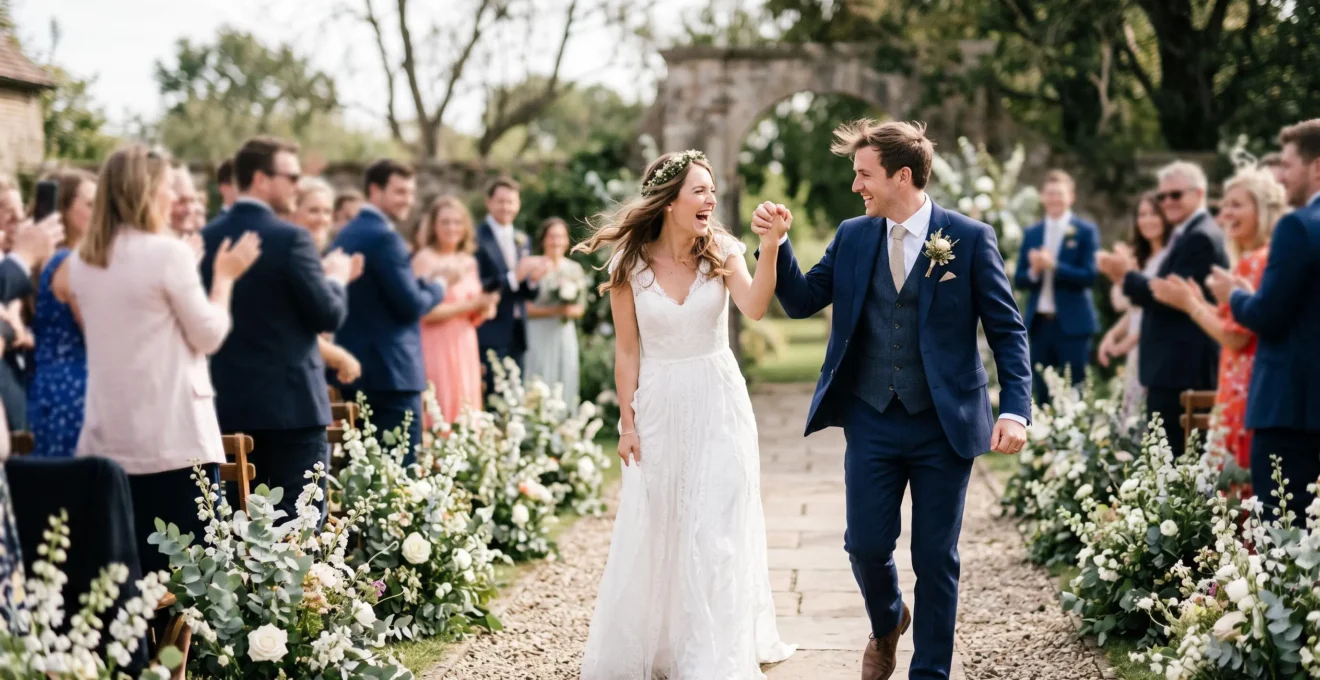
The secret to vibrant recessional photos isn’t better camera settings; it’s understanding the precise moment of “cognitive release” when a couple’s formal tension transforms into pure, uninhibited joy.
- Most photographers focus on technicals, but the real magic comes from anticipating the neurological flip from ceremony restraint to celebratory euphoria.
- Mindless continuous shooting creates a “paparazzi effect” that stifles emotion, while purposeful, timed bursts capture peak moments.
Recommendation: Shift your focus from simply documenting the walk to capturing the story of emotional release, and your recessional images will transform from stiff to spectacular.
We’ve all seen it: the recessional photos that should be the pinnacle of wedding day joy but instead show a couple walking stiffly, eyes locked on the ground, wearing a forced smile. As a photographer, it’s a frustrating moment. You know the energy is there, but your images show a self-conscious march rather than an explosion of happiness. The common advice is predictable: use a wide lens, shoot in burst mode, or stand in the middle of the aisle. While these technical tips have their place, they often fail to address the core problem and can even make it worse, turning a sacred moment into a high-pressure paparazzi run.
The issue isn’t a lack of joy from the couple; it’s a failure to understand the delicate dynamics of the moment itself. Capturing authentic emotion requires more than just the right gear; it requires a deep understanding of human psychology and the narrative arc of the day. The recessional isn’t just another event to document; it’s the cathartic climax of a deeply emotional journey. It’s the physical and mental release after minutes—or hours—of intense focus, public vulnerability, and formal restraint.
But what if the key to unlocking that authentic joy wasn’t in telling the couple what to do, but in anticipating how they will naturally react? What if the secret lay in understanding the very predictable, neurological shift from high-tension ceremony to euphoric celebration? This is the concept of cognitive release. By focusing on this moment of transition, you can move beyond stiff documentation and start capturing the powerful, kinetic, and utterly genuine energy that makes a recessional so magical.
This guide will deconstruct the recessional, not as a logistical challenge, but as an emotional event. We will explore the science behind that jubilant feeling, how to choose your position to best capture it, and how to use your camera not as a machine gun, but as a precise storytelling tool. Prepare to change the way you see—and shoot—the walk back down the aisle.
Summary: Unlocking the Joy of the Wedding Recessional
- Why Ceremony Recessionals Feel Jubilant and Energetic While Processionals Feel Formal and Restrained
- Centre Aisle Position or Side Angle Coverage: Which Captures More Powerful Recessional Energy
- Couple’s Joy or Guest Reactions: Which to Prioritise During Fast-Paced Ceremony Recessionals
- The Continuous Shooting Mistake That Makes Recessionals Feel Like Paparazzi Assault
- When to Anticipate Recessional Pauses for Kisses Versus Couples Who Walk Straight Through
- When to Press the Shutter During Dynamic Action: Before, During, or After Peak Movement
- Why Authentic Laughter Erupts in Predictable Patterns During Wedding Speeches and Toasts
- How to Build Compelling Wedding Day Storytelling From Preparation Through to Final Exit
Why Ceremony Recessionals Feel Jubilant and Energetic While Processionals Feel Formal and Restrained
The stark contrast between the processional and the recessional isn’t just a matter of direction; it’s a profound psychological and physiological event. The walk *to* the altar is defined by anticipation, nervous energy, and immense social pressure. The body is held in a state of high-alert restraint. The walk *away* from the altar is the exact opposite: it’s a moment of cognitive release. This is the instant the brain’s tension-fueled chemistry flips to a reward-driven state, flooding the body with endorphins. The result is a visible, often explosive, burst of pure, uninhibited joy.
The Science of a Smile: Endorphins and Social Laughter
This “cognitive release” isn’t just a feeling; it has a clear biological basis. Researchers used advanced imaging to find that social laughter leads to endogenous opioid (endorphin) release in specific brain regions. The recessional, filled with cheers and laughter from guests, acts as a massive trigger for this neurochemical reward system, creating the authentic, radiant happiness that stiff processional photos lack.
As a photographer, your job is to capture this shift. Notice the change in posture: shoulders that were tight and raised during the vows will drop and relax. Hands that were clenched will loosen. The couple’s steps become lighter and faster, their bodies turning towards each other. This is the physical manifestation of that endorphin rush. The formal, performative aspect of the ceremony is over, and what you are witnessing is a raw, celebratory release. It’s a moment of pure emotion, driven by powerful brain chemistry, and it’s highly contagious.
This contagious energy is a key element to capture. As Professor Robin Dunbar of the University of Oxford notes, “laughter is highly contagious, and the endorphin response may thus easily spread through large groups.” The couple’s joy ignites the guests, and the guests’ cheers amplify the couple’s joy, creating a powerful feedback loop of celebration. Understanding this dynamic is the first step to moving beyond documenting a walk and starting to capture a feeling.
Centre Aisle Position or Side Angle Coverage: Which Captures More Powerful Recessional Energy
The classic recessional shot is taken from the very end of the aisle, looking straight at the approaching couple. This position creates a powerful, symmetrical “hero shot” that emphasizes the architecture of the venue and the grandness of the moment. Using a wide-angle lens like a 16-35mm or a versatile medium zoom like a 24-70mm from this spot allows you to capture the couple, the cheering guests, and the environment in a single, epic frame. It’s a safe, reliable, and often beautiful composition that tells a clear story of “just married.”
However, while the centre-aisle position excels at capturing scale, it can sometimes feel impersonal and distant. It places the photographer in the role of an observer rather than a participant in the emotion. To capture the more intimate, kinetic energy of the cognitive release, a side-angle approach offers a compelling alternative. By moving off-centre, perhaps a few rows back, you can get closer to the couple’s expressions, capture the texture of their movement, and create a more dynamic and engaging frame. This position allows you to focus on the connection *between* the couple—the shared glance, the squeeze of a hand, the head thrown back in laughter.
The optimal strategy, especially if you have a second shooter, is to do both. The lead photographer can secure the iconic wide, symmetrical shot from the end of the aisle for the first few seconds of the recessional. As the couple passes, the second shooter (or the lead, after moving quickly) can capture the interaction from a side angle. Having shooters on different lenses—one wide, one tighter—ensures you get both the epic environmental story and the intimate emotional story. This two-pronged approach provides a richer, more complete narrative of the moment, combining the grand celebration with the personal joy.
Couple’s Joy or Guest Reactions: Which to Prioritise During Fast-Paced Ceremony Recessionals
The recessional is a whirlwind of emotion, and it’s not limited to the couple. The joy on the faces of parents, the tears in a sibling’s eyes, and the roaring laughter of friends are all integral parts of the story. As the Rangefinder editorial team points out, “it’s a moment that captures the emotions of not only the couple, but also their family and friends.” The challenge for the photographer is deciding where to point the lens when everything is happening at once. Do you stay locked on the couple, or do you pivot to capture the reactions of their loved ones?
The answer is not to choose one over the other, but to anticipate and frame for both. The priority must remain the couple, as they are the emotional core of the moment. However, a truly great recessional gallery includes the context of that emotion. Before the recessional begins, take a moment to scan the first few rows. Identify the key players—parents, grandparents, the wedding party—and note their locations. These are the faces that will likely be the most expressive.
When the recessional starts, your primary focus is on the couple as they take their first steps. Once you have secured those initial shots, you can begin to “shoot through” the guests. This means using a slightly wider framing that includes both the couple and the faces of those in the front rows. Look for the interactions: the high-five from a groomsman, the moment a mother reaches out to touch her daughter’s arm, the ecstatic cheers from a group of friends. These are the moments of emotional contagion in action, where the couple’s joy is reflected and amplified by their community.
Don’t be afraid to take multiple shots of the same interaction. A slight variation in expression or a subtle shift in body language can make a significant difference in the emotional impact of the photo. By anticipating where the key reactions will be and using a composition that allows for both the couple and guests to share the frame, you create images that are not just portraits of two happy people, but a document of a shared, communal celebration.
The Continuous Shooting Mistake That Makes Recessionals Feel Like Paparazzi Assault
In the face of fast-paced action, the instinct for many photographers is to hold down the shutter button in high-speed continuous mode, a technique often called “spraying and praying.” While this guarantees you won’t miss *a* moment, it comes at a significant cost. The relentless clatter of a mechanical shutter can be jarring, transforming a beautiful celebration into what feels like a paparazzi assault. This intrusive noise can make a couple self-conscious, causing them to look down or force a smile, effectively killing the very authentic joy you’re trying to capture. Furthermore, this method is inefficient, as one memory card guide notes, a typical high-capacity card can fill with nearly 2,000 images in under five minutes, creating a massive culling task later.
The solution is not to abandon burst mode, but to use it with intention. Instead of a continuous, long burst, think in terms of short, purposeful bursts timed to coincide with anticipated emotional peaks. This requires you to be an active participant, watching for the signs of a genuine smile, a laugh, or a shared glance, and pressing the shutter at that precise instant.
Modern mirrorless cameras offer another powerful tool: the silent electronic shutter. Using the electronic shutter for the first few steps of the recessional can be a game-changer. It allows you to capture the initial, most intimate moments of release without any distracting noise, preserving the sanctity of the moment. However, be mindful of the primary drawback: rolling shutter. Fast-moving subjects, like a hand waving or confetti falling, can appear distorted. Therefore, a strategic approach is best. Use the silent shutter for the initial walk away from the altar, and once the couple is further down the aisle and the celebratory noise from guests provides cover, switch back to the more reliable mechanical shutter to avoid any motion artifacts.
When to Anticipate Recessional Pauses for Kisses Versus Couples Who Walk Straight Through
The mid-aisle or end-of-aisle kiss is an iconic recessional shot, but it rarely happens spontaneously. As the team at Pinky Photography observes, “the bride and groom can get so overwhelmed with the audience and the cheers that they tend to look down at the ground.” They are caught in a whirlwind of emotion and logistics, and pausing for a kiss is often the last thing on their minds. Simply hoping for it to happen is a recipe for disappointment. To capture this moment, you need to engage in a bit of what we can call structured spontaneity.
The most effective method is to plant a simple, low-pressure seed before the ceremony. During a quiet moment, you can say something like, “When you’re walking back down the aisle, if the moment feels right, feel free to stop halfway for a kiss. It always makes for a beautiful photo.” This empowers them to own the moment, making it feel like their idea rather than a photographer’s command. It’s not a pose; it’s a suggestion that gives them permission to pause and connect amidst the chaos.
Even with this prep, you must remain vigilant. A photographer’s true skill lies in anticipation. Watch their body language closely as they walk. Key signals that a pause is imminent include:
- A sudden change in walking pace, either slowing down or speeding up.
- The couple turning their bodies or heads more directly toward each other.
- A squeeze of the hand or a shared, knowing glance.
When you see these cues, be ready. Your camera should be up, your focus locked, and you should be prepared to fire a short burst to capture the entire sequence of the kiss. Having a second shooter at a different focal length is invaluable here, as one can capture a tight, emotional close-up while the other gets a wider shot that includes the cheering guests in the background. By gently cueing the couple and then expertly reading their non-verbal signals, you can reliably create the opportunity for this timeless photograph.
When to Press the Shutter During Dynamic Action: Before, During, or After Peak Movement
Capturing dynamic action like a recessional is a game of milliseconds. Do you press the shutter as the couple starts to laugh, in the middle of the laugh, or as the laugh subsides? The answer lies in understanding the concept of peak emotion and using your camera’s technology to capture it. For subjects moving towards you at a variable pace, setting your camera to a high continuous frame rate is essential. But simply holding the button down is inefficient. The true art is in timing short, controlled bursts to coincide with the emotional apex of any given action.
Think of an action not as a single point in time, but as a small arc: a beginning, a middle, and an end. For a laugh, the most authentic and photogenic moment is often not the full, wide-mouthed laugh, but the moment just before it erupts or the instant it begins to soften into a radiant smile. By starting your burst just before you anticipate the peak and continuing it for a second after, you give yourself a sequence of frames from which to choose the most powerful one. This is far more effective than just “spraying and praying.”
To make this work, your technical setup must be flawless. Ensure your autofocus is set to a continuous mode (AF-C or AI Servo) with a reliable tracking subject detection, like Eye AF. This will keep the couple razor-sharp as they move towards you, freeing you to concentrate solely on composition and timing. The goal is to let the camera handle the technical challenge of focus so your brain can handle the artistic challenge of anticipating emotion. After the wedding, make a habit of reviewing your recessional bursts frame by frame. This analysis is invaluable; it will train your eye to see exactly when peak emotion lands relative to the physical movement, making your timing more intuitive for the next wedding.
Why Authentic Laughter Erupts in Predictable Patterns During Wedding Speeches and Toasts
While this section’s title points to speeches, the underlying principle is the engine that drives the recessional’s energy: the power of social and contagious emotion. The explosive joy of a recessional is not just a personal experience for the couple; it’s a shared, communal event. The science behind this is fascinating. Neuroscientist Sophie Scott explains that “Contagious laughter demonstrates affection and affiliation,” which is precisely the dynamic at play as a couple walks back down the aisle, newly unified, into the embrace of their community.
This is not a mild or subtle effect. The power of the group to amplify emotion is immense. In fact, research on social laughter has found that people are a staggering 30 times more likely to laugh when they are in a group than when they are alone. When the officiant announces the couple for the first time, it acts as a social cue. One person cheers, which triggers another, and within seconds, the couple is walking into a wave of positive auditory feedback. This wall of sound and laughter triggers their own endorphin release, which we see as a genuine, radiant smile.
For a photographer, this means the recessional is not just about the couple. It is about the energetic exchange between the couple and their guests. Your lens should not only be looking for the couple’s reaction but also for the catalysts of that reaction within the crowd. Is there a guest with a particularly infectious laugh? Is there a group of friends erupting in cheers? Capturing these moments provides essential context. By understanding that this joy is a predictable, contagious social phenomenon, you can position yourself to capture both the spark (the guests’ cheers) and the fire (the couple’s resulting happiness).
Key Takeaways
- The best recessional photos capture the “cognitive release”—the authentic shift from formal tension to euphoric joy.
- Mindless burst shooting creates a “paparazzi effect”; use short, timed bursts or a silent shutter to preserve the moment’s intimacy.
- Positioning is a narrative choice: a central aisle shot is epic and environmental, while a side angle is intimate and emotional.
How to Build Compelling Wedding Day Storytelling From Preparation Through to Final Exit
The ceremony recessional is not an isolated event; it is the emotional climax of a story that began hours earlier. To capture its full power, you must view it within the larger narrative of the wedding day. Great wedding photography is not a series of beautiful but disconnected images; it is a cohesive story with a beginning, middle, and end. As industry analysis shows that “unposed, natural shots are still trending,” the demand for authentic storytelling has never been higher. This means shifting your mindset from a “shot list” to a “story arc.”
Your day should be structured around identifying the defining emotion of each phase. The morning preparation is a story of anticipation and nervous excitement. The ceremony is one of solemnity and profound connection. The recessional is the moment of exuberant release and catharsis. The reception is about communal celebration and joy. By consciously identifying these emotional chapters, your photographic choices—your lens, your distance, your composition—can be made to serve that specific part of the story. For example, the tight, intimate shots of the preparation contrast powerfully with the wide, energetic shots of the recessional.
To build a compelling narrative, focus on “following, not stalking.” Be an unobtrusive observer, allowing moments to unfold naturally. Look for visual through-lines—a small, meaningful object like a grandparent’s locket or a specific color that appears in the flowers, the ties, and the decor. Tracking these elements creates a subtle thread that ties the entire gallery together. Also, consider developing a supporting “B-plot.” This could be the story of the couple’s grandparents watching the day unfold, or a group of old friends reuniting. By returning to this B-plot 3-4 times throughout the day, you add depth and richness to the main narrative, creating a gallery that feels like a complete, immersive film rather than a simple photo album.
Action Plan: Your Storytelling Audit
- Emotional Arc Mapping: Before the wedding, list the key phases (Prep, First Look, Ceremony, Recessional, Reception) and assign a primary emotion to each. This is your narrative guide for the day.
- Identify Narrative Threads: During the prep, identify 2-3 visual or emotional threads to follow. This could be a physical object (heirloom), a recurring color, or a key relationship (B-plot).
- Capture Context and Climax: For each major moment, ensure you capture not just the event itself, but the “before” (anticipation) and “after” (reaction). The recessional is the climax; make sure you’ve built the narrative tension leading up to it.
- Vary Your Shot Composition: Consciously mix wide, environmental shots that establish the scene with medium shots of interactions and tight close-ups on emotional details (hands, expressions).
- Gallery Curation as Storytelling: When editing and sequencing the final gallery, order the images to tell the story you mapped out. The flow should guide the viewer through the day’s emotional journey, culminating in the recessional’s peak joy.
Ultimately, transforming your recessional photography starts with a change in perspective. Move beyond the technical checklist and embrace your role as an emotional storyteller. By understanding the science of joy, anticipating the key moments, and placing them within the grand narrative of the day, you will start creating images that don’t just show what a recessional looks like, but what it truly feels like.