
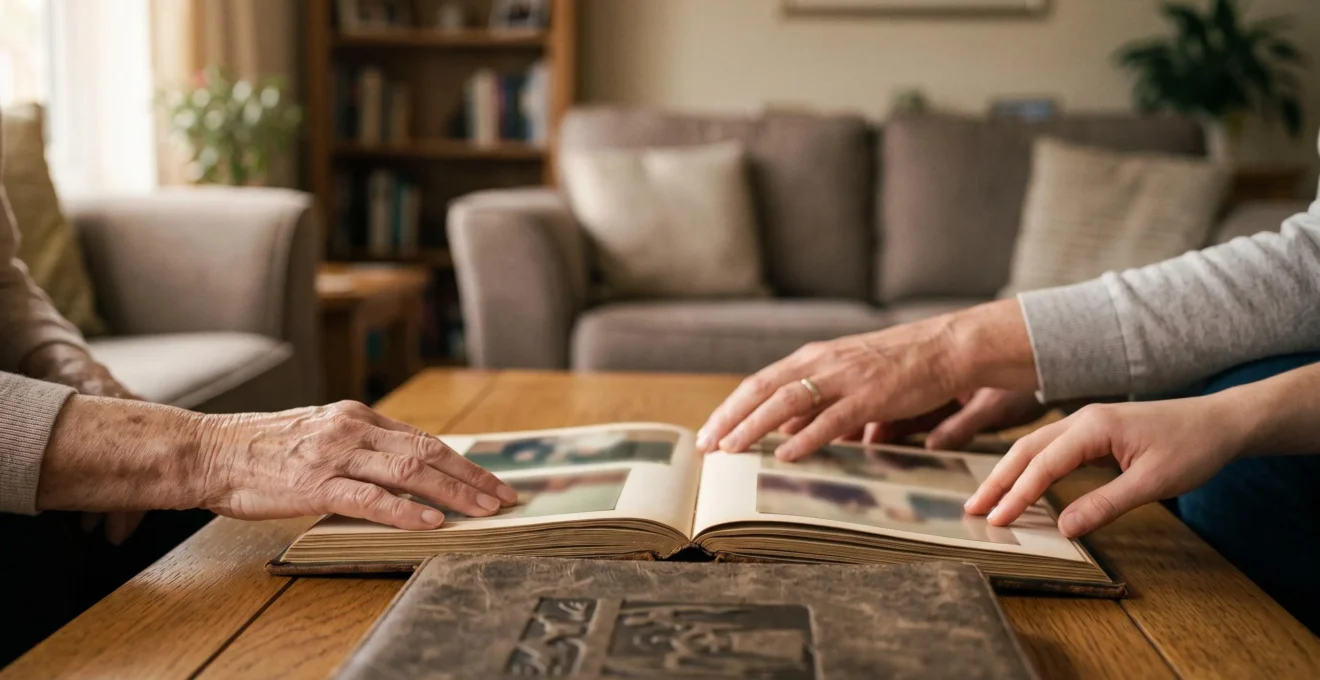
The true value of a wedding album is unlocked when it is crafted not as a report of the day, but as a tactile reliquary of family history, designed for rediscovery.
- Heirloom albums are revisited far more often than digital galleries because physical prints actively reinforce memory and identity.
- Longevity is non-negotiable, achieved through archival-grade papers and meticulous binding that ensures the album survives for a century or more.
- Elegant design relies on emotional curation and narrative pacing, using negative space and a restrained image count to let key moments breathe.
Recommendation: Shift your mindset from a post-shoot “designer” to an “archivist” and “curator” from the moment you pick up your camera, planning the physical narrative as you capture it.
As a wedding photographer, you create beautiful digital galleries that your clients adore. They share them, download their favourites, and the ‘likes’ pour in. Yet, you carry a quiet concern: after the initial flurry of excitement, these meticulously curated galleries often lie dormant, lost in the digital ether of cloud storage and forgotten hard drives. The emotional resonance of the day, so powerfully captured, fades with each passing software update. You sense there must be a more permanent, a more meaningful way to preserve the legacy you’ve helped to create.
The common advice is to “offer an album,” often framed as a simple upsell. Photographers are told to tell a story, pick the best photos, and use a slick design template. But this approach merely scratches the surface. It treats the album as a container for pictures, not as a significant object in its own right. This thinking leads to albums that are merely printed versions of the online gallery—overcrowded, chronologically rigid, and ultimately, just as likely to be put on a shelf and forgotten.
But what if the key wasn’t simply offering a product, but mastering a craft? The transition from a good photographer to a true visual historian lies in understanding that a wedding album is not a book *of* photos, but a book *as an object*. This guide moves beyond the platitudes of album design. We will explore the principles of archival craftsmanship and emotional curation that transform a collection of images into a tangible, tactile legacy—an heirloom that a family will not just own, but will actively revisit and treasure for the next three generations.
This article provides a complete framework, from the foundational psychology of physical prints to the nuanced art of narrative sequencing. We will cover the essential choices in materials, the common mistakes to avoid, and the mindset shift required to craft an album that truly endures.
Summary: A Complete Guide to Crafting Heirloom Wedding Albums
- Why Couples Revisit Heirloom Albums 10x More Frequently Than Digital Galleries After Two Years
- How to Choose Archival Materials That Guarantee Your Wedding Albums Last 100+ Years
- Leather, Linen or Acrylic Covers: Which Heirloom Album Finish Suits Classic British Weddings
- The Overcrowding Mistake That Makes Heirloom Albums Feel Chaotic Instead of Elegant
- When to Mentally Plan Album Spreads: During the Shoot or Only After Culling Images
- Heirloom Albums or Digital Galleries: Which Delivery Method Suits Luxury Narrative Clients in 2020s Britain
- Why Brides Display One Signature Portrait Prominently and Store the Other 49 in Albums
- How to Build Compelling Wedding Day Storytelling From Preparation Through to Final Exit
Why Couples Revisit Heirloom Albums 10x More Frequently Than Digital Galleries After Two Years
The persistent allure of the physical wedding album in a digital-first world isn’t driven by nostalgia, but by neuroscience. A digital gallery is a database, an archive to be scrolled. An heirloom album is an experience, an invitation to slow down, touch, and remember. The tangible nature of a printed photograph fundamentally changes our relationship with the image. Rather than a fleeting pixel on a screen, it is a physical artifact that occupies space, has weight, and engages multiple senses. This physicality is key to memory consolidation and emotional connection.
Research into the psychology of photography supports this distinction. According to Dr. Linda Henkel, a psychologist who studies memory and photography, we need to take the time to look at photos after the experiences to “reactivate those mental representations.” A physical album facilitates this reactivation in a way a digital gallery cannot. It’s a closed, finite world, free from the distractions of notifications and open tabs. It encourages a focused, shared experience—a couple on their anniversary, a child asking about their parents’ wedding—that deepens the memory and its associated feelings.
The impact extends beyond the couple to the next generation. A study by Chatbooks and HP revealed that printed photos play a significant role in a child’s developing sense of self. It found that 75% of parents agreed that printed photos gave their child a stronger sense of their own identity. The album becomes a foundational text of family history. Furthermore, a separate Epson survey found that 45% of people believe physical prints help them recall events more clearly than digital images. This demonstrates that an album isn’t just a collection of memories for the couple; it’s a tool for building family identity and passing down stories, ensuring its continued relevance long after the digital files are lost to technological obsolescence.
How to Choose Archival Materials That Guarantee Your Wedding Albums Last 100+ Years
An object intended to become an heirloom must be built with permanence in mind. The difference between an album that fades and yellows in a decade and one that remains vibrant for a century lies in a single concept: archival integrity. This isn’t about luxury for its own sake; it’s a technical requirement for creating a true legacy product. The core components determining an album’s longevity are its paper and ink.
Standard photographic papers, often used in consumer-grade photo books, contain acids and lignin from wood pulp. Over time, these elements react to light and air, causing the paper to become brittle and the images to fade and shift in colour. Archival printing, by contrast, uses a combination of acid-free, lignin-free paper and stable, pigment-based inks. The difference in lifespan is staggering: while a standard print might show noticeable fading within 10 years, true archival prints can last 50-100+ years with minimal degradation when cared for properly.
This paragraph introduces the concept of archival paper. For a deeper understanding, the illustration below shows a macro view of the texture and binding that define a high-quality, long-lasting album.
As you can see, the quality is in the details. The choice of paper is the most critical decision in ensuring this longevity. Not all “archival” papers are created equal. The best are made from 100% cotton rag, a naturally acid-free and stable material, while others are made from purified alpha-cellulose. Understanding these tiers allows you to educate your clients and make an informed choice that aligns with the heirloom promise.
The following table breaks down the three main tiers of paper quality, providing a clear guide for selecting the foundation of your heirloom albums.
| Tier | Paper Type | Composition | Expected Longevity |
|---|---|---|---|
| Best | Cotton Rag Paper | Acid-free, lignin-free, pure cotton fiber | Hundreds of years with minimal degradation |
| Better | Alpha-Cellulose (Archival) Paper | Purified, acid-free, lignin-free wood pulp | 50-100+ years without significant fading |
| Good | Standard Photographic Paper | May retain acid and lignin | Noticeable fading within 5-10 years |
Leather, Linen or Acrylic Covers: Which Heirloom Album Finish Suits Classic British Weddings
The cover of an heirloom album does more than protect the pages within; it sets the narrative tone. It’s the first point of tactile contact and makes an immediate statement about the story it contains. For a photographer catering to the discerning British market, selecting a cover material is an exercise in contextual awareness. The choice of leather, linen, or acrylic should not be arbitrary but should feel like an authentic extension of the wedding day’s character and venue.
A stately home or historic manor wedding, with its sense of permanence and tradition, finds its material soulmate in genuine or high-quality vegan leather. As noted by the experts at CEWE UK, a leather cover feels “weighty and well-made,” offering the best long-term protection. Its character deepens over time, developing a unique patina with every handling, mirroring the family history it chronicles. In contrast, a wedding set in the rustic charm of the Cotswolds or the rolling hills of the countryside calls for the soft, familial warmth of fine woven linen. Its textile nature is inviting and less formal, speaking to a celebration rooted in nature and intimate connection.
Finally, for a sharp, contemporary wedding in a modern London hotel or art gallery, an acrylic cover offers a crystal-clear, high-impact finish. It is unchanging and modern, a perfect medium for a bold, graphic signature portrait that defines the album’s contents. Many artisan binderies in the UK specialize in this kind of bespoke service. For instance, a UK-based bindery that hand-makes personalised wedding albums offers a wide range of materials, allowing photographers to perfectly match the tactile identity of the cover to the specific character of a British wedding venue.
To help guide this crucial conversation with your clients, this table summarises the tactile character and ideal setting for each primary material.
| Cover Material | Tactile Character | Best Suited Wedding Style |
|---|---|---|
| Genuine or Vegan Leather | Rich, weighty, develops a personal patina over time | Stately, historic manor weddings |
| Linen | Fine woven textile, soft familial warmth | Rustic countryside celebrations |
| Acrylic | Crystal-clear, sharp and unchanging finish | Contemporary city weddings |
The Overcrowding Mistake That Makes Heirloom Albums Feel Chaotic Instead of Elegant
After ensuring the album’s physical longevity, the greatest challenge becomes its internal design. The single most common mistake that separates an amateur-feeling photo book from an elegant heirloom album is overcrowding. The impulse to include as many photos as possible, driven by a fear of leaving something out, is the enemy of good design. It creates visual chaos that overwhelms the viewer and dilutes the impact of even the most beautiful images. A true artisan understands that the power of an album lies not just in the photos that are included, but in the space that surrounds them.
This is the principle of narrative pacing. Like a film director who uses a quiet, wide shot after a frantic action sequence, an album designer must use ‘breathing room’ to guide the viewer’s eye and emotion. A full-bleed, double-page spread of an epic portrait should be followed by a spread with just a few smaller images, or even a single, poignant detail shot floating in a sea of white space. This creates a rhythm, a visual cadence that keeps the viewer engaged and allows them to absorb the emotional weight of each key moment.
This illustration of a minimalist spread demonstrates the power of restraint. The expansive white space is not empty; it is an active design element that amplifies the importance of the single image.
To achieve this elegant pacing, follow a few simple but powerful rules. These guidelines, adapted from professional album designers, prevent clutter and maintain a sophisticated narrative flow throughout the book.
- Stick to photo combinations of 2, 3, 4, or at most 5 images per spread. Anything more tends to look busy and chaotic.
- These smaller combinations are ideal for telling mini-stories: the sequence of a shared laugh, the exchange of rings, or a series of details from the bride’s attire.
- Reserve single-image spreads for your most powerful, “anchor” images that deserve to be contemplated without distraction.
- As a rule of thumb, aim for around 100-120 images for a standard 30-spread (60-page) album. This provides a robust narrative without feeling rushed.
- To maintain visual interest, never use the exact same layout design on two consecutive spreads.
When to Mentally Plan Album Spreads: During the Shoot or Only After Culling Images
The transition from photographer to true album artisan involves a crucial shift in mindset: album design does not begin at the computer. It begins on the wedding day. While the final selection and layout happen during post-production, the most compelling and cohesive albums are born from a process of shooting with the final spreads in mind. This proactive approach transforms you from a reactive documentarian into a deliberate visual author.
Thinking in spreads as you shoot means you start to see in combinations. You’re no longer just capturing isolated “hero” shots; you’re collecting the narrative tissue that connects them. When you photograph the bride’s shoes, you also capture a wide shot of the dress and a close-up of the lace on her veil. In your mind, you’re already seeing a beautiful, detail-focused spread that sets the scene for the day. This mental pre-visualization ensures you capture the necessary variety of shots—wide, medium, tight, horizontal, vertical—that are essential for creating dynamic and engaging layouts later on.
A powerful example of this is planning for specific story beats. One photographer tells of a wedding where the groomsmen wanted “game day” pictures to kick off the day. Anticipating this, the photographer dedicated a future spread to this moment, consciously capturing an individual shot of each groomsman followed by a dynamic group shot, knowing they would work together as a narrative unit. This intentionality is what elevates an album from a simple collection of pictures to a thoughtfully constructed story. It’s about designing the album “with layouts in mind, so they work well together as a unit, visually and as a story.”
This doesn’t mean storyboarding every single shot. It means having a mental checklist of the “chapters” of the day and ensuring you have the visual ingredients for each one. By planning the album layout conceptually before you even start the design software, you streamline the entire process and create a far more powerful and coherent final product.
Heirloom Albums or Digital Galleries: Which Delivery Method Suits Luxury Narrative Clients in 2020s Britain
In the contemporary luxury wedding market, the question is not “album *or* digital gallery?” but rather “how do the album *and* the digital gallery work together?” Attempting to position the heirloom album as a replacement for the online gallery is a losing battle. Instead, the savvy photographer understands their complementary roles and educates the client on the unique function of each. They are two sides of the same legacy coin, serving different but equally important purposes.
The digital gallery is the archive. It is the comprehensive, all-encompassing record of the day. Its primary function is utility: for guests to find photos of themselves, for immediate sharing on social media, and for ordering individual prints of moments that might not have made the album’s final cut. It is expansive, inclusive, and designed to be viewed and distributed widely online. It serves the immediate need for access and sharing.
The heirloom album, by contrast, is the master narrative. It is the curated, emotional core of the wedding story. Its function is not utility but legacy. It is not for scrolling; it is for revisiting. It is not for sharing with hundreds; it is for sharing with a loved one on a quiet evening. As the Pic-Time editorial team aptly puts it, “Wedding galleries are designed to be viewed, shared, and revisited. Albums are designed to be kept.” The album is the definitive, distilled version of the story, crafted for a tactile, intimate experience that will endure for generations.
For discerning clients in 2020s Britain, who value both digital convenience and tangible craftsmanship, the most successful delivery is a dual one. The online gallery provides instant gratification and archival completeness, while the heirloom album provides the lasting emotional anchor and the physical artifact that will become a cornerstone of the family’s visual history. Presenting them as a synergistic pair, rather than competing options, demonstrates a sophisticated understanding of a modern client’s needs.
Why Brides Display One Signature Portrait Prominently and Store the Other 49 in Albums
A common observation in the homes of married couples reveals a core principle of visual storytelling: one or two portraits are chosen for the wall, while hundreds of other images are carefully preserved within the pages of an album. This isn’t a random occurrence; it reflects the two primary ways we interact with photographs: as a public declaration (the Signature Image) and as a private narrative (the Album Story). Understanding this distinction is crucial for curating an album that works in harmony with a client’s life.
The image chosen for a large frame is the “Signature Image” or “Anchor Image.” It is a single, powerful photograph that encapsulates the emotional peak or the aesthetic essence of the wedding day. It’s often a breathtaking portrait, a moment of pure joy or quiet intimacy that can stand alone as a piece of art. Its job is to make a singular, impactful statement. As the Photobook Press team advises, you must “identify your ‘Anchor Images,’ those breathtaking shots that define the emotional peaks of your day.” These are the images deserving of a full page or a prominent place on a wall.
This image perfectly captures the concept: the single, statement portrait on the wall, and the detailed, narrative album in hand, both serving different emotional needs.
The album, however, serves a different and more complex function. It provides the context, the build-up, and the nuance that the single signature image cannot. It tells the story of *how* that peak moment came to be. It contains the quiet, preparatory moments; the laughter with bridesmaids; the nervous glance at the altar; the candid chaos of the dance floor. The 49 (or 99) other images in the album are not lesser photos; they are the narrative threads that weave the story together. The signature image is the destination; the album is the entire, beautiful journey.
Key Takeaways
- An album’s value lies in its physical, tactile nature which reinforces memory more effectively than a digital screen.
- True heirloom quality is non-negotiable and depends on using archival-grade, acid-free papers and stable pigment inks to guarantee 100+ years of longevity.
- Elegant design is about restraint; use negative space and limit spreads to 2-5 images to create narrative pacing and avoid visual clutter.
How to Build Compelling Wedding Day Storytelling From Preparation Through to Final Exit
Ultimately, the creation of a timeless heirloom album comes down to one thing: compelling storytelling. It’s the synthesis of archival materials, thoughtful pacing, and a deep understanding of narrative structure. The goal is to move beyond a simple chronological report of events and craft a captivating story that captures the unique emotional essence of the special day. This means thinking like a novelist or filmmaker, complete with chapters, pacing, and emotional arcs.
The most effective way to structure this narrative is to divide the day into distinct “chapters.” This not only organizes the story for the viewer but also helps you as the photographer ensure you’ve captured all the necessary elements. Each chapter should have its own visual tempo. “Preparation” might be quiet, intimate, and filled with soft light and delicate details. “The Ceremony,” in contrast, is a point of high emotional crescendo, while “The Reception” is about dynamic energy and connection. Using detail shots—a grandparent’s hands holding an order of service, the empty dance floor before the party begins—can act as “palate cleansers” between these high-emotion chapters, giving the viewer a moment to breathe and absorb what they’ve seen.
As the artisan of this story, your role is to guide the viewer through these moments, building the narrative from the quiet anticipation of the morning to the celebratory release of the final exit. This checklist provides a practical framework for structuring the wedding day into a compelling narrative flow.
Your Action Plan: Structuring the Wedding Day Into Narrative Chapters
- Establish Narrative Chapters: Before designing, formally divide the day into key sections: Preparation, First Look, Ceremony, Cocktail Hour, Portraits, Reception, and Final Exit. Give each chapter its own visual identity.
- Select Anchor Images: For each chapter, identify one or two “anchor” images that define its emotional peak. Build the rest of the spread around these key shots.
- Incorporate “Texture” Shots: Weave in detail shots (flowers, shoes, rings) and scene-setting wide shots to act as establishing shots and transitions between emotional moments, like palate cleansers.
- Vary the Pacing: Follow a high-energy, multi-image spread (like dancing) with a quiet, single-image spread (a couple’s quiet glance). This creates a rhythm that keeps the viewer engaged.
- Review the Narrative Arc: Read through the finished album. Does the story build? Is there a clear beginning, middle, and end? Does it feel like a journey? Make final adjustments to ensure a smooth and emotionally resonant flow.
By embracing the role of an artisan, curator, and storyteller, you can transform your service from providing beautiful digital files to crafting priceless family heirlooms. This commitment to tactile legacy is not just a superior service for your clients; it is the key to creating work that truly endures.