
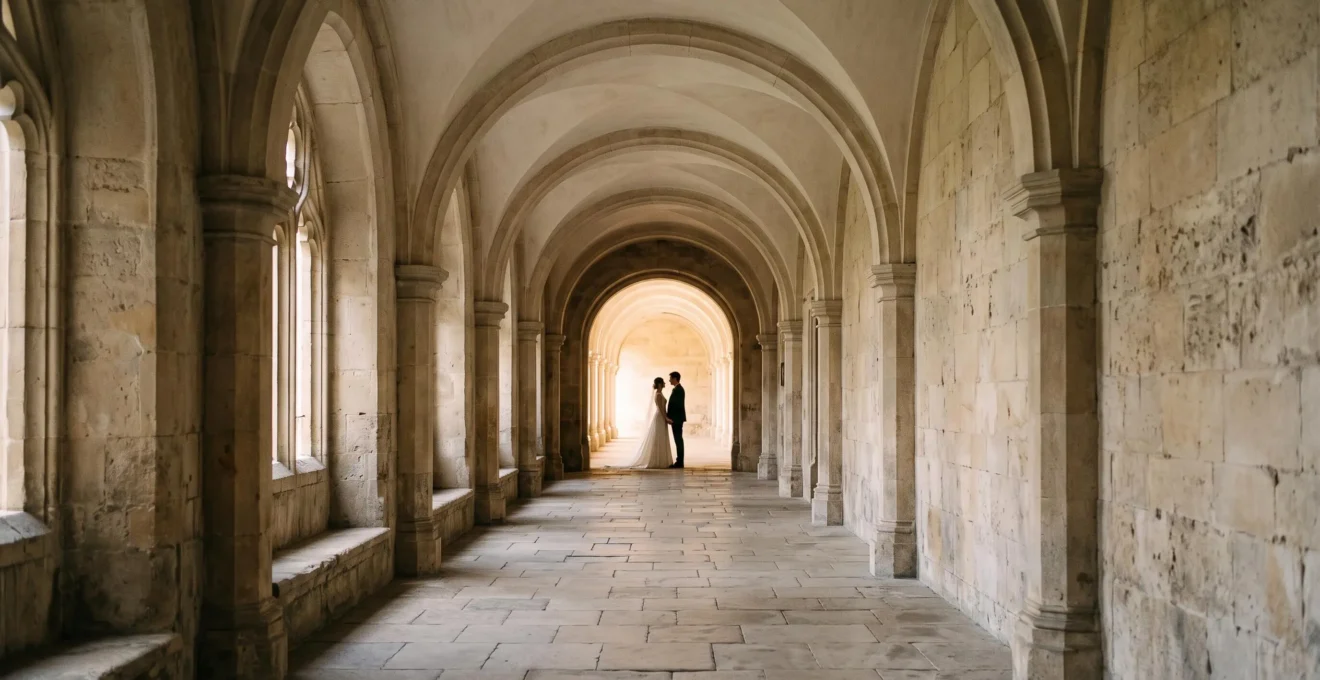
The greatest missed opportunity in wedding photography is treating a magnificent venue as a passive backdrop instead of an active compositional instrument.
- Architectural leading lines are not just found; they are intentionally orchestrated by understanding the building’s geometric system.
- A photographer must consciously balance the ‘compositional weight’ between the structure’s dominance and the couple’s intimacy.
Recommendation: Shift your mindset from simply ‘placing’ the couple in a scene to actively ‘deconstructing’ the architecture to build a powerful visual narrative around them.
For many wedding photographers, a grand venue is a beautiful but static backdrop. You place the couple in front of an impressive archway or along a stately colonnade, and the architecture does its job. But what if this approach fundamentally misunderstands the power at your disposal? What if the building isn’t a stage, but an active participant in your composition—a geometric system of lines, planes, and volumes waiting to be conducted?
The common advice is to “find leading lines” like paths or fences. This is rudimentary. The true craft lies in seeing the venue itself as a source of powerful directional force. This requires a mental shift: you are not just a photographer; you are an interpreter of architectural geometry. You must learn to deconstruct a space into its core components—the converging vectors of a hallway, the repeating rhythm of a staircase, the perfect symmetry of a facade—and use them to precisely command the viewer’s gaze.
This guide moves beyond the basics. It will train your eye to spot and utilize the inherent structural narrative within any wedding venue. We will analyze the psychological impact of different lines, discuss the critical error of letting architecture overpower your subjects, and explore advanced techniques to capture both grandeur and intimacy. The goal is to transform your images from beautiful portraits *in* a location to compelling stories told *through* its very structure.
This article provides a structured approach to mastering this skill. By exploring the science, strategies, and technical execution, you’ll learn to see and capture wedding venues with newfound compositional authority.
Summary: A Photographer’s Guide to Architectural Composition
- Why Leading Lines Make Viewers Look Exactly Where You Intend in Busy Wedding Group Photos
- How to Spot Natural Leading Lines in Wedding Venues From Hallways, Arches, and Symmetrical Architecture
- Converging Perspective Lines or Parallel Symmetrical Lines: Which Creates Stronger Architectural Wedding Portraits
- The Architectural Dominance Mistake Where Leading Lines Overpower the Wedding Couple
- When to Position Couples Along Architectural Leading Lines During Ceremony Processions and Portraits
- How to Use 16mm Ultra-Wide Lenses to Capture Venue Scale Without Distorting Architecture
- How to Identify Natural Rule of Thirds Gridlines in Unpredictable Wedding Venue Architecture
- How to Photograph Wedding Venue Grandeur That Showcases Architectural Scale and Splendour
Why Leading Lines Make Viewers Look Exactly Where You Intend in Busy Wedding Group Photos
The power of leading lines is not just an artistic principle; it’s a neurological shortcut. Our brains are hardwired to follow lines to see where they lead. In the visual chaos of a wedding—guests mingling, vibrant decorations, complex backgrounds—leading lines act as a focusing mechanism. They cut through the noise and provide a clear, subconscious instruction to the viewer: “Look here.” This is especially critical in group photos, where you need to establish a primary focal point amidst multiple faces and figures.
Recent research confirms this intuitive understanding. For example, a 2024 eye-tracking study of 34 participants found that compositions utilizing strong directional lines significantly guided and held the viewer’s gaze on the intended subject. By harnessing a venue’s architecture, you are essentially pre-programming the viewing experience, ensuring the couple remains the hero of the image, even when surrounded by a crowd. As photographer Pye Jirsa advises, you should actively “Take advantage of leading lines and place your subjects at the point of convergence.”
A powerful, practical example of this is the spiral staircase technique. In the case study on this method, a photographer shoots down from the top of a spiral staircase while the couple stands on the ground floor. The spiraling handrails and steps create powerful, curving lines that draw the eye directly and elegantly to the couple, effectively isolating them from the visual clutter of other guests. This is a perfect demonstration of using existing architecture to solve a common compositional problem.
How to Spot Natural Leading Lines in Wedding Venues From Hallways, Arches, and Symmetrical Architecture
The first step is a mental shift from passive observation to active geometric deconstruction. You must train your eye to scan a venue not for its overall beauty, but for its underlying linear structure. Arches create framing curves, hallways form powerful converging perspectives, and symmetrical facades provide a stable grid of parallel and perpendicular lines. These are not just decorative elements; they are compositional tools waiting to be activated.
Begin your venue scout with a singular focus: identify the strongest lines. Look for:
- Corridors and Hallways: The floors, walls, and ceilings create powerful vanishing points.
- Colonnades and Pillars: These create a rhythm of repeating vertical lines.
- Staircases: Both straight and spiral staircases offer strong diagonal or curving vectors.
- Window and Door Frames: These act as natural grids and frames-within-a-frame.
- Floor Patterns: Tiled or wood-planked floors often have built-in parallel or diagonal lines.
This initial scout is about mapping the geometry. The second layer is understanding how light interacts with it. As the ArteVisual Wedding Photography Guide states, “Light changes everything.” The direction and quality of light will determine which lines are emphasized and which are subdued. A low sun might cast long shadows from pillars, turning them into dramatic diagonal lines across a floor. Soft window light can trace the gentle curve of an archway. Your walkthrough should ideally happen at the same time of day as the wedding events to see exactly how these lines will be revealed.
In this image, the repeating door frames and floor pattern create undeniable parallel lines that pull the viewer deep into the frame. By placing the couple as a small element near the vanishing point, the photographer uses the architectural lines not just to guide the eye, but also to establish a sense of immense scale and quiet intimacy within the grand space.
Converging Perspective Lines or Parallel Symmetrical Lines: Which Creates Stronger Architectural Wedding Portraits
Not all lines tell the same story. The choice between using converging lines and parallel lines is a critical decision that defines the structural narrative of your portrait. It’s the difference between telling a story of a dynamic journey and one of timeless stability. Neither is inherently “better,” but each serves a distinct emotional and compositional purpose. The key is to match the type of line to the moment you are capturing.
Converging lines—like those of a long hallway, a road, or a railway track—pull the viewer’s eye towards a single vanishing point. This creates a powerful sense of depth, distance, and forward motion. Compositionally, they suggest a journey, a future, and a shared destiny. This makes them ideal for dynamic moments like the recessional walk after the ceremony or a dramatic exit from the venue. The visual energy of converging lines complements the emotional energy of the moment. Remember that even two straight, parallel lines will appear to converge due to perspective; your job is to harness this effect deliberately.
In contrast, parallel lines—found in symmetrical colonnades, architectural facades, or rows of trees—create a sense of order, stability, and harmony. They don’t rush the eye to a single point but guide it smoothly through the frame. This structure conveys a feeling of timelessness, balance, and enduring strength in the couple’s bond. Parallel lines are perfectly suited for quiet, intimate portraits where the focus is on the connection between the two individuals, framed by a stable, serene environment.
This table breaks down the distinct visual effects and narrative meanings, helping you make a more intentional choice during your shoot.
| Line Type | Visual Effect | Narrative Meaning | Ideal Wedding Moment |
|---|---|---|---|
| Converging Lines | Feeling of distance and depth | The Journey — future, destiny, dynamic movement | Recessional walk, dramatic hallway exit |
| Parallel Lines | Sense of structure and stability | The Bond — harmony, timelessness, enduring stability | Quiet intimate portrait, colonnade walk |
The Architectural Dominance Mistake Where Leading Lines Overpower the Wedding Couple
The most common error when incorporating strong architectural lines is allowing them to become the subject of the photograph. When the lines are too bold, too numerous, or too complex, they can overwhelm the frame and reduce the couple to a mere afterthought. As one PentaxForums composition guide warns, it is easy to use converging lines “in an unimaginative and cliché manner” where the technique overshadows the emotion. The goal is to create a harmonious balance, where the architecture serves the couple, not the other way around. This balance is what we call compositional weight.
Your primary tool for controlling compositional weight is depth of field (DoF). A wide aperture (e.g., f/1.8 to f/2.8) creates a shallow depth of field, throwing the background architecture into a soft, pleasing blur. The lines remain visible as gentle guides, directing the eye without competing for attention. Their geometric power is suggested rather than stated, preserving the focus squarely on the sharply detailed subjects. This technique allows you to use the structure’s form while subduing its texture and detail.
This image demonstrates perfect control over compositional weight. The couple’s hands and fabric are in crisp focus, filled with tactile detail. In the background, the architectural lines are reduced to abstract shapes and soft gradients. They still provide a sense of place and structure, but they do not distract. The human element is dominant; the architecture is a supporting character.
Other techniques to manage architectural dominance include using lighting to selectively illuminate the couple while letting parts of the structure fall into shadow, or composing the shot so the couple occupies a larger portion of the frame. The key is to constantly ask yourself: Who is the hero of this image? If the answer is “the building,” you need to adjust your composition, aperture, or lighting until the couple reclaims their central role.
When to Position Couples Along Architectural Leading Lines During Ceremony Processions and Portraits
Identifying lines is the first skill; positioning subjects within them is the art. The placement of the couple is a deliberate act that dictates the entire visual flow of the image. The most powerful location is often at the point of convergence, where all the lines in the composition meet. Placing the couple at this vanishing point creates an undeniable focal point, pulling the viewer’s eye directly to them with maximum force. This is particularly effective for static portraits where you want to convey a sense of arrival or destiny.
However, you can also place the couple *along* the path of the leading lines, rather than just at the end. This is ideal for more dynamic moments, such as the processional or recessional. By positioning them one-third or halfway down a long colonnade or aisle, you create a sense of movement and narrative progression—they are on a journey. The lines ahead of them suggest the future, while the lines behind them represent the past they are leaving together.
In this composition, the couple is placed precisely at the vanishing point of the colonnade. The converging lines of the columns and floor tiles act like arrows, all pointing directly to them. Their intimate gaze towards each other, rather than the camera, creates an emotional focal point that is powerfully reinforced by the architectural geometry. The structure guides our eyes, but their connection holds our attention.
Action Plan: Positioning Couples at Compositional Convergence Points
- Identify the point where the architectural lines in your scene converge, whether it’s a vanishing point in a hallway or the meeting point of a wall and a row of pillars.
- Place this convergence point at one of the four intersections of a rule of thirds grid. This combines two powerful compositional rules for maximum visual impact.
- For straight lines, ensure your camera’s horizon is perfectly level to maintain structural integrity and avoid unintentional, chaotic diagonals.
- When straight lines aren’t available, look for natural S-curves in pathways or architectural details. Use these to lead the eye around the image, adding a sense of gentle motion and depth.
- Position the couple along the curve or at its end to create a graceful, flowing composition rather than an abrupt one.
How to Use 16mm Ultra-Wide Lenses to Capture Venue Scale Without Distorting Architecture
To capture the grandeur of a venue, an ultra-wide lens (like a 14mm or 16mm) is an indispensable tool. It allows you to get close while still including the vast sweep of a ceiling or the full length of a hall. However, this power comes with a significant risk: barrel distortion. This optical effect bends straight lines near the edges of the frame into curves, making a stately building look like it’s made of rubber. The key is to use the lens for its scale-capturing ability while actively mitigating its distorting tendencies.
The first line of defense is in-camera technique. To minimize distortion, keep the camera perfectly level and aim for the center of the architectural subject. Tilting an ultra-wide lens up or down dramatically exaggerates perspective, causing vertical lines to converge unnaturally. When you keep the sensor plane parallel to the building’s facade, you maintain the integrity of its lines. As wedding photographer Jiggie Alejandrino demonstrates in a case study on using ultra-wides, proper subject placement and frame proportions are crucial to avoid common mistakes and even use distortion for compositional advantage.
Your second tool is post-processing. Modern software like Adobe Lightroom and Capture One have lens correction profiles that can automatically counteract the known distortion of your specific lens. By simply checking a box, you can straighten out most of the barrel distortion. For more complex issues, the perspective control tools (like the “Guided Upright” tool) allow you to manually draw lines on the image that should be vertical or horizontal, and the software will warp the image to make it so. This combination of careful in-camera work and precise post-processing allows you to deliver images that feel both epic in scale and architecturally true.
Choosing the right lens is the first step. This table, based on an analysis of top architectural lenses, highlights some leading options known for their sharpness and distortion control.
| Lens | Focal Range | Key Strength |
|---|---|---|
| Canon EF 16–35mm f/2.8L III | 16–35mm | Exceptional sharpness and distortion control |
| Nikon AF-S 14–24mm f/2.8G ED | 14–24mm | Sharpness, color accuracy, distortion management |
| Sony FE 12–24mm f/4 G | 12–24mm | Ultra-wide perspective with controlled distortion |
| Tokina AT-X 11–16mm f/2.8 | 11–16mm | Budget-friendly sharp wide-angle option |
How to Identify Natural Rule of Thirds Gridlines in Unpredictable Wedding Venue Architecture
The rule of thirds is not just a digital overlay in your camera’s viewfinder; it is a compositional principle that can be found in the real world. A truly skilled photographer learns to see the venue’s architecture as a natural, pre-existing grid. This allows for more organic and powerful compositions than simply relying on an electronic guide. Window frames, columns, and even the lines in floor tiles can serve as real-world gridlines for placing your subjects.
Start by identifying the dominant horizontal and vertical lines in the scene. A horizon, the top of a distant wall, or a long banquet table can serve as a horizontal gridline. A tall pillar, the edge of a doorway, or a standing flagpole can act as a vertical one. Instead of defaulting to placing your subject in the center, try aligning them with one of these natural architectural lines. This creates a composition that feels more balanced, intentional, and integrated with the environment.
The synergy between leading lines and the rule of thirds is particularly powerful. As experts at the Corel Discovery Center note, “Placing the convergent point at one of the target spots for the rule of thirds” powerfully draws the eye. Imagine a long hallway with converging lines. Instead of placing the vanishing point in the dead center of the frame, shift your composition so that the vanishing point—and your subject—lands on one of the four power points where the rule of thirds grid intersects. This creates a dynamic asymmetry that is far more visually engaging than a simple, centered shot.
Don’t limit yourself to straight lines. Curved lines, such as a winding path or a sweeping archway, can lead the eye around the image in a more graceful, meandering way. Placing a couple along this curve, again aligning them with a thirds intersection, creates a composition that is both structurally sound and visually fluid.
Key Takeaways
- Shift your mindset from seeing venues as backdrops to deconstructing them as active geometric systems.
- Balance ‘compositional weight’ by using techniques like shallow depth of field to ensure the architecture guides the eye to the couple without overpowering them.
- Match the type of line to the moment: use converging lines for dynamic journeys (recessionals) and parallel lines for stable, intimate portraits.
How to Photograph Wedding Venue Grandeur That Showcases Architectural Scale and Splendour
Capturing the sheer scale of a magnificent venue while keeping the couple as the emotional heart of the image is one of the greatest challenges in wedding photography. A wide-angle lens can show the grandeur, but often diminishes the couple. A telephoto lens can isolate the couple, but loses the sense of place. The solution lies in an advanced technique that combines the best of both: the Brenizer Method (also known as bokeh panorama).
The Brenizer Method involves using a telephoto lens (like an 85mm or 135mm) with a wide aperture (f/1.4 or f/1.8) to create a panoramic stitch. You first focus on the couple and take your “hero” shot. Then, without changing your focus or exposure, you capture a grid of overlapping images of the surrounding environment—above, below, and to the sides of the couple. In post-processing, you stitch these multiple images together into a single, high-resolution panorama. The result, as photographer Aaron Varga describes it, is the “appearance of a really wide lens with a ridiculously impossible shallow depth-of-field.”
This technique brilliantly solves the scale-versus-intimacy problem. You get the wide, sweeping view of the venue that shows its architectural splendour, but because it was shot with a telephoto lens, the couple remains beautifully isolated against a creamy, out-of-focus background. It’s a way to have it all: the grand, structural narrative of the space and the intimate, personal story of the couple. As a case study on a Brenizer wedding portrait demonstrates, the final image perfectly balances scale and intimacy, using the grandeur of the surroundings to frame the couple, who remain at the emotional center.
Mastering this technique requires practice, especially in maintaining consistent overlap between shots and a stable camera position. However, it is the ultimate expression of the principles discussed here: a deliberate, technical, and artistic orchestration of geometry, perspective, and focus to create an image that is both architecturally impressive and deeply human.
By shifting your perspective from passively observing to actively deconstructing, you can transform any wedding venue into a powerful tool for visual storytelling. Begin implementing these geometric principles on your next shoot to create images with unparalleled depth, intention, and impact.