
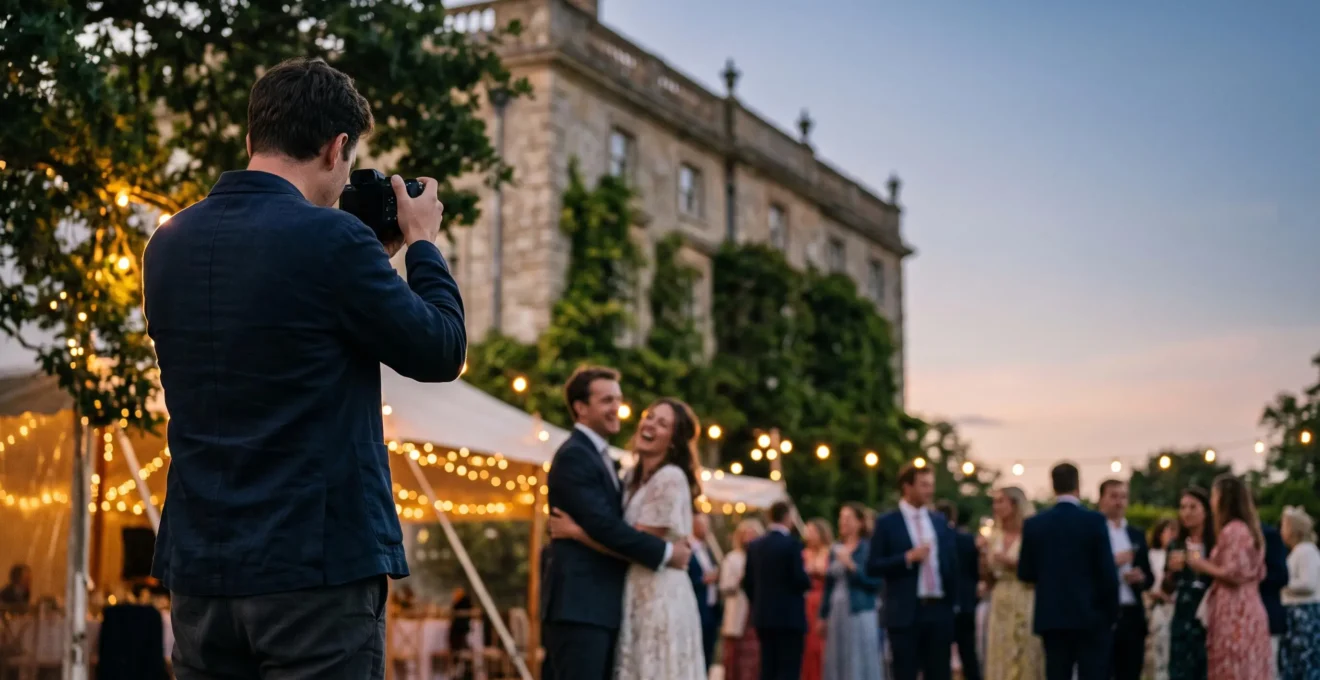
Adding short video clips is not about becoming a full-time videographer; it’s a strategic decision to create a premium ‘hybrid deliverable’ that protects your core photography business and profitability.
- Client demand is shifting towards capturing small, authentic moments, not just cinematic epics.
- Success depends on mastering a non-disruptive workflow, choosing the right minimalist gear, and pricing for the extra time involved.
- Technology like gyro-stabilisation now offers a crucial safety net for solo shooters to achieve professional results without heavy equipment.
Recommendation: Instead of asking ‘if’ you should offer video, ask ‘how’ you can integrate short, high-value clips as a profitable, low-risk add-on to your existing photography packages.
As a wedding photographer in the UK, you’ve undoubtedly noticed the shift. More clients are asking, “Do you do video, too?” or “Can you just capture a few short clips?” The pressure is mounting, fueled by the endless scroll of social media where moments live as much in motion as they do in stills. The common advice is to simply adapt, buy a new camera, and press record. But this simplistic view ignores the fundamental business questions: Is it profitable? Will it compromise the quality of my photography? Is the investment in new skills and gear actually worth the return?
The anxiety is justified. Jumping into videography without a plan risks diluting your expertise, damaging your brand with amateurish footage, and, most critically, eating into your profit margins with unbilled hours. Many photographers rightly fear becoming a master of none, delivering mediocre photos and shaky videos, all while working twice as hard for the same pay. This is a legitimate threat to a finely tuned business model.
But what if the question isn’t about becoming a videographer? The real opportunity lies in reframing the offering. It’s not about adding a separate, demanding service, but about strategically integrating short, high-impact video moments to create a ‘hybrid deliverable’. This is a premium product that enhances your photography, meets modern client expectations, and, crucially, protects your workflow and profitability. This guide is a business-analytical breakdown for the working photographer, weighing the ROI and impact of this strategic shift. We will dissect the workflow, the gear, the pricing, and the specific moments where video adds undeniable value, transforming a source of anxiety into a new revenue stream.
This article provides a structured analysis to help you make an informed business decision. It moves from understanding the market demand to the practicalities of workflow, gear, pricing, and mastering a modern hybrid approach.
Summary: Mastering Hybrid Wedding Coverage in the UK
- Why 70% of Couples Now Request Short Video Clips Even When They’ve Hired Professional Videographers
- How to Capture 10-Second Video Clips During Key Moments Without Disrupting Photography Workflow
- Hybrid Mirrorless Camera or Dedicated Cinema Rig: Which Suits Occasional Wedding Video Clip Capture
- The Shaky Footage Mistake That Makes Wedding Video Clips Look Amateurish and Unusable
- Which 5 Wedding Moments Justify Video Clip Capture and Which Are Better as Still Images
- Why Successful Hybrid Coverage Requires 30% More Contracted Time Than Pure Reportage or Traditional Approaches
- When to Use Continuous LED Video Lights Instead of Flash in Extremely Dark Reception Venues
- How to Master Modern Hybrid Wedding Coverage That Satisfies Both Reportage and Portrait Expectations
Why 70% of Couples Now Request Short Video Clips Even When They’ve Hired Professional Videographers
The first step in evaluating any business decision is to understand the market demand. The request for short video clips, even when a dedicated videography team is present, isn’t just a fleeting trend. It signals a fundamental shift in how couples perceive their wedding memories. They are no longer thinking in terms of a single, polished wedding film. Instead, influenced by social media, they desire a multi-layered, textured record of their day. They want the small, unscripted laughs, the ambient sounds of the venue, and the fleeting glances that don’t always translate into a still photograph. It’s about capturing the ‘vibe’ as much as the event.
This is validated by market data; a recent analysis shows that nearly 80 percent of British couples say they want their wedding film to capture more than just the big moments. They are looking for the ‘in-between’ content—the kind of short, shareable clips that a photographer, already present for candid moments, is uniquely positioned to capture. This isn’t about competing with the main videographer; it’s about supplementing their cinematic work with a different, more immediate style of content. It fills a gap that couples feel exists between formal photos and a long-form film.
As UK wedding videographer Tom Juggins observes, this has given rise to the ‘content creator’ role at weddings, a trend he expects to grow. He states:
Content creators make a great addition to traditional wedding photography and videography, and I’m sure we’ll see even more of this in 2025.
– Tom Juggins, UK Wedding Videographer Blog — Top 10 Wedding Trends 2025
For the still photographer, this is the opportunity. You can position yourself as this hybrid creator, offering a package that includes both stunning stills and a curated collection of video moments. You’re not replacing the cinema team; you are providing an entirely different, highly-valued deliverable that satisfies the modern couple’s desire for layered, authentic content.
How to Capture 10-Second Video Clips During Key Moments Without Disrupting Photography Workflow
The single greatest fear for a photographer venturing into video is compromising their primary craft. The question isn’t *can* you capture video, but can you do it without missing a crucial still shot? The answer lies in ruthless planning and workflow protection, not improvisation. Attempting to shoot both photo and video simultaneously without a clear strategy is a recipe for failure. The key is to pre-identify specific, short ‘video-only’ moments and resist the urge to do everything at once. This requires a mental shift from ‘capturing the day’ to ‘executing a pre-planned shot list of hybrid moments’.
This process begins long before the wedding day. Your pre-wedding consultation must now include a discussion about video. You need to review the timeline specifically to identify 3-5 key moments that are best suited for a 10-15 second video clip. These are your triggers. For the rest of the day, the video function on your camera remains off. This disciplined approach prevents the cognitive overload of constantly switching between modes and ensures your photographic instincts remain sharp. Remember, a mid-range hybrid job can easily demand 30-50 hours of total work, most of which is in planning and post-production. On-the-day energy is a finite resource to be spent on execution, not decision-making.
For a solo shooter, this means having your camera settings dialled in. Many modern mirrorless cameras allow you to save custom settings, enabling a quick switch from your go-to photography mode (e.g., Aperture Priority, 1/250s) to a video mode (e.g., Manual, 1/50s shutter, 24fps) with the turn of a dial. Practice this transition until it becomes muscle memory. For ambient sound, a quality on-camera shotgun microphone is a non-negotiable minimum. It adds crucial atmosphere that elevates a simple clip into a living memory, without the complexity of a full audio rig.
Your Action Plan: Integrating Video Without Workflow Chaos
- Pre-Wedding Triage: Dedicate time in your client consultation and timeline review to pre-identify and agree upon a small number of ‘video-only’ moments. Do not improvise on the day.
- Calculate Total Investment: Acknowledge that a hybrid job realistically requires 30–50 hours of total investment. Allocate sufficient time for pre-wedding planning and post-production in your schedule and pricing.
- On-Day Execution: Reserve your energy and attention strictly for the pre-planned video trigger moments. The moment you press record, you are a videographer for those 10 seconds. The rest of the time, you are 100% a photographer.
By implementing these guardrails, you transform video capture from a chaotic distraction into a controlled, predictable part of your service. It’s about working smarter, not harder.
Hybrid Mirrorless Camera or Dedicated Cinema Rig: Which Suits Occasional Wedding Video Clip Capture
The gear question can be paralyzing, but for a photographer adding *occasional* video clips, the answer is refreshingly simple from an ROI perspective. A dedicated cinema rig is overkill. It represents a significant capital investment, a steep learning curve, and a cumbersome physical presence that directly contradicts the goal of a non-disruptive workflow. For a solo operator, carrying a second, large camera body is impractical and immediately signals a divided focus to the client and guests.
The modern hybrid mirrorless camera is the definitive tool for this job. Cameras from Sony, Canon, Fuji, and Panasonic now offer professional-grade video capabilities in the same body you use for stills. The key is to choose a model that makes the switch between photo and video modes as seamless as possible. Look for features like: a dedicated video record button, the ability to save and recall custom shooting modes (one for stills, one for video), and robust video specifications like 4K resolution and 10-bit colour for post-production flexibility. Your existing collection of high-quality prime and zoom lenses will serve you perfectly for video, maintaining a consistent look across both deliverables.
Investing in a high-performance hybrid body is a far more strategic use of capital. It enhances both your photography (with better autofocus, sensors, etc.) and provides the video functionality you need as a value-add. This approach aligns with the business model of offering a ‘hybrid deliverable’ rather than a separate videography service. The goal is minimal gear with maximum output. A single, powerful camera body, your existing lenses, and a good on-camera microphone are all that’s required to start. This lean setup keeps you mobile, discreet, and focused on the moment, which is the very essence of your value as a photographer.
The Shaky Footage Mistake That Makes Wedding Video Clips Look Amateurish and Unusable
Nothing screams ‘amateur’ more than shaky video footage. For a solo photographer capturing handheld clips between still shots, carrying a gimbal is often impractical. It adds weight, setup time, and complexity, directly violating the principle of a non-disruptive workflow. This is where a technological ‘safety net’ becomes a game-changer for the hybrid shooter: gyro-based stabilisation software.
Modern mirrorless cameras from manufacturers like Sony and Panasonic can record gyroscope data alongside the video file. This data tracks the camera’s precise movements—every tiny shake and wobble. In post-production, free and powerful open-source software like Gyroflow uses this data to digitally stabilise the footage with incredible accuracy. The result can be as smooth as if it were shot on a gimbal, but without the on-site hardware. The sheer popularity of this solution is evident in the data, with more than 1,209,464 downloads of the Gyroflow tool, showing how widely creators rely on this post-production fix.
The process is transformative for the hybrid photographer. As detailed in a case study on the software, Gyroflow can produce gimbal-like stabilisation with no weight penalty by using the camera’s logged motion data, combined with precise lens calibration profiles. This means you can shoot a 15-second handheld clip of the confetti throw, knowing that even if there’s some movement, it can be smoothed out later to look polished and professional. It’s a low-friction, high-impact technique that directly addresses the biggest quality risk in solo hybrid shooting.
Mastering this post-production step is a non-negotiable skill for offering a credible hybrid service. It allows you to maintain the agility of a stills photographer while delivering the smooth motion clients associate with professional video. It’s the critical link that makes a lightweight, single-camera setup a viable professional strategy.
Which 5 Wedding Moments Justify Video Clip Capture and Which Are Better as Still Images
A successful hybrid offering is built on strategic ‘moment triage’—the conscious decision of what to capture in motion and what to preserve as a still. Attempting to capture everything both ways is a path to missing the best of both. The value of a video clip is in its ability to capture three things a photo cannot: sustained motion, essential audio, and dynamic emotion. By applying this filter, you can create a concise shot list that adds immense value without overwhelming your workflow.
Based on this principle, here are five key moments that are prime candidates for a short video clip:
- The Exchange of Vows/Rings: The spoken words are the heart of this moment. A 15-second clip capturing a key phrase and the placement of the ring holds emotional weight that a silent photo cannot fully convey.
- The Recessional/Confetti Throw: This is pure, joyful, dynamic movement. The explosion of confetti and the couple’s reaction moving down the aisle is a perfect, high-energy video moment.
- Lifting the Bride/Groom: A moment of spontaneous celebration, like a groom lifting his bride, is defined by its movement and is often more powerful in motion.
- The First Dance: As a moment built around music and sustained movement, capturing a 20-30 second segment of the first dance is essential. This is one moment that justifies a dedicated video-only focus.
- Candid Guest Reactions: During the speeches, pivoting for 10 seconds to capture parents laughing or crying provides a priceless, emotive cutaway shot that enriches the story.
Conversely, moments of peak-action or classic portraiture are almost always better as stills. The ‘first kiss’ is a perfect example; a high-resolution photograph freezing that single, iconic instant is far more powerful than a video of it. Formal family portraits, detailed shots of the rings or dress, and moments requiring precise composition are the domain of photography. Professionals creating highlight reels instinctively understand this, building a narrative from key video moments while relying on stills for the rest. A successful hybrid photographer must adopt this same editorial mindset.
Why Successful Hybrid Coverage Requires 30% More Contracted Time Than Pure Reportage or Traditional Approaches
The most common mistake photographers make when adding video is failing to price for the extra time. It’s not just about the 10 seconds you spend pressing the record button; it’s about the cumulative impact on your entire business process. A successful, profitable hybrid service requires more planning, more gear management on the day, and significantly more time in post-production. A mid-range hybrid package realistically represents a 30–50 total hour investment, and your pricing must reflect this reality.
The time cost is broken down across three stages. First, pre-wedding preparation grows from a simple timeline review to a detailed shot-list consultation, which can add 1-2 hours. Second, on the day, even with a disciplined workflow, there is a cognitive load and minor time cost to switching modes and managing audio. But the biggest hidden cost is in post-production. You are now not only culling and editing thousands of photos but also reviewing video clips, performing stabilisation, colour grading them to match your photos, and rendering final files. This can easily add a full day or more to your editing schedule.
The UK market rates for dedicated video professionals underscore this value. A camera operator alone costs £450–£650 per day, with post-production editing typically running £350 per day on top. When you, as a solo operator, take on these roles, you are providing that value and must charge accordingly. Simply adding a token £100 to your photography package is a direct path to losing money. A realistic approach might be to calculate your standard hourly rate and add the 8-16 extra hours a hybrid service requires. For example, a UK photographer has found a viable market for a solo hybrid package at £650 for intimate weddings—a price point that acknowledges it as a distinct, more intensive service than photography alone.
When to Use Continuous LED Video Lights Instead of Flash in Extremely Dark Reception Venues
Lighting is what separates professional imagery from amateur snapshots, and this is doubly true for hybrid coverage. While flash (strobe) is the photographer’s tool of choice for its power and ability to freeze motion, it is completely useless for video. In the notoriously dark reception venues of the UK—historic barns, castle cellars, and candlelit halls—a different approach is needed. This is where continuous LED lighting becomes an essential tool for the hybrid shooter.
Modern, portable LED panels offer precise control over both brightness and, crucially, colour temperature. This allows you to add light to a scene that perfectly matches the existing ambient warmth of the venue, avoiding the harsh, ‘deer-in-the-headlights’ look that a mismatched flash or bright white video light can create. For a hybrid shooter, an LED light on a stand in the corner of the dance floor serves a dual purpose: it provides enough constant light for capturing video clips of the party, and it can act as a modeling light or fill light for your still photographs, reducing your reliance on flash recycling times.
This approach is about working *with* the atmosphere, not against it. As the UK specialists at Oakwood Events, who light historic venues, note, aesthetic harmony is key:
We exclusively use warm white lighting because it sits far more naturally within historic barn venues, complementing the tones of old timber, natural stone and Cotswold stone.
– Oakwood Events, Wedding Lighting and Draping, Oxfordshire and Berkshire
Using continuous LEDs means you can shoot at higher frame rates for video and never miss a shot waiting for a flash to recycle. It creates a consistent, beautiful, and less intrusive lighting environment that benefits both your stills and your video clips. For the photographer covering a dark reception, a single, powerful, bi-colour LED panel is a smarter, more versatile investment than a new flashgun.
Key Takeaways
- Shift your mindset from “adding video” to “offering a premium hybrid deliverable” that enhances, not replaces, your photography.
- The profitability of a hybrid service hinges on disciplined workflow protection and strategic ‘moment triage’ to avoid burnout and missed shots.
- Price for the total time invested, not just the on-day shooting. Account for the significant extra hours in planning and post-production.
How to Master Modern Hybrid Wedding Coverage That Satisfies Both Reportage and Portrait Expectations
Mastering hybrid coverage is the final step: integrating these skills into a coherent, profitable business offering. It’s about packaging, pricing, and communicating your unique value. You are not a discounted videographer; you are a premium photographer offering an enhanced, layered storytelling service. This distinction must be clear in your packages and your contracts. Clients need to understand they are booking one creative vision, which, as a UK video company notes, means “one less supplier to coordinate on the biggest day of your life.” This convenience is a significant part of your value proposition.
Your packages should clearly define the scope of the video component. Specify the number and approximate length of the clips, and what moments will be covered. This manages expectations and protects you from ‘scope creep’. When structuring your pricing, real-world UK examples provide a useful guide. A solo hybrid package for an intimate wedding might be a specific, lower-cost option, while a combined package for a larger wedding could be priced closer to the sum of two separate services. Offering a ‘stills-from-video’ add-on is another way to extract more value from your work.
The following table, based on real UK market data from a Manchester-based hybrid photographer’s pricing, illustrates how these different models can be structured:
| Pricing Model | Example UK Price | Best Suited For |
|---|---|---|
| Entry-level Wedding Film only | £950 | Couples wanting a simple video keepsake without full hybrid coverage |
| Hybrid Coverage (solo photographer + videographer) | £650 | Intimate weddings, smaller venues, one-person operation |
| Combined Photography + Feature Film package | £2,375 | Couples wanting one trusted supplier for both services |
| Second Videographer add-on | £450 | Larger weddings needing additional coverage angles |
| Stills-from-Video add-on | £200 | Couples wanting hand-edited photo frames pulled from film footage |
Ultimately, success comes from a clear plan. If working alongside a dedicated videographer, define zones of operation for key moments like the ceremony and speeches to avoid getting in each other’s way. If you are the sole hybrid creator, your pre-wedding plan is your bible. By mastering the workflow, technology, and business strategy, you can confidently meet the modern client’s expectations, satisfy both reportage and portrait demands, and build a more resilient, profitable photography business.
The next logical step is to audit your current packages and workflow to identify the most profitable and least disruptive entry point for offering hybrid deliverables to your clients.