
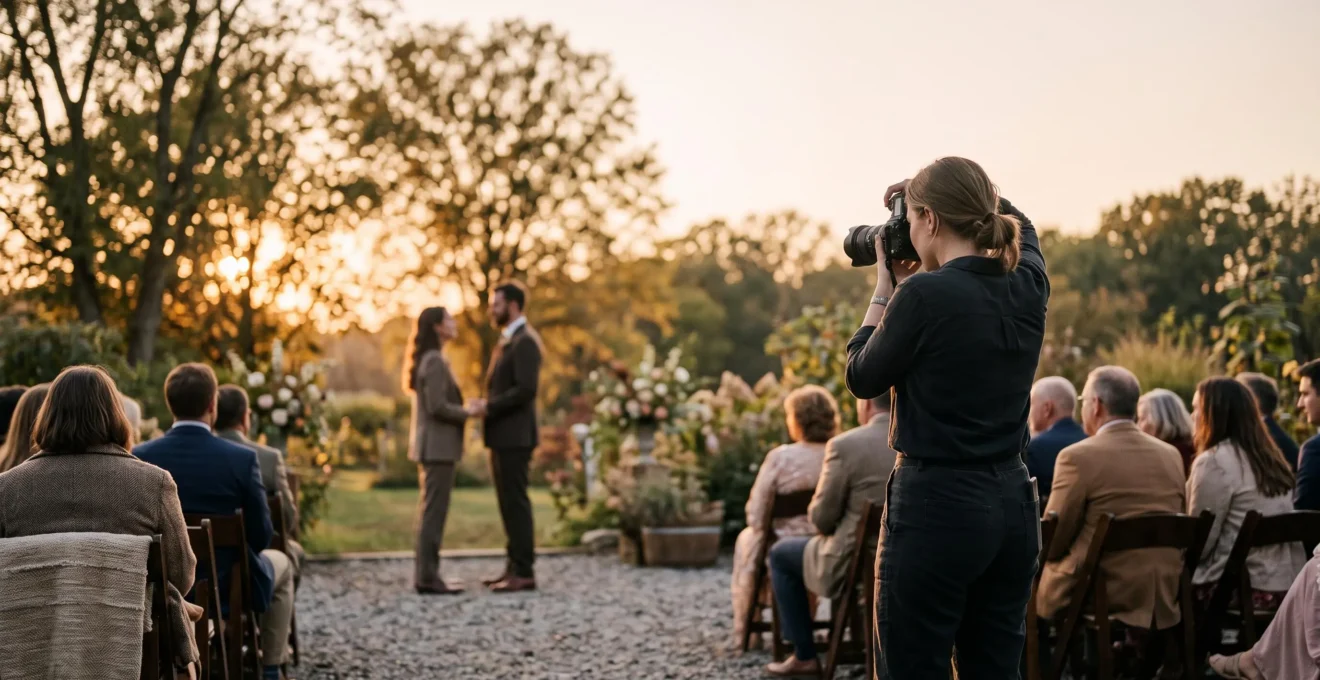
Contrary to the popular view of wedding photography as a creative service, its true nature is a solemn act of historical preservation.
- Your role transcends that of an artist; you are the designated custodian of a family’s single, unrepeatable day.
- The high price point is not for pictures, but for the assumption of risk and the guarantee of psychological vigilance.
Recommendation: Shift your mindset from ‘executing a job’ to ‘safeguarding an archive.’ Your contingency plans, client education, and mental preparation must all flow from this profound duty.
Many photographers enter this field drawn by the creativity, the emotion, and the celebration. They see a wedding day as the ultimate canvas. But after decades behind the lens, I can tell you this perspective is incomplete and, frankly, dangerous. The industry is crowded, and a recent industry analysis reveals a 51% increase in U.S. photography businesses between 2014 and 2024, while wedding numbers remain flat. This competition can tempt photographers to treat each event as just another “gig” in a portfolio-building exercise. But this mindset overlooks the terrifying, singular truth of our profession.
The common advice is to have backup gear, know the timeline, and capture the “key shots.” This is entry-level thinking. It addresses the mechanics of the job but fails to confront the soul of it. The real weight isn’t in your camera bag; it’s in the trust placed upon you by two families. You are not just being hired to create beautiful images. You are being entrusted with the stewardship of irretrievable history. These moments will never happen again. There are no reshoots for a father’s tear, a mother’s glance, or the shared breath before a vow.
So, what if the key to mastering this pressure isn’t just better gear or faster workflows, but a fundamental shift in how we perceive our role? This is not about being a vendor. It is about becoming a custodian of memory. The difference is profound. A vendor provides a service. A custodian accepts a sacred duty. This understanding changes everything—from how you prepare for a day to how you value your work and communicate that value to a client who sees only a price tag.
This article will guide you through that mental shift. We will deconstruct the unique gravity of this work, explore the psychological tools needed to bear it, and redefine your role from a simple service provider to an essential guardian of a family’s legacy. This is the path from being a good photographer to becoming a truly indispensable one.
To navigate this profound subject, we have structured this guide to build from the foundational principles of responsibility to the practical applications in your work. The following sections will provide a clear roadmap for mastering the weight and privilege of this profession.
Table of Contents: A Guide to Mastering the Weight of Wedding Photography
- Why Wedding Photography Carries Heavier Responsibility Than Commercial, Portrait or Event Photography
- How to Manage the Psychological Pressure of Knowing Every Moment Is Unrepeatable
- How to Educate Clients Who Don’t Understand Why Wedding Photography Costs £3,000+
- The Complacency Trap That Makes Experienced Photographers Treat Weddings as Routine
- What Contingency Plans to Prepare for Illness, Equipment Failure or Emergency During Weddings
- Why Some Emotional Moments Become Treasured Heirlooms While Others Are Forgotten Within Months
- Why Ceremony Vow Photos Become the Most Treasured Images Despite Being Technically Challenging to Capture
- Wedding Photography as Holistic Celebration Documentation: Beyond Technical Execution
Why Wedding Photography Carries Heavier Responsibility Than Commercial, Portrait or Event Photography
In commercial photography, a product can be reshot. In a portrait session, a pose can be retaken. Even at a corporate event, a missed handshake is rarely a generational catastrophe. Wedding photography exists in a category of its own because it operates under a unique and unforgiving constraint: every critical moment is both emotionally priceless and entirely unrepeatable. This is not a photoshoot; it is live, unscripted history. Your role is not merely to document, but to witness and preserve with absolute fidelity.
The pressure is amplified by the fact that the subjects are not professional models but real people experiencing one of the most significant emotional culminations of their lives. They are vulnerable, present, and utterly dependent on your ability to see and capture moments they are too immersed in to notice. A missed shot is not a professional failure; it is a permanent hole in a family’s legacy. The weight of this truth separates our work from all other photographic disciplines.
This responsibility can extend to the most extreme circumstances, demanding a level of commitment far beyond that of a typical creative professional. This is a burden of trust that must be consciously accepted.
Case Study: The Everest Base Camp Wedding
When photographer Charleton Churchill agreed to document a wedding at the base camp of Mount Everest, he wasn’t just taking on a creative challenge. As the first to ever achieve this, he accepted the responsibility for capturing once-in-a-lifetime moments in an extreme, high-risk environment where there was zero margin for error. Equipment failure, weather, or altitude sickness could have irrevocably lost the couple’s history. This illustrates the ultimate extension of a wedding photographer’s duty: the willingness to assume immense risk to fulfill the promise of preserving an unrepeatable story, no matter the conditions.
Understanding this distinction is the first step toward embodying the gravity of the profession. You are not simply a photographer for a day; you are the archivist for a lifetime of memories that begins with this single, irreplaceable event.
How to Manage the Psychological Pressure of Knowing Every Moment Is Unrepeatable
Accepting this profound responsibility comes with a significant psychological cost. The constant, high-stakes demand for psychological vigilance—being hyper-aware of every shifting glance, every fleeting touch, every potential memory—can be mentally and emotionally draining. This is not the same as merely “paying attention.” It is a sustained state of deep focus that, if left unmanaged, leads directly to professional burnout. This is a state of emotional, mental, and physical exhaustion caused by excessive stress, and the wedding industry is rife with it.
According to a testimony on professional pressure, many photographers in high-stakes fields like weddings report elevated levels of burnout. The key to longevity in this profession is not to ignore the pressure, but to build a system to manage it. The first step is acknowledging its existence and its source: the knowledge that your work is final. There are no second chances. This acceptance allows you to move from a state of anxiety to one of controlled readiness.
To cultivate this readiness, you must build moments of intentional calm into the chaos of the day. This isn’t about taking a long break; it’s about micro-resets. These are deliberate, 30-second pauses to ground yourself before entering the next critical phase of the day.
As shown in the image above, finding a quiet space to take a single, deep, conscious breath can reset your nervous system. This simple act of mindfulness allows you to step back from the adrenaline, quiet the internal noise, and re-engage with heightened awareness rather than frantic energy. It is in these moments of quiet focus that you transform pressure from a debilitating force into a tool for heightened perception.
How to Educate Clients Who Don’t Understand Why Wedding Photography Costs £3,000+
One of the greatest challenges a responsible photographer faces is articulating their value to clients who see the fee as an hourly rate for taking pictures. The disconnect is vast; as recent wedding industry data shows, the average U.S. photography package is priced far higher than the average amount couples actually budget for photography. Your job is to bridge this gap not by defending your price, but by reframing their understanding of what they are actually purchasing. They are not buying photos; they are investing in risk mitigation and peace of mind.
The fee doesn’t just cover your time on the day. It covers the years of experience that allow you to anticipate moments before they happen. It covers the thousands of pounds of redundant, professional-grade equipment that ensures a critical failure doesn’t mean a critical loss. It covers the robust digital archiving strategy that protects their memories from fire, theft, and technological obsolescence for decades to come. Most importantly, it covers the mental and emotional capacity you bring, which allows the couple to be fully present and unburdened by the fear of a missed moment.
The following table is a powerful tool for this conversation. It moves the discussion away from tangible deliverables and toward the immense, intangible value that a true professional provides. This is how you shift the client’s mindset from “cost” to “investment.”
| Fee Component | Tangible Deliverable | Intangible Value Transferred |
|---|---|---|
| Coverage Hours | Up to 10 hours of on-site shooting | Sustained focus and vigilance across an entire unrepeatable day |
| Digital Gallery & Album | Edited high-resolution images and printed keepsakes | Decade-proof archiving strategy against loss, theft, and technological obsolescence |
| Second Shooter / Backup Gear | Additional angles and redundant equipment | Risk mitigation and crisis problem-solving capacity |
| Experience & Reputation | Portfolio and client reviews | Client’s freedom to be fully present, unburdened by the fear of a missed moment |
When a client understands that they are paying for the guarantee that their one day will be safeguarded by an expert, the price is no longer an obstacle but a logical and necessary investment in their own history.
The Complacency Trap That Makes Experienced Photographers Treat Weddings as Routine
While inexperience brings the risk of technical error, experience carries a more insidious danger: complacency. After shooting dozens, or even hundreds, of weddings, the rhythm can become familiar. The toasts, the first dance, the cake cutting—they can all start to feel like a checklist to be executed efficiently. This is the complacency trap, where the “job” aspect of photography overtakes the “responsibility” aspect. The drive for efficiency, while good for business, can numb the creative and emotional senses required to see each wedding as the unique event it is.
When you start seeing patterns instead of people, you have fallen into the trap. You begin to shoot what you know works, rather than what is truly happening. You are no longer a custodian of their specific memory but a manufacturer of generic wedding photos. This is the greatest betrayal of the trust placed in you. The antidote to this trap is to actively seek out challenges and impose creative constraints that force you to see with fresh eyes every single time.
This means consciously fighting against the urge to go on autopilot. It means arriving at a venue and looking for the one angle nobody has ever used. It means focusing on the quiet, in-between moments, not just the “big” ones. As celebrated photographer Jose Villa advises, you must take ownership of your own inspiration.
Find ways to inspire yourself and your clients by taking on challenges and thinking fast in situations that aren’t inspiring, make them inspiring.
– Jose Villa, ShootDotEdit
This proactive pursuit of inspiration ensures that your experience becomes a tool for deeper perception, not a catalyst for routine. It keeps your senses sharp and your mind engaged, allowing you to honour the uniqueness of every couple and every story you are privileged to document.
What Contingency Plans to Prepare for Illness, Equipment Failure or Emergency During Weddings
A true professional is defined not by how they perform when things go right, but by how they have prepared for when things go wrong. Contingency planning is the most tangible expression of your role as a custodian of memory. It is the practical application of your responsibility, covering everything from a sudden illness to a catastrophic equipment failure. Your clients are not just paying for your artistry; they are paying for your foresight and your robust safety nets.
Shockingly, this level of preparedness is not standard in the industry. Industry insurance data indicates that only about 71,500 of roughly 260,000 U.S. photography businesses carry liability insurance, a basic tenet of professional risk management. This exposes a widespread failure to take the role’s responsibilities seriously. A true professional’s contingency plan goes far beyond insurance. It includes:
- Dual-Card Slot Cameras: Every image is written to two memory cards simultaneously, making data loss from card failure nearly impossible.
- Redundant Equipment: Carrying at least two professional camera bodies, multiple lenses, and backup lighting for every scenario.
- A Network of Trusted Associates: Having a list of equally skilled photographers on standby who can step in, with a pre-agreed-upon plan, in the event of a medical emergency.
- Off-site and Cloud-based Backups: Ensuring that as soon as the wedding is over, the images are backed up in at least three separate locations to protect against fire, theft, or hardware failure.
These are not optional extras; they are the non-negotiable foundations of professional practice. They are the systems that allow you to look a client in the eye and honestly tell them that their memories are safe with you. Preparing for a crisis is as important as preparing for the creative aspects of the day.
Your Crisis Readiness Checklist: From Burnout to Backup Plans
- Recognize the early physical and emotional symptoms of exhaustion before a crisis compounds them.
- Set clear professional boundaries with clients and vendors ahead of the wedding day to manage expectations and stress.
- Build regular breaks and recovery time into busy wedding seasons to prevent systemic fatigue.
- Incorporate relaxation techniques, like deep breathing, to stay composed when unexpected problems arise on the day.
- Seek support from peers or professionals to process high-pressure events after the fact and prevent cumulative stress.
Your readiness for disaster is the ultimate proof of your professionalism and your commitment to safeguarding your clients’ irretrievable history.
Why Some Emotional Moments Become Treasured Heirlooms While Others Are Forgotten Within Months
Once you have the systems in place to prevent failure, the next level of mastery is understanding what makes an image endure. Not all photographs are created equal. Some are looked at once and filed away; others are printed, framed, and passed down through generations. These are what we call heirloom-grade moments. The difference rarely lies in technical perfection. It lies in emotional authenticity. An image becomes an heirloom when it captures a truth about a person or a relationship.
The market intuitively understands this. Recent market data confirms that candid photography leads the wedding photography style segment with a 40.3% market share in 2024. Clients are increasingly rejecting overly posed, manufactured images in favor of photos that feel real. They want to remember not just what their wedding looked like, but what it *felt* like. Your responsibility as a custodian of memory is to hunt for these moments of unscripted truth.
This requires a shift in focus from directing to observing. An heirloom moment is rarely found during the formal portraits. It is found in the nervous glance a groom shares with his best man, the quiet squeeze of a grandmother’s hand, or the spontaneous burst of laughter between bridesmaids. These are the moments that reveal character and connection. They are fleeting and require immense presence of mind to capture, as the legendary Henri Cartier-Bresson articulated.
Photography is for me, a spontaneous impulse that comes from an ever-attentive eye, which captures the moment and its eternity.
– Henri Cartier-Bresson, ShootDotEdit
To create heirlooms, you must become an “ever-attentive eye.” You must learn to anticipate emotion, to read body language, and to position yourself for the moments that matter most, not just the ones on the shot list. This is how you create an emotional archive that grows more valuable with each passing year.
Why Ceremony Vow Photos Become the Most Treasured Images Despite Being Technically Challenging to Capture
Of all the moments in a wedding day, the exchange of vows is the emotional and narrative apex. It is the literal and figurative centrepiece of the story. For this reason, photographs from the ceremony, and especially the vows, often become the most treasured images in the entire collection. This is because they document the very act of commitment—the promise that is the entire reason for the day’s existence. It is no surprise that a major global wedding report found that photographers are engaged by nearly nine in ten couples worldwide; they are being hired, first and foremost, to witness and record this singular, sacred act.
However, these moments are also among the most technically and logistically challenging to capture. Lighting is often poor and mixed, movement is restricted, sound is a factor (you must be silent), and the emotional intensity is palpable. You must navigate these constraints flawlessly while remaining unobtrusive, capturing the raw emotion without becoming a distraction. This is a high-wire act that requires a masterful blend of technical skill, situational awareness, and emotional intelligence.
The true power of a vow photograph often lies in the details. It’s not just the wide shot of the couple at the altar; it’s the macro shot of their intertwined hands, the tear on a cheek, the subtle tremor of a lip. These are the details that convey the immense emotional weight of the moment.
An image like this transforms an abstract promise into a tangible, emotional artifact. It freezes a moment of profound connection, making it available for endless reflection. Mastering the vow exchange is not just a technical challenge; it is the ultimate test of your ability to act as a silent, sensitive witness to history. It is where your role as a custodian is most critical and most deeply felt.
Key Takeaways
- Wedding photography is not a creative service but a solemn duty to preserve irretrievable family history.
- Your value is defined by your contingency planning and psychological vigilance, not just your artistic skill.
- Authenticity is the key to creating heirloom-grade images; prioritize candid, emotional moments over perfectly posed shots.
Wedding Photography as Holistic Celebration Documentation: Beyond Technical Execution
Finally, to truly fulfill your role as a custodian, you must expand your vision beyond simply capturing people and key events. Your responsibility is to document the holistic celebration. This means seeing the wedding not as a series of moments, but as a complete ecosystem of people, places, and emotions. The story of the day is told as much by the quiet, empty spaces as it is by the crowded dance floor. It’s about capturing the context that holds all the memories.
This includes documenting the venue before guests arrive, capturing the carefully chosen details, and feeling the atmosphere of the space. These “scene-setting” shots provide the container for the human story. They are the establishing shots in the film of the day, giving context and depth to the emotional moments that follow. They help trigger “flashbulb memories,” where a single detail can bring back a flood of sensory information about a moment in time.
A photograph of an empty ceremony space, filled with anticipation, can be as powerful as a photo of the first kiss. It speaks to the potential and the gravity of what is about to unfold. This holistic approach is what separates documentation from true storytelling.
When you deliver a gallery that includes these atmospheric images, you are not just giving back photos of people. You are returning the entire world of their wedding day. You are providing a complete emotional and environmental archive. This is the final layer of responsibility: to see and preserve not just the moments, but the very soul of the celebration itself.
Embracing this solemn duty transforms not only your work but your relationship to it. By shifting your perspective from artist to custodian, you can serve your clients at the highest level and build a career defined by trust, integrity, and profound meaning.