
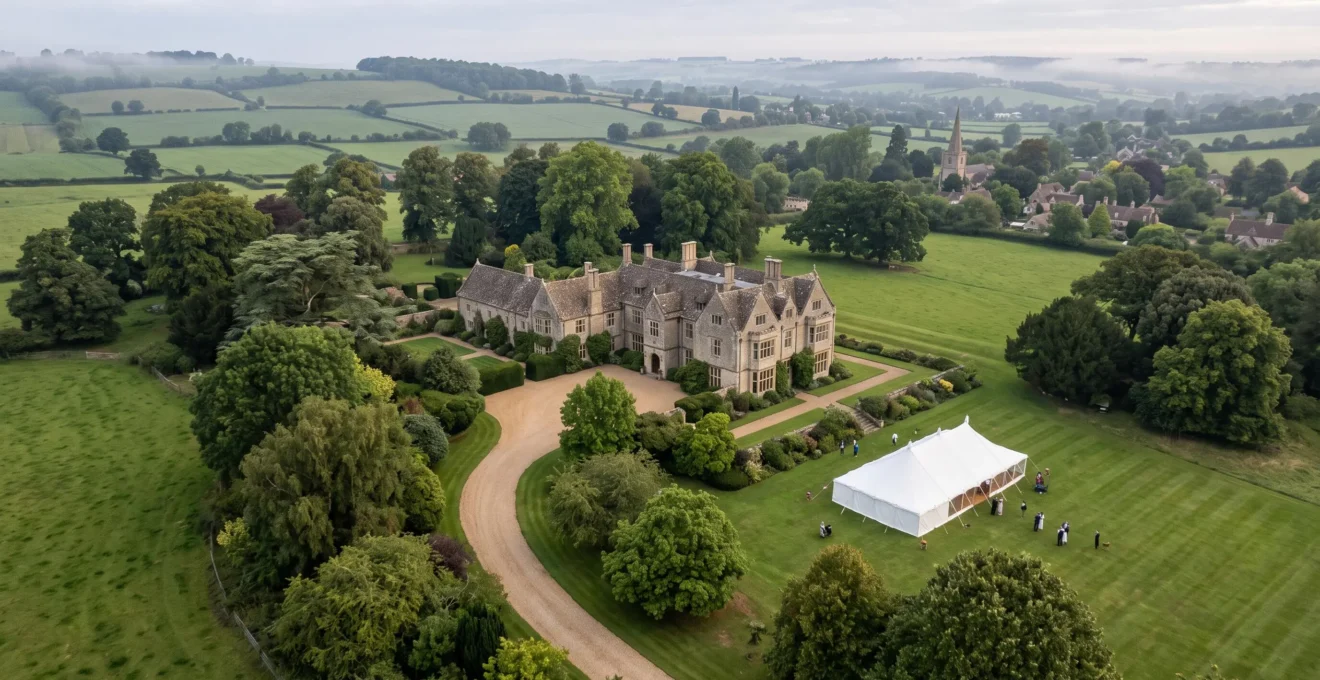
Adding drone services is profitable only when treated as a strategic business decision, not just a creative add-on.
- The financial return depends less on the drone itself and more on targeting clients whose premium venues justify the unique perspective.
- Navigating CAA regulations, securing high-level insurance, and managing venue permissions represent significant, non-negotiable operational overhead.
Recommendation: Begin with a sub-250g drone (like a DJI Mini) to test client appetite and master workflows with minimal regulatory burden before committing to a larger investment.
As a wedding photographer, the pressure to innovate is constant. Lately, the buzz around aerial photography has become a roar. You see those sweeping, cinematic shots of a stately home, the couple a tiny, perfect detail in a vast landscape, and the question is inevitable: should I be offering this? The idea of adding drone services is tempting, promising a “unique perspective” that can elevate your portfolio and command a higher fee. Many photographers jump in, thinking the hardware is the main hurdle, only to find themselves tangled in a web of unexpected complexities.
The common advice is to “get a license” and “offer it as an upsell.” But this surface-level approach ignores the core business reality. It overlooks the significant operational drag of CAA compliance, the hidden costs of commercial-grade insurance, and the critical fact that not all weddings—or venues—are created equal from 50 metres up. The real challenge isn’t just learning to fly; it’s learning *when* to fly, *where* to fly, and for *whom* the service provides genuine, premium value.
But what if the key to a successful drone offering isn’t about having the most expensive equipment, but about mastering a strategic framework? This guide moves beyond the “wow-factor” to provide a frank, ROI-analytical assessment from a commercial operator’s perspective. We will dissect the financial and practical viability, analysing the client psychology that drives demand, the non-negotiable regulatory overhead, and the critical skill of identifying which venues actually justify the investment. This is not about the art of the aerial shot, but the business of making it profitable.
This article will guide you through the essential business calculations needed to determine if drone photography is a sound investment for your specific situation. We will explore the factors that make it a premium service for some clients, the legal and logistical hurdles you must overcome, and how to capture architectural grandeur with or without a drone.
Summary: A Photographer’s Guide to the Business of Wedding Drones
- Why Some Couples Pay £800+ Extra for Drone Coverage While Others Show Zero Interest
- How to Navigate CAA Drone Regulations and Historic Venue Flight Restrictions for Legal Wedding Aerial Photography
- DJI Mini or Professional Cinema Drone: Which Investment Level Suits Wedding Aerial Photography
- The Distraction Mistake Where Drone Operation Makes You Miss Ground-Level Moments
- Which Wedding Venues Justify Drone Deployment and Which Look Unimpressive From Above
- How to Use 16mm Ultra-Wide Lenses to Capture Venue Scale Without Distorting Architecture
- Why Some Architectural Photos Convey Grand Scale While Others Make Large Spaces Feel Small
- How to Photograph Wedding Venue Grandeur That Showcases Architectural Scale and Splendour
Why Some Couples Pay £800+ Extra for Drone Coverage While Others Show Zero Interest
The decision to offer drone photography, often as an add-on costing £800 or more, begins with understanding client value perception. While it might seem like a universally appealing feature, the reality is far more nuanced. Demand is growing; Bridebook data shows that demand for wedding drone footage rose from 12% of UK couples in 2022 to 17% in 2023. However, this interest is not evenly distributed. The determining factor is almost always the venue and its surrounding landscape.
A couple getting married in a central London hotel or a charming but compact barn conversion will see little to no value in an aerial perspective. Their celebration is about the interior, the intimacy, and the details. For them, a drone is a solution to a problem they don’t have. Conversely, a client who has invested a significant portion of their budget in a venue defined by its context—a Scottish castle overlooking a loch, a historic estate set in rolling hills, or a dramatic coastal clifftop location—has a completely different mindset. They didn’t just book a building; they booked a landscape.
For this second group, the drone is not a gimmick. It is the only tool that can truly capture the full scale and grandeur of their chosen location, justifying their investment in the venue itself. A case study of UK drone videography highlights that the most requested shots are wide, establishing views that reveal the entire venue and its surroundings. This is especially true for capturing the architectural beauty of churches and country estates. It articulates the ‘why’ behind their venue choice in a way that ground-level photography cannot. Therefore, your ability to sell this service hinges on identifying and attracting clients whose venue choice inherently creates the demand.
Ultimately, a successful drone offering is not about convincing every client they need it. It is about aligning your service with the clients who already understand its value because of the epic story their venue tells.
How to Navigate CAA Drone Regulations and Historic Venue Flight Restrictions for Legal Wedding Aerial Photography
Once you’ve identified the market, the next gatekeeper to profitability is the regulatory overhead. Flying a drone commercially at a wedding in the UK is not a casual affair; it requires strict adherence to Civil Aviation Authority (CAA) rules and, often, navigating complex venue-specific permissions. Ignoring this is not an option and constitutes a significant business risk. The foundation of legal operation is securing the correct credentials.
At a minimum, every commercial drone operator must possess:
- A Flyer ID: This proves you have passed the CAA’s online theory test and is required for flying any drone you own or are responsible for.
- An Operator ID: This must be displayed on your drone(s) and is required if your drone is over 250g or has a camera, which applies to all wedding photography scenarios.
- An A2 Certificate of Competency (A2 CofC) or a GVC: These advanced qualifications are necessary for operating slightly larger drones closer to people, which is almost unavoidable at a wedding. The specific certificate dictates the operational subcategories you can fly in.
The regulatory burden extends far beyond personal certification. Many premium wedding venues, particularly historic properties, have stringent policies. The National Trust, for example, treats all drone activity as a commercial filming request. Their official policy clarifies that permission is only considered for established production companies with robust insurance, and it involves a location fee and a separate drone processing fee. This turns a simple photo shoot into a formal production, adding layers of cost and administration that must be factored into your pricing.
Furthermore, standard insurance is often insufficient. While basic drone insurance is a legal requirement, high-value venues frequently demand higher levels of protection. For prestigious UK filming locations, it is common for venues to require £5 million to £10 million in public liability cover. This is a significant step up from a basic policy and represents a tangible cost in your business model. Understanding these layers of compliance is central to calculating the true ROI of a drone service.
Failing to account for this regulatory overhead can quickly erode any potential profit, turning a premium service into a loss-making headache.
DJI Mini or Professional Cinema Drone: Which Investment Level Suits Wedding Aerial Photography
Choosing the right drone is a critical investment decision, balancing capability, cost, and the regulatory overhead discussed previously. The UK’s drone class system provides a clear framework for this choice. For a wedding photographer, the decision largely falls between two practical tiers: the “Easy Add-On” sub-250g class and the more capable “Prosumer” class.
The sub-250g category, dominated by models like the DJI Mini series, is the most logical entry point. Its primary advantage is regulatory simplicity. Drones in this class (C0 or UK0) can be flown with only a Flyer and Operator ID, bypassing the need for an A2 CofC. This drastically lowers the barrier to entry and the ongoing operational drag. While their smaller sensors have limitations in lower light, modern Mini drones produce outstanding image quality in good conditions, perfectly adequate for the sweeping daytime establishing shots that most couples desire. They are less intimidating to guests and their lower cost presents a much faster path to ROI.
The next step up involves prosumer models like the DJI Air or Mavic series, which typically fall into the C1/UK1 class (under 900g). These drones offer larger sensors, better wind resistance, and more advanced features. However, this increased capability comes with a higher price tag and, crucially, a greater regulatory burden, often requiring an A2 CofC to operate legally in the environments typical of a wedding. The leap to even larger, cinema-class drones (C2/UK2) is generally unjustifiable for a standard wedding photography business, as the exponential increase in cost and regulation offers diminishing returns for the type of shots clients actually want. The following table breaks down these investment tiers:
| Tier | Class & Weight | Example Drones | Certification Needed |
|---|---|---|---|
| Easy Add-On | UK0/C0, under 250g | DJI Mini 3 Pro, Mini 4 Pro, Neo, Flip | None beyond Flyer/Operator ID |
| Prosumer Videographer | UK1/C1, under 900g | DJI Air 3S, Avata 2, Mavic 3 Classic | Flyer/Operator ID; enhanced safety features |
| Luxury / Specialist | UK2/C2, under 4kg | Higher-payload prosumer & cinema-class platforms | A2 CofC required |
Your Action Plan: Future-Proofing Your Drone Purchase
- Verify if your target drone already has a European C-class mark (C0-C4), as these remain valid under equivalent UK rules.
- Remember that until 31 December 2027, a C-class marked drone can be legally operated as if it were the corresponding UK-class drone.
- Be aware that from 1 January 2026, any new drone model sold in the UK must carry a UK class mark.
- Avoid purchasing an unmarked ‘legacy’ drone as the 2028 cut-off approaches, as it will face significant operating restrictions once the transition period ends.
- Prioritise a drone with a class mark to ensure long-term operational freedom and protect your investment against future regulatory changes.
For most photographers, the smart money is on starting small, proving the concept with a sub-250g model, and only upgrading when consistent client demand and profit margins clearly justify the increased complexity.
The Distraction Mistake Where Drone Operation Makes You Miss Ground-Level Moments
The single biggest operational risk of adding drone services is not a crash or a regulatory fine, but what I call “operational drag.” This is the critical time and focus you divert from your primary job: capturing the irreplaceable moments happening on the ground. Every minute spent calibrating a compass, swapping a battery, or framing an aerial shot is a minute you are not capturing a laugh, a tear, or a candid glance between the couple and their guests. This is a significant trade-off that is often underestimated.
Flying a drone is an active, attention-intensive task. It is not a “set-and-forget” camera. Real-world experience from a photographer’s first all-drone wedding shoot highlights several practical lessons. For instance, you must budget real time for tasks like changing ND filters as the sun moves behind clouds. Smooth camera movements require a physical remote controller, not just Wi-Fi control from a phone, and even then, quick pans can cause the stabiliser to judder. The most crucial lesson, however, is scheduling. The propeller noise is highly audible and disruptive; attempting a flight during the ceremony or speeches is a recipe for disaster and will alienate the couple, guests, and venue staff.
The only way to mitigate this risk is through rigorous planning and time management. Drone flights should be scheduled for specific, low-impact windows: before guests arrive to capture the empty venue, during the drinks reception when there is ambient noise and you can coordinate with the couple for a few minutes, or during the golden hour for those epic scenic shots. Having a second shooter is almost a prerequisite if you plan to operate a drone, allowing one person to focus on the sky while the other guarantees no ground-level moments are missed. Without this structure, you risk delivering a handful of nice aerials at the expense of a gallery missing the core human story of the day.
Treat the drone as a specialist tool for specific, pre-planned shots, not as a replacement for your camera on the ground. Your main value to the client remains in capturing moments, not just vistas.
Which Wedding Venues Justify Drone Deployment and Which Look Unimpressive From Above
The profitability of drone photography is directly tied to a crucial skill: venue assessment. Not every location benefits from an aerial view. In fact, many look surprisingly unimpressive from above, making the service a hard sell and a poor reflection of your brand. The key is to understand what makes a venue “drone-worthy.” The ideal candidates are properties whose character is defined by their architecture and their relationship with the surrounding landscape.
Think of a grand, symmetrical stone estate in the British countryside. From the air, you can capture its full architectural form, the layout of its manicured gardens, and its majestic position within the rolling hills. This is a story of scale and splendour that cannot be told from the ground. A drone shot here isn’t just a photo; it’s an architectural portrait of the venue. As one UK drone videography study notes, these sweeping aerial views are particularly effective at capturing the full beauty of churches and country estates, providing the quintessential “establishing shot” that sets the scene for the entire wedding story.
Conversely, many venues, even beautiful ones, are simply not suited for aerials. A venue enclosed by other buildings, a location with a visually cluttered roof (like a hotel with extensive HVAC units), or a property surrounded by a car park will look chaotic and unappealing from the air. Flying a drone here does a disservice to the venue and the client. Part of your role as an expert is to provide an honest assessment and manage expectations. Offering drone services for a venue that won’t shine from above devalues your work and the client’s investment.
Your drone should be deployed as a specialist tool to articulate grandeur, not as a blanket add-on for every booking. The most profitable operators are those who can confidently advise clients when an aerial shot will be epic—and, just as importantly, when it won’t.
How to Use 16mm Ultra-Wide Lenses to Capture Venue Scale Without Distorting Architecture
While drones offer the ultimate high-angle perspective, they are not the only tool for capturing a venue’s grandeur. In situations where a drone is impractical—due to weather, cost, or regulations—a ground-based ultra-wide-angle lens can be an incredibly powerful alternative. Lenses in the 14-24mm range (on a full-frame camera) can create a profound sense of scale and immersion, but they must be handled with technical precision to avoid the classic pitfall: unflattering distortion.
The biggest mistake photographers make with ultra-wide lenses is tilting the camera upwards to fit a tall building into the frame. This causes “keystone distortion,” where vertical lines converge, making the structure look like it’s falling backwards. This is an amateurish look that destroys architectural integrity. The professional approach is to keep the camera perfectly level. Find a vantage point far enough back to include the building, and position the camera so the sensor plane is parallel to the building’s facade. This will likely mean the top of the building is cut off in-camera, and there’s a large amount of uninteresting foreground.
This is where post-production becomes part of the photographic process. In software like Adobe Lightroom or Camera Raw, you use the “Transform” panel. The “Guided” or “Full” upright corrections will analyse the image and correct the perspective, making all vertical lines perfectly parallel. This technique effectively mimics the function of a much more expensive tilt-shift lens. After correction, you will need to crop the image to remove the empty space created by the transformation. The result is a powerful, dramatic wide shot that conveys immense scale while respecting the architect’s design, all without leaving the ground.
It demonstrates that true photographic expertise lies not just in owning a drone, but in understanding the principles of optics and perspective to solve problems creatively with the tools at hand.
Why Some Architectural Photos Convey Grand Scale While Others Make Large Spaces Feel Small
The ability to convey scale is a hallmark of masterful photography, whether architectural or environmental. It’s a skill that separates a mere snapshot from a powerful, evocative image. As the Skylum editorial team aptly puts it, “Classic wedding photos and videos can convey the atmosphere, but not always the scale.” This is because scale is not just about showing how big something is; it’s about creating a feeling of vastness and making the viewer feel a sense of awe. Many photographers fail at this, and their images of grand spaces end up feeling flat and confined.
One of the most effective techniques for conveying scale is the use of a human element for reference. By placing a person (or a couple) within a massive environment and framing them as a small part of the overall composition, you immediately give the viewer a tangible sense of proportion. The vastness of the space is no longer an abstract concept; it is measured against the familiar size of a human figure. A shot of a soaring manor hall is impressive, but a shot of a tiny couple dwarfed by that same hall’s towering vaulted ceiling is breathtaking. This compositional choice tells a story of the couple being enveloped by the grandeur of their chosen space.
Another critical factor is light. Large, open spaces often feel smaller in photos if they are lit flatly. Using dramatic light—such as strong shafts of sunlight from a high window, or carefully placed off-camera flash to create highlights and deep shadows—helps to sculpt the space. Light and shadow create depth, define architectural lines, and guide the viewer’s eye through the scene, enhancing the perception of three-dimensional volume. A flatly lit image compresses this depth, making the space feel less expansive. By mastering the interplay of human reference, composition, and light, a photographer can make a large space feel truly monumental.
This understanding is more valuable than any piece of equipment, as it allows you to create a sense of splendour in any environment, from a vast landscape to a majestic interior.
Key Takeaways
- Profitability is driven by targeting clients whose premium, landscape-defined venues justify the cost of aerials.
- CAA compliance, high-level insurance, and venue permissions are significant, non-negotiable business costs, not just a checklist.
- Starting with a sub-250g drone minimises regulatory burden and allows you to test the market with a faster path to ROI.
How to Photograph Wedding Venue Grandeur That Showcases Architectural Scale and Splendour
Capturing the grandeur of a wedding venue is about telling a multi-layered story. It’s a mistake to think that scale can only be shown with a single, wide, establishing shot. True mastery lies in weaving a narrative that moves seamlessly from the epic to the intimate, showing both the magnificent whole and the exquisite details that give the venue its character. A photographer who specializes in grand historic properties, like five-time UK Wedding Photographer of the Year Chris Chambers who shoots at venues like Allerton Castle, understands this balance. The approach blends documentary coverage with fine art portraiture to articulate splendour on every level.
The complete story of a venue’s grandeur is told in three distinct shots. First is the macro view: the sweeping drone or ultra-wide shot that establishes the venue in its landscape, as discussed earlier. This is the shot that says, “This is the world you are entering.” It sets the scene and conveys the overall scale. It’s the visual anchor for the day.
Second is the meso view: the ground-level shots that show the architecture in relation to the people. This involves using techniques like placing the couple as a small element in a grand hall to emphasize interior scale or framing them through an elegant archway. These images connect the human story of the wedding to the architectural story of the venue. Finally, there is the micro view: the close-up details. The weathered texture of a stone carving, the intricate ironwork on a gate, the patina on a centuries-old door handle. These shots speak of history, craftsmanship, and the soul of the building. They add a tactile, sensory layer to the gallery that a wide shot can never capture.
A truly spectacular wedding gallery doesn’t just show the venue; it allows the viewer to experience it. It combines the epic aerials with the intimate details, proving that grandeur is found as much in a single stone as it is in a sprawling estate.