
The difference between a £3,500 and a £15,000 wedding photographer isn’t the camera—it’s the ability to act as a visual editor, not just a documentarian.
- Editorial vision means actively curating a narrative by identifying “emotional signifiers” and “narrative currency” in every moment.
- Mastering the “intentional friction” between directing for perfection and stepping back for authenticity is key to creating images with both beauty and soul.
Recommendation: Start by pre-visualising scenes not as events to be captured, but as potential contributions to a cohesive, art-directed story.
As a professional wedding photographer, you’ve likely hit a plateau. Your images are beautiful, your clients are happy, but your work feels indistinguishable from the sea of other talented shooters. You hear the advice to “tell a story” and “capture the details,” but these platitudes offer no clear path to elevating your craft to the level of high-end, magazine-worthy coverage—the kind that discerning clients pay a significant premium for. You see the work in luxury publications and wonder what secret ingredient you’re missing.
The truth is, the gap isn’t technical; it’s philosophical. The transition from a competent documentarian to a sought-after visual artist lies in a fundamental mindset shift. It’s about ceasing to be a passive recorder of events and becoming an active curator of a visual narrative. This isn’t about fabricating moments, but about developing an editorial eye that sees the world differently—an eye that can identify the narrative potential in a fleeting glance, the texture of a dress, or the quality of light in a room.
But if the secret isn’t a new lens or a lighting preset, what is it? It’s a framework for decision-making. As a former fashion editorial photographer who made the leap to luxury weddings, I can tell you it’s a learnable skill. It’s about understanding why some images have an emotional weight that transcends the moment they were taken. This guide will deconstruct that editorial vision, moving beyond generic tips to provide a concrete framework for developing your own. We will explore the mindset, the practical application in real wedding scenarios, and the tangible financial value of this sophisticated approach.
This article provides a comprehensive roadmap to developing that editorial eye. Below, you will find a structured exploration of the key concepts, from understanding the value of a visual narrative to creating images with the timeless quality of fine art.
Summary: How to Develop an Editorial Eye That Transforms Wedding Coverage Into Magazine-Worthy Stories
- Why 90% of Wedding Photographers Lack the Editorial Vision Clients Pay Premium Rates For
- How to Pre-Visualise Editorial Compositions in Real Wedding Scenarios Without Staging
- Editorial Minimalism or Rich Documentary: Which Approach Suits High-End City Weddings Versus Country Estates
- The Editorial Trap That Makes Your Wedding Photos Stunning but Emotionally Empty
- When to Direct for Editorial Perfection and When to Step Back During Unpredictable Moments
- Why Fine Art Wedding Photographers Charge £12,000+ While Documentary Shooters Average £3,500 in the UK
- Why Affluent Couples Pay £15,000 for Visual Narrative When £3,000 Photographers Deliver Beautiful Images
- How to Create Fine Art Wedding Imagery That Resembles Museum Photography More Than Event Coverage
Why 90% of Wedding Photographers Lack the Editorial Vision Clients Pay Premium Rates For
The vast majority of wedding photographers are excellent technicians. They master light, composition, and their gear. Yet, they remain service providers, tasked with “capturing the day.” This is the fundamental barrier. The elite few who command premium rates operate from a different premise, one perfectly encapsulated by the legendary photographer Ansel Adams, who said, “You don’t take a photograph, you make it.” This shift from *taking* to *making* is the essence of the editorial vision. It’s the difference between being a passive documentarian and an active visual editor.
A documentarian follows a shot list, ticking boxes: the dress, the kiss, the first dance. A visual editor sees these moments as raw material for a larger narrative. They are constantly assessing each element for its “narrative currency”—its ability to contribute to the story’s theme, mood, and emotional arc. This mindset is not about staging fake moments but about recognising and isolating the moments that are most potent with meaning. It’s a process of intentional selection and subtraction.
Case Study: How Jonas Peterson Shifted From Shot Lists to Narrative-Driven Wedding Storytelling
Renowned destination wedding photographer Jonas Peterson speaks of a pivotal shift in his career. Influenced by another artist, he moved away from the safety of client-provided shot lists and Pinterest boards. Instead, he began the harder work of pursuing a genuine, unique narrative at every wedding. This deliberate choice transformed his role from a service provider fulfilling a checklist to a commissioned artist tasked with interpretation. This exact mindset shift is what separates photographers who compete on price from those whom affluent clients seek out for their unique vision, proving that the highest value is placed on artistry, not just technical execution.
This curatorial approach is what clients are paying for when they invest five figures. They aren’t just buying photos; they are commissioning an artist to interpret their day and translate it into a cohesive, evocative collection of images. They are paying for an opinion, a perspective, and a vision that transcends simple documentation. Lacking this vision means competing on price in a crowded market, forever stuck below the glass ceiling of premium work.
How to Pre-Visualise Editorial Compositions in Real Wedding Scenarios Without Staging
Pre-visualisation in an editorial context isn’t about storyboarding every shot. It’s about cultivating a state of heightened awareness. Instead of just seeing a bride getting ready, the editorial eye is scanning for vignettes that tell a deeper story. It’s about asking, “What does this feel like?” before asking, “What does this look like?” You must train yourself to hunt for textures, gestures, and qualities of light that carry emotional weight. This is how you move beyond a generic “detail shot” of a perfume bottle and instead create an image that evokes sensuality, anticipation, and quiet luxury.
This means developing a “sensory shot list” in your mind. Rather than listing objects (shoes, rings, flowers), you list feelings and concepts: quiet intimacy, nervous energy, overwhelming joy, architectural stillness. With this framework, you begin to see compositions everywhere. A hand nervously twisting a piece of fabric becomes an image about anticipation. The way light catches the dust motes in a silent room becomes a portrait of time standing still before the ceremony. These are the found compositions, the un-staged moments that feel perfectly art-directed because your eye was trained to find them.
Look at how texture and form can communicate more than a wide shot. This image isn’t about identifying a person; it’s about the feeling of connection, the quiet promise symbolised by the band, and the softness of the moment. This is what it means to capture an emotional signifier, a visual cue that does the emotional work for you. It’s a detail that tells a macro story. Developing this ability to see the part that represents the whole is a cornerstone of the editorial mindset.
Your Action Plan: Auditing for Narrative Currency
- Identify the Core Theme: Before shooting, ask the couple: “What three words describe the feeling of your wedding?” Use these words (e.g., “elegant, intimate, joyous”) as your creative filter.
- Hunt for Emotional Signifiers: During the day, actively look for visual evidence of your theme words. A tear during the vows, a shared laugh between grandparents, a quiet hand squeeze—these are your story’s building blocks.
- Assess Compositional Value: For each potential shot, ask: “Does this image move the story forward, or is it just a pretty picture?” Prioritise images that add to the narrative arc over those that are merely decorative.
- Connect Details to Character: Don’t just shoot the shoes. Shoot them in a way that says something about the wearer. Are they kicked off under a table, signifying a wild party? Or perfectly placed, signifying meticulous elegance?
- Review and Curate: In your final edit, be ruthless. Create a “director’s cut” of 50-75 images that tell the most powerful, cohesive story. This is your true product, not the 800-image data dump.
Editorial Minimalism or Rich Documentary: Which Approach Suits High-End City Weddings Versus Country Estates
One of the biggest mistakes photographers make is applying the same stylistic approach to every wedding. An editorial vision demands adaptability. The aesthetic choices—be it stark minimalism or a lush, layered documentary style—should be dictated by the environment itself. Your job as a visual editor is to let the venue become a character in the story, not just a passive backdrop. Its personality should inform your compositional language.
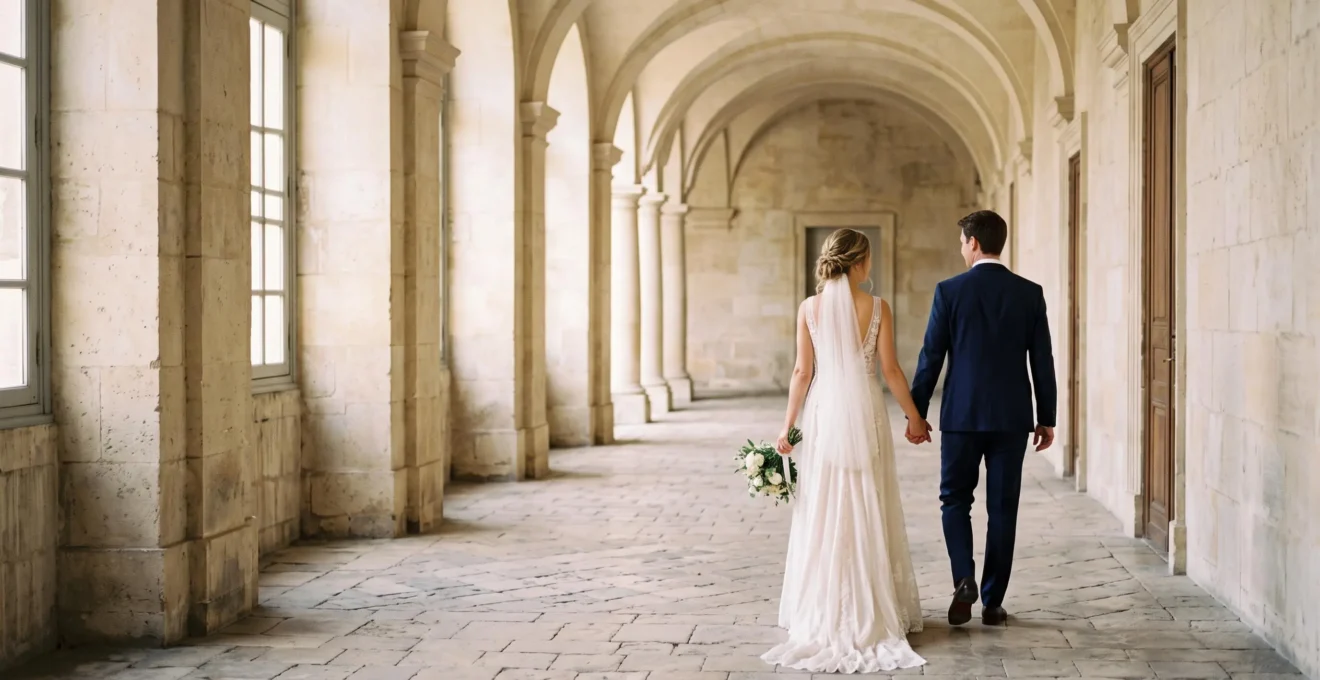
Consider a high-end city wedding in a modern art gallery or a historic library. These spaces are defined by clean lines, dramatic architecture, and a sense of ordered grandeur. Here, an editorial minimalist approach often sings. By using negative space, emphasizing symmetry, and isolating the couple as small figures within the vast, powerful architecture, you create images that feel intentional, sophisticated, and timeless. The story is one of elegance and refined taste, where the couple becomes a part of the curated beauty of their surroundings.
Conversely, a sprawling country estate with its rolling hills, ancient trees, and multiple locations teeming with guests calls for a different strategy. This environment is about life, texture, and overlapping moments. A rich, layered documentary approach is more effective here. You might use a longer lens to compress layers of action—guests laughing in the foreground, dancing in the mid-ground, and the sun setting over the hills in the background. The goal is to capture the beautiful, chaotic energy of the celebration. The story is one of warmth, community, and joyful abundance. Forcing a minimalist style here would feel cold and miss the entire point of the chosen venue.
The key is to “read the room” on a macro level. Before you take a single photo, walk the space and ask: What is this place trying to say? Is it about quiet sophistication or boisterous celebration? Let the answer guide your lens and your approach. This adaptability is a hallmark of a true editorial photographer.
The Editorial Trap That Makes Your Wedding Photos Stunning but Emotionally Empty
There is a dangerous pitfall in the pursuit of editorial perfection: creating a portfolio of breathtakingly beautiful but utterly soulless images. This is the editorial trap. It happens when the photographer becomes so obsessed with perfect composition, perfect light, and perfect poses that they forget the core purpose of the day—human connection. The result is a collection of images that look like a styled shoot for a bridal magazine, featuring two models who happen to be the bride and groom. The photos are stunning, but they are emotionally empty.
The antidote to this trap is to anchor your entire process in genuine feeling. As the legendary war photographer Don McCullin powerfully stated, “If you can’t feel what you’re looking at, then you’re never going to get others to feel anything when they look at your pictures.” This must be your mantra. Before you press the shutter, you must connect emotionally with the scene in front of you. If you feel nothing, your camera will record nothing of value, no matter how technically perfect the image is.
This is where the concept of “emotional signifiers” becomes your most crucial tool. Instead of trying to capture a vague concept like “love,” you train your eye to find its specific, tangible evidence. It’s the tear welling in a father’s eye as he sees his daughter in her dress. It’s the way a groom’s hand unconsciously finds the small of his bride’s back. It’s the proud, quiet smile on a grandmother’s face as she watches from the edge of the dance floor. These small, authentic moments are the narrative heart of the wedding. They are the images that will resonate most deeply and stand the test of time, long after the beauty of the floral arrangements has faded from memory.
The technically perfect wide shot of the ballroom is for the venue’s brochure. The tight, imperfect, but emotionally raw shot of the bride’s father seeing her for the first time is for the family’s soul. A true editorial artist knows how to capture both but understands implicitly which one holds the real value.
When to Direct for Editorial Perfection and When to Step Back During Unpredictable Moments
The most sophisticated photographers master a delicate dance between control and surrender. This is the concept of “intentional friction”—the conscious, moment-to-moment decision of when to intervene and direct for an editorial-style portrait, and when to become invisible and let an authentic, unpredictable moment unfold. Many photographers live at one extreme: either they are pure photojournalists who never interact, or they are portraitists who direct every second. The true master moves fluidly between the two.
Directing for perfection has its place. During the couple’s portrait session, for example, your role is to be a director. You are responsible for finding the best light, refining a pose to be more flattering, and clearing a distracting element from the background. This is where you “make” the photograph, using your expertise to create a piece of art that the couple could not create on their own. This is part of the value you provide.
However, the ability to step back is equally, if not more, important. This requires earning trust. Robert Capa’s famous adage, “If your pictures aren’t good enough, you’re not close enough,” is not just about physical proximity; it’s about emotional access. You cannot capture genuine, intimate moments if you are seen as an outsider or a vendor. This is where preparation and empathy become your primary tools.
Case Study: The Listen-Trust-Empathy-Access Framework
Photographer Drew Bird developed a powerful framework for achieving the level of access needed for profound documentary work. His process is simple: Listen to your clients deeply before the wedding day. Build Trust by showing you understand their values and relationships. Cultivate Empathy for their experience. This pre-day work grants you Access on the wedding day—not just physical access, but emotional access. When guests and family see you as a trusted observer, they will grant you the proximity needed to capture truly genuine images. This earned trust allows a photographer to anticipate emotional peaks and read the room, knowing exactly when to be invisible because they have already done the hard work of being seen and accepted.
Why Fine Art Wedding Photographers Charge £12,000+ While Documentary Shooters Average £3,500 in the UK
The financial disparity in the wedding photography market can seem baffling. How can one photographer charge £12,000 or more while the national average sits so much lower? While the average spend on a wedding photographer in the UK is around £1,484, according to Bridebook’s UK wedding report, even skilled documentary photographers often find themselves in the £3,500 bracket. The leap to the five-figure range isn’t about taking more photos or working longer hours. It’s about a fundamental difference in the perceived value of the product delivered.
A documentary shooter, even a very good one, is often perceived as providing a service: the comprehensive and beautiful documentation of an event. The value is tied to the labour and the delivery of a set number of high-quality images. The client is buying a record of their day. This is a valuable service, and it commands a professional fee.
However, the fine art wedding photographer has successfully repositioned their offering from a service to a commissioned work of art. Their clients are not just buying a record; they are investing in an artist’s unique vision and interpretation. They are paying for the photographer’s eye, their taste, and their ability to distill a complex, emotional day into a curated collection of images that possess a timeless, heirloom quality. The £12,000+ fee is not for the photography of a wedding; it is for the creation of a family’s first collection of fine art, with the wedding day as its subject.
This is a crucial distinction. The fine art photographer’s portfolio demonstrates a consistent, recognisable style and a deep understanding of narrative and aesthetics. They are selling an outcome that is more than the sum of its parts—a cohesive visual narrative that feels elevated and singular. Clients who pay this premium are looking for a collaborator who will enhance the legacy of their day, not just document its passing. They are buying a treasure, not just a memory.
Why Affluent Couples Pay £15,000 for Visual Narrative When £3,000 Photographers Deliver Beautiful Images
From the outside, the difference between a £3,000 wedding package and a £15,000 one can seem abstract. After all, many photographers at the lower end of that spectrum produce technically flawless, beautiful images. So what are affluent couples actually purchasing with that extra £12,000? The answer is simple: they are buying a visual narrative. They are investing in a photographer who functions less like a technician and more like a film director or an author—someone who can find and articulate the unique story of their day.
A £3,000 photographer often delivers a collection of beautiful but disconnected moments. The photos are lovely, but they exist as individual snapshots. A £15,000 photographer delivers a curated gallery where each image feels like a sentence in a larger paragraph, and each sequence of images feels like a chapter in a book. There is an intentional flow, a consistent mood, and a clear point of view. This is what transforms a gallery of pictures into a compelling visual narrative. While the entry point for high-end work can be steep, with luxury editorial and documentary photographers often starting around £1,800–£3,500+, the leap to the very top tier is justified by this curatorial skill.
Affluent couples who choose this level of investment understand the long-term value of their imagery. They aren’t thinking about their Facebook profile pictures for next week; they are thinking about the album their grandchildren will look at in 50 years. They recognise that a skilled narrator can capture not just what happened, but how it *felt*. They are paying for empathy, intuition, and the artistic sensibility to see the invisible threads connecting people, moments, and emotions, and to weave them into a story that feels both epic and deeply personal.
Ultimately, they are paying for permanence. In ten years, the cake will have been eaten, the flowers will have wilted, and the dress will be stored in a box. The photographs are the one element that not only endures but appreciates in emotional value over time. For these clients, entrusting the telling of that enduring story to a master narrator is a wise and worthy investment.
Key Takeaways
- The primary difference between mid-tier and luxury pricing is the shift from photographer-as-documentarian to photographer-as-visual-editor.
- True editorial work relies on finding “emotional signifiers”—small, authentic moments and details that carry immense narrative weight.
- The best approach (minimalist vs. documentary) is dictated by the venue, which should be treated as a character in the story, not just a backdrop.
How to Create Fine Art Wedding Imagery That Resembles Museum Photography More Than Event Coverage
The final frontier in elevating your wedding photography is to move beyond the “wedding” category altogether and begin creating work that could hang on a museum wall. This requires a profound shift in influence and intention. Instead of looking at other wedding photographers for inspiration, you must start studying the masters of fine art photography, photojournalism, and even classical painting. Your goal is no longer to document an event, but to create singular images that stand on their own as works of art.
One powerful way to begin this process is to embrace interpretation over literal representation. As fine art photographer Michael Kenna noted, “We see in color all the time. Black and white is therefore immediately an interpretation of the world, rather than a copy.” This is a key insight. Choosing to render a scene in black and white is a conscious artistic decision. It strips away the distraction of color and forces the viewer to focus on emotion, composition, light, and texture. It is an immediate signal that you are not just a recorder, but an interpreter.
Furthermore, this approach requires immense patience and a deeper understanding of storytelling. You must look beyond the obvious “big” moments and find the quiet, “in-between” moments that often hold the most power. It’s about creating images that ask more questions than they answer, inviting the viewer to linger and construct their own narrative. This is where the study of other genres becomes invaluable.
Case Study: Elevating Storytelling by Studying Photojournalism Masters
To break free from wedding industry trends, photographers can look to the pioneers of photojournalism. For instance, studying Henri Cartier-Bresson teaches the art of “the decisive moment”—the apex of an action that reveals its essential truth. This is about anticipation and perfect timing. Similarly, an analysis of Robert Capa, who famously immersed himself in his subjects’ worlds, offers a lesson in the power of proximity and trust. As noted in a piece by Liam Smith Photography about storytelling, these cross-disciplinary lessons in patience, timing, and immersion are what elevate simple documentary coverage toward museum-grade, narrative-driven imagery. By internalizing these principles, a wedding photographer begins to create work with historical and artistic resonance.
By shifting your influences, embracing artistic interpretation, and developing a patient, observant eye, you can begin to create a body of work that transcends the ephemeral nature of a single event. Your images will start to feel less like event coverage and more like a timeless, poignant commentary on the human condition—and that is the very definition of fine art.
Begin today by applying this curatorial eye to your own work and client communication. Watch as you transform from a photographer who is hired, into a visual artist who is commissioned.